

Glory to Ukraine!
Glory to the defenders of Ukraine and the entire modern civilization!
Today in the issue:
- Decision-making chaos, extension of lifting sanctions on Russian oil
- Professor Phillips O’Brien: “Recently, writing off the United States as an ally might have seemed like an omen of imminent doom for Ukraine. But now it’s not like that anymore.”
- Does the US still have real allies?
- War with Iran: Trump seeks agreements. But hasn’t found any yet. And orders Israel to stop fighting Hezbollah.
- “Lyrical digression”
The past week showed how the chaos in decision-making in the Trump administration has worsened.
About ten days ago, an order from Trump appeared in the Federal Register extending for a year Joe Biden’s April 15, 2021, Executive Order 14024 declaring a national emergency due to Russia’s malicious actions against the national security of the US, its allies, and partners. Accordingly, all numerous sanctions against the empire of evil introduced under this order were extended for a year.
On April 5, the effect of the so-called “General License” 133 issued by OFAC—the Office of Foreign Assets Control of the Treasury Department responsible for imposing sanctions—ended, which allowed the US to suspend sanctions on Russian oil and all related transactions for 30 days if this oil was already on tankers.
On Wednesday, April 15, US Treasury Secretary Scott Bessent stated that this general license should not be renewed and sanctions on all operations related to the trade of Russian oil should be reinstated.
However, on the evening of Friday, April 17, OFAC issued General License 134B, lifting sanctions on Russian oil and all related sales operations until May 15, if this oil was already on tankers by midnight on April 17.
If on Wednesday the Treasury Secretary confidently publicly stated that the lifting of sanctions against Russian oil trading would not be extended, and by Friday this lifting was extended, then who and at what level made this decision? Logically, the decision was made by someone who can order the Treasury Secretary to do something, even completely contrary to what this Treasury Secretary publicly stated. And it seems the only person who could have made such a decision was the 47th president.
Possibly with the support of Vice President Vance (if, of course, Trump discussed this issue with him), who this week on Wednesday revealed that he is most proud of the administration’s decision to end aid to Ukraine.
Vance said what he said. He openly expressed his position, which, however, there was no doubt about. But in the textbooks of modern history from which American schoolchildren and students will learn in the not-too-distant future, the termination of aid to Ukraine by the Trump administration will be called America’s disgrace. There is no doubt that it will be so.
▶ On Saturday, The Atlantic published an article by British historian and political scientist Professor Phillips O’Brien with the telling title “Ukraine Finally Gives Up on Trump.”
Latest in @TheAtlantic . The Ukrainians are no longer pretending that Donald Trump’s USA is their friend. Their honesty is important as they seem to understand how much Trump is helping Putin and therefore how important it is that Europe stick together. Gift link.…
— Phillips P. OBrien (@PhillipsPOBrien) April 18, 2026
This is what O’Brien writes, in particular:
“For over a year after Donald Trump returned to the White House, Ukraine maintained hope—at least publicly—that they could sway him to their side. Trump, who repeatedly showed his fondness for Russian leader Vladimir Putin, effectively suspended American military aid to Kyiv. He regularly made disparaging remarks about the Ukrainian leadership, and in February 2025 personally admonished President Volodymyr Zelensky directly in the Oval Office. Nonetheless, Ukraine diligently participated in peace negotiations initiated by Trump, which were initially aimed at rewarding Putin for his invasion and ultimately proved fruitless. Zelensky agreed to mineral extraction deals that, it was claimed, promised enrichment for the American side. He even lavished generous praise personally on Trump. Despite growing doubts, Ukrainian leaders believed that flattering remarks about the American president would not be harmful and might actually help in winning his favor.”
However, now it seems Kyiv is completely disillusioned with the United States. It is actively seeking new diplomatic and military partners, sharing its invaluable experience in drone warfare with Saudi Arabia, Qatar, and the United Arab Emirates, and entering into agreements with Germany for joint weapons production. Ukraine has struck drone attacks on oil export facilities near St. Petersburg, deep within enemy territory, acting against what Zelensky himself called “signals” from unnamed “partners” urging restraint from attacking Russian energy infrastructure.
Using rhetoric that not long ago would have seemed unthinkable, Zelensky indicated that he no longer considers the United States a reliable ally and—more strikingly—that all of Europe should begin to move away from the transatlantic relationship model.
“Ukraine’s readiness to speak openly is driven by a combination of factors. The United States has reduced the already scarce supply of weapons to Ukraine to conserve stocks for a war against Iran. Although Trump discussed the possibility of imposing tough sanctions against Russia—perhaps to appease Ukraine’s supporters within his own party—he has recently stopped making such gestures. What frustrates Ukrainians the most is that the Trump administration repeatedly pressured them to cede Donbas territories and their citizens to Putin as part of a peace agreement.”
“Ukraine’s public position is changing amid an improved military situation in the country—at least compared to the challenges it faced last year. Relying mainly on its drone industry and military structure, Ukrainian forces have regained the initiative on many fronts. Reportedly, in recent months, they have inflicted losses on the enemy that exceed Russia’s replenishment capabilities and have recaptured more territory than Russia has managed to seize. Along the front line, Ukraine has fortified and expanded the so-called ‘drone wall,’ which restricts Russian troop movements and manpower. Earlier this week, Kyiv announced it had captured a Russian position and took several Russian soldiers prisoner without endangering any Ukrainian soldiers—an operation carried out exclusively with unmanned aerial and ground vehicles.
Meanwhile, Ukrainians have gained greater confidence in striking medium- and long-range targets deep in enemy territory, as demonstrated by the attack near St. Petersburg. Finally, Ukraine continues to block Russian naval forces in the Black Sea. Even ships at the most secure Russian naval bases can no longer feel safe from Ukrainian attacks.
For the past 15 months, American officials and many Western analysts have been fixated on Ukraine’s “weakness.” Last year, Trump famously insisted that the Ukrainians had “no cards to play.” However, their ability to adapt—even without US assistance—has been remarkable. As a world leader in the development and production of drones today, Ukraine reportedly plans to produce up to 7 million military unmanned aerial vehicles by 2026.
Ukrainians would undoubtedly prefer to see the United States on their side rather than Russia’s. From 2022 to 2024, Washington provided Ukraine with more military aid than anyone else. And while a significant portion of this aid was delayed, and in some cases came with regrettable restrictions, it played a crucial role in allowing Ukraine to withstand the early years of the war. Nevertheless, Ukrainians do not believe that losing American support will inevitably lead to their defeat. They see how they manage to maintain combat capability—using their own resources and relying on help from European partners—even as the US gradually distances itself from the conflict. Not long ago, writing off the United States as an ally would have seemed to Ukraine like an omen of inevitable doom. But now it is not the case.
▶ To this, one can add another global fact: the loss of trust by the United States among all its traditional allies. It is difficult to find a country among the notable US allies, among liberal democracies, that the 47th president has not criticized, whose leaders he has not insulted. “We don’t need them,” “we don’t need anyone,” “NATO is a paper tiger,” the 47th president smugly states, speaking of allies. “We want Greenland,” he repeatedly threatens, threatening to seize Denmark’s territory. And to make it perfectly clear, he directly suggests that the Saudi Arabian crown prince kiss his rump.
After another recent threat by Trump to leave NATO, Mark Rutte urgently went to Washington to “appease” the 47th president. Rutte can be understood. He is doing what we all do at the end of each of these news releases—counting how many days are left until January 20, 2029. And there are still fewer with each passing day. The problem, however, is that destroying anything can be done very quickly. Restoring, rebuilding—this takes time, a lot of time. And even more time is needed for the restoration to be perceived as something that has always been there, as if nothing was destroyed. The person who comes into the Oval Office shortly after noon on January 20, 2029, will have to sort through a lot of rubble. In everything. But restoring trust with allies and normal relations with them will take more time than one presidency.
▶ Chaos is evident in all the decisions of the 47th president related to the war with Iran. In the morning, he announces that by evening he will completely destroy the entire Iranian civilization. By evening, he declares a ceasefire. In the morning, he announces that the Strait of Hormuz is open from now on, and by evening, he declares its blockade (meaning the blockade of Iranian ports). In the morning, he announces all leaders in Iran have been eliminated; by evening, he announces there are new leaders who are better than the old ones, and he’s negotiating with them. He says the negotiations are going very well, then says it’s difficult to reach an agreement with Iran.
Trump is looking for a way out of the war. A way he could declare as his victory. His subconscious likely suggests that the way out would be an agreement similar to the JCPOA, reached in 2015, which Trump exited in 2018. But he doesn’t know how to achieve such an agreement. The JCPOA was reached by professional American diplomats, with a team of experts – military, nuclear experts. Currently, negotiations with Iran are led by people without any diplomatic experience or necessary knowledge.
But Trump seeks a way out. Because he understands that the real goal of the war – regime change in Iran – has not been achieved. That halting Iran’s nuclear program is possible only if an agreement is reached with Iran. But most importantly for Trump – the resumption of shipping in the Strait of Hormuz is possible only if an agreement with Iran is reached. And the longer the Strait of Hormuz remains closed to shipping, the longer high oil prices will persist, the longer fuel will be expensive, the more problems there will be in the American economy, and the more likely a devastating defeat for the Republican Party in the congressional elections in November becomes.
And the Strait of Hormuz, although declared open by the 47th president, remains closed. The Islamic Revolutionary Guard Corps announced that the strait will remain closed until the U.S. lifts the blockade on Iranian ports. After Iran fired on two ships attempting to pass through the strait, shipping there ceased without truly beginning.
Incidentally, the fact that the IRGC announced the strait would remain closed despite a statement by Iranian Foreign Minister Araghchi suggests that the IRGC’s command plays a decisive role in the new Iranian politburo.
Incidentally, again about Trump’s attitude toward allies. In this case, towards the only ally in the war with Iran – Israel. On Friday at 9:57 AM, the “best friend of Israel of all time” wrote in a tweet:
“Israel will no longer bomb Lebanon. The USA FORBID them to do so. Enough is enough!!! Thank you! President DJT.”
He really wants everything he initiated on February 28 to end quickly, so that American voters forget the consequences before the elections. Because he understands that if they don’t, the last two years of his presidency will be a nightmare of parliamentary investigations, impeachments of his ministers, and himself.
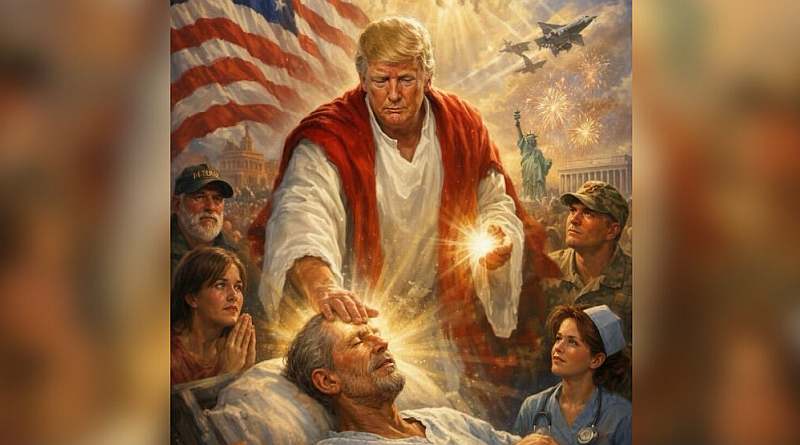
▶ On Saturday, the 47th president worked tirelessly. Both night and day. He surpassed even himself in productivity. From midnight to 1:15 AM, he wrote 14 tweets. From 7:09 AM to 9:59 PM, he wrote another 44 tweets. About how he won the 2020 election, how those who do not support him are against America, how under Biden gas prices increased because Biden “attacked Americans”, how The New York Times is a “failing newspaper”, and CNN is “fake news”, and so on, and so on, and so on…
▶ “Lyrical digression.”
“Delusions of grandeur, megalomania (from Ancient Greek μεγάλως ‘grandly’, μέγας ‘large, great’ and Ancient Greek μανία ‘passion, madness’), megalomaniac or megalomanic delusion, expansive delusion (from Latin expando ‘expand, spread, extend’) – a delusional type of self-awareness and behavior characterized by an extreme overestimation of one’s importance, fame, popularity, wealth, power, genius, political influence, reaching up to omnipotence” (from Wikipedia, with original references to scientific sources).
“Narcissistic personality disorder – a personality disorder characterized by belief in one’s own uniqueness, special status, superiority over others, grandiosity; an inflated opinion of one’s talents and achievements; obsession with fantasies of success; expecting unconditional favorable treatment and unquestioning compliance from others; seeking admiration from others to confirm one’s uniqueness and significance; inability to empathize; ideas about one’s freedom from any rules, that others envy them. Narcissistic individuals constantly try to control others’ opinions about themselves. They tend to devalue almost everything around them, idealizing what they associate with themselves. Perceiving people and situations in black-and-white terms, as completely bad or completely good, is one type of narcissistic defense” (from Wikipedia, with original references to scientific sources).
Whether these definitions align with the personal characteristics of a real, specific person is for you to decide.
There are 1008 days left until the end of the story called “Fear: Trump in the White House” © (title of a book by Bob Woodward, published in 2018).
Thank you to everyone who read. Take care of yourself and your loved ones. Take care of each other, help each other. Wishing everyone health.
Ultimately, what happens in the world depends on us. Whether we fight evil, do good, remain mere observers, wait passively and believe that someone somewhere will decide for us, or fight evil and do everything possible for good to prevail.
We must not allow evil to win. The victory of evil would mean the end of the world we live in. We cannot allow that. Especially now.
Ukrainian friends, I embrace and love you all. Take care of each other, I plead with you.
Ukraine is and will always be.
And evil will be defeated and punished. And this is inevitable.
