
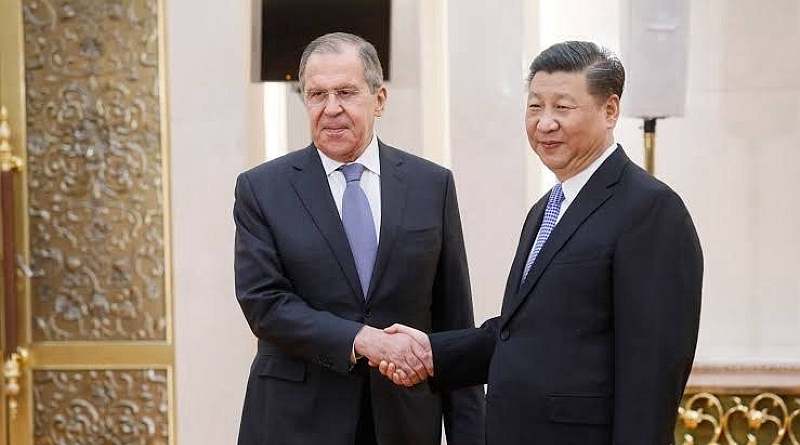

The visit of Sergey Lavrov to Beijing, presented by official Putin propaganda as a “meeting of equal partners,” in reality looks like another report of a vassal to his suzerain. Behind the diplomatic smiles and routine phrases about a “multipolar world,” lies a harsh reality: Russia is finally losing its subjectivity, turning into a raw material and political appendage of the PRC. Against this backdrop, at least four key aspects of such political degradation can be highlighted.
Contrary to optimistic reports, the economic foundation of the Russia-China “friendship” is falling apart.
The comrades in Beijing have taken an extremely tough stance in the negotiations over “Power of Siberia – 2.” China demands prices close to domestic Russian ones and is in no hurry to commit to purchase volumes.
Russia, cut off from the European market, finds itself trapped by the monopoly of the eastern buyer. China understands the Kremlin’s desperation and bluntly uses this to its advantage. Lavrov goes to Beijing not to negotiate, but to accept conditions, which starkly contrasts with the usual ultimatum behavior of Russians. For China, Russia is now just a giant “discount gas station,” whose resources should fuel China’s economic growth amid global competition with the US.
Despite the prevailing myth of a “unified anti-Western front,” tensions are increasing between Moscow and Beijing in the Middle East. For instance, analysts from Le Monde highlight that Beijing is extremely unhappy with Moscow’s passive, and sometimes destabilizing, position regarding Iran.
For China, as the largest importer of oil, stability in the Strait of Hormuz is critically important. Meanwhile, Moscow, keen to distract collective Western attention from Ukraine, turns a blind eye to escalation from pro-Iranian proxies. Beijing sees this as a threat to its “One Belt, One Road” logistics routes. It was clearly conveyed to Lavrov in Beijing: chaos, which benefits the Kremlin, is unacceptable to Xi Jinping.
Meanwhile, Russia is rapidly turning into a “junior partner,” whose foreign policy is now de facto coordinated from Beijing. The shift to the yuan, technological dependence on Chinese components, and political isolation have made Russia hostage to the interests of the red Chinese emperor. Thus, the “pivot to the East” has turned into a surrender of sovereignty. The Kremlin can no longer make significant decisions without considering China’s reaction. This is no longer a strategic partnership, but a form of voluntary colonization, where Moscow pays with territories, resources, and the future of the next generations for the immediate survival of the regime.
Finally, the organization of the visit itself points to the professional degradation of the Russian Foreign Ministry. Sergey Lavrov, whose “thuggish diplomacy” style has long become toxic to the civilized world, has finally outlived its usefulness. His methods, based on disinformation and aggressive rhetoric, bring no benefit to Russia.
In Beijing, Lavrov looks like a relic of a bygone era, trying to sell an ideological void to leaders who think in terms of hard pragmatism. Lavrov has become the face of Russia’s global isolation. His inability to establish an equal dialogue even with “allies” confirms that the Russian foreign policy department needs radical personnel changes.
But in a system where loyalty is valued above efficiency, the old minister continues to play the role of a courier, bringing the keys to the remnants of Russian sovereignty to Beijing.
Therefore, Lavrov’s visit is not a triumph for Moscow, but an inventory of assets that China is gradually taking over in exchange for debts and loyalty. Russia is moving under Beijing’s protectorate, losing the right to its own voice in world history.
