
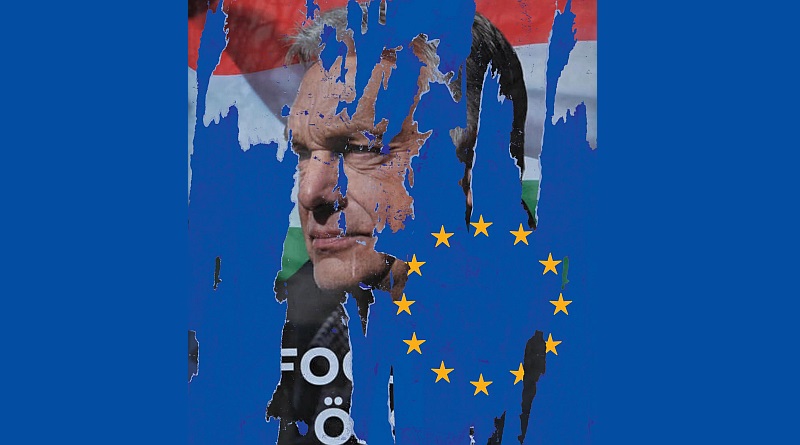
Vitaliy Portnikov / Vilni Media
The main conclusion that the United States administration could draw from the results of the parliamentary elections in Hungary and Viktor Orban’s stunning defeat is that Europe is not disappearing, and the citizens of the European Union countries want to be Europeans.
For many years, the Hungarian Prime Minister exploited precisely the anti-European idea and perhaps that’s why he earned such respect from both American President Donald Trump and Russian leader Putin. After all, as strange as it may seem, weakening the European Union is almost equally in the interest of Washington, Moscow, and even Beijing. Of course, it is easier to deal with each individual European country than with a united bloc of European states. But it seems to me that this logic should primarily belong to authoritarian or totalitarian regimes, and the largest democratic country in the world—the United States—should be interested in cooperating with the democratic European countries united in an effective union.
During his tenure as prime minister, Orban did everything possible to undermine this union’s unity and, as we can see, did not hide his intentions from Putin.
Among his last decisions was blocking European aid to Ukraine, although this aid was in the interest not only of Ukraine itself, which needs support for its war-torn economy, but also of Europe, which simply needs to restrain Russia’s ambitions.
It is simply paradoxical that the Prime Minister of a country from which Russians have taken freedom so many times acted like a politician at the Kremlin’s call. It is simply paradoxical that the President of the United States, who publicly supported Orban before the elections and even sent his own vice president to Budapest to campaign for Orban’s party, did not use this support and personal relations with the Hungarian Prime Minister to persuade him to withdraw this veto. And it is astonishing that the President of the United States, who for years persuaded Europeans to abandon Russian oil and gas, repeatedly turned a blind eye when it came to Hungary buying Russian energy. Although now it is already obvious that Putin exchanged this supposedly cheap Russian oil for political support and the facilitation of a corrupt mechanism within the Hungarian state itself.
Orban’s rule indeed came at a great cost to Ukraine. There were no grounds for worsening Hungarian-Ukrainian relations, except one—the readiness of Budapest to support Moscow. There was no reason to accuse Ukraine of not respecting the rights of Transcarpathian Hungarians. But Orban not only made such statements but also invested resources in creating a corresponding political atmosphere in Ukraine’s border region. This is despite the fact that Transcarpathian Hungarians remained one of the few national communities in Europe that managed to preserve both their native language and national traditions, education, and political representation—all this on Ukrainian soil.
I once advised the Hungarian Prime Minister to inquire about the fate of two other Hungarian peoples—the Khanty and Mansi, who live in Russia. Under Putin’s era, they have finally lost both their own language and the ability to read poetry and prose of their own writers, and even the apparent attributes of their national statehood, although these peoples live on land that can be compared to the wealth of the United Arab Emirates and could thus provide their indigenous peoples at least some conditions for development. But instead of defending the Hungarian peoples before Putin, Orban tried to speculate on the issues of Transcarpathian Hungarians before Poroshenko or Zelensky. And this once again illustrates the insincerity of a politician who was more pro-Russian than pro-Hungarian. And, of course, more pro-Russian than pro-American.
From this, Trump should also draw conclusions if he managed to open his eyes: people who work against European unity will never really think about the global interests of the United States. Such politicians are much closer to Moscow than to Washington.
Poster: Vasco Gargalo
