
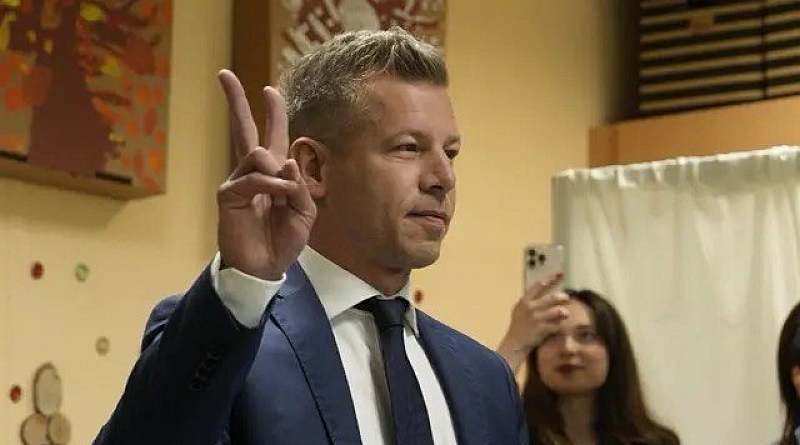

The events of April 12, 2026, in Hungary will be recorded in history books not merely as a change of government, but as the definitive collapse of the “illusionary facade” of the eternal stability of authoritarianism. The victory of Peter Magyar and his party “Tisza” with over 54% of the votes, securing 138 seats in parliament and a constitutional majority, is no longer merely an internal affair of Budapest. This is a tectonic shift, sending very unpleasant vibrations directly to the walls of the Moscow Kremlin.
For 16 years, Viktor Orban was Moscow’s most valuable asset within the EU and NATO. Hungary skillfully played the role of a “brake” on anti-Russian sanctions and military aid to Ukraine. Peter Magyar’s rise to power puts an end to this strategy.
Moscow loses its main euro outpost. Recent leaks, confirming the transfer of confidential EU documents from the Hungarian Foreign Ministry directly to Sergey Lavrov, will now become the property of investigative commissions. Magyar has clearly stated: the era of “proxy politics” in the interests of the Kremlin is over. Russia will no longer be able to use one country’s veto to paralyze the collective will of the West.
Orban’s Hungary long served as a “showcase” of successful illiberalism—a system where, despite the preservation of formal democratic institutions, power is completely concentrated in one hand through control over the media and business.
The fall of the Fidesz regime sends a negative signal to Putin, who for years observed Orban as a younger but very capable ideological brother. It turned out that even an electoral system “tuned” to power is helpless against a consolidated protest and the emergence of a leader from within the system itself.
The main enemy of long rule is not the opposition, but the physical and mental fatigue of the nation. Magyar won on the slogan of a “new beginning,” and this trend is almost a death sentence for Putin, clinging to power for decades.
When a leader becomes “part of the furniture,” any fresh face is perceived as salvation. Slogans “Ruszkik, haza!” (Russians, go home!), once again echoing in the squares of Budapest, are addressed not only to energy dependence but to the very model of “stability through stagnation” that the Kremlin embodies.
After the victory, Magyar made a series of statements about “pragmatism” in relations with Russia. But Moscow should not be deluded. For Magyar, pragmatism consists of elements such as revising binding energy contracts; refusing to play the role of “devil’s advocate” in Brussels; and demanding an end to killings in Ukraine!
Unlike Orban, who traded the EU’s loyalty for cheap gas and political support from Russia, Magyar will build relations based on Hungarian sovereignty. “We don’t have to like each other, we must respect boundaries,” – this phrase from the new prime minister ends the era of “special relations.”
The crucial difference between the Hungarian transition and the hypothetical Russian one is the presence of an alternative. “Tisza” managed to accumulate the energy of the masses while preserving institutional frameworks. However, in Russia, after Putin’s fall, having cleared any political field, “fierce chaos” is highly likely to begin.
Hungary returns to Europe with a ready party structure and the support of allies. Russia, having destroyed systemic opposition, risks falling into a power vacuum, where not politicians, but power clans will fight for succession. This makes the example of Hungary even more frightening for the Russian establishment: they see that changes are inevitable, but they understand they have no “parachute” in the form of legitimate power transition.
Ultimately, the triumph of Peter Magyar was not just a change of faces in Budapest. It is proof that the time of “strong leaders” of the last century has expired. Moscow lost not just an ally, but the last argument in favor of authoritarianism being eternal.
