
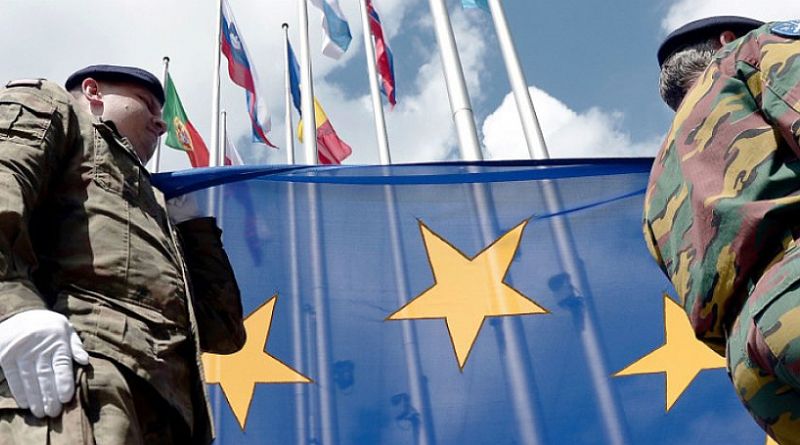
After 2022, a word that had been avoided for decades emerged in European politics – “war.” It is used in strategic documents, presidential speeches, and defense department reports. The European Union increasingly speaks of “common defense,” “strategic autonomy,” and the need to prepare for a major conflict. In EU strategic documents, political speeches, and military addresses, phrases about “high intensity,” “prolonged conflicts,” and “preparation for worst-case scenarios” appear more frequently.
But behind this rhetoric lies a simple and uncomfortable question: is Europe ready not just to talk about war, but to actually wage it?
The authors of the “Roadmap to Common European Defense” attempted to provide an answer. This white paper was prepared by a group of European researchers associated with the Brussels-based Centre for European Policy Studies (CEPS) and the analytical platform Charge Research. It is not an official EU strategy, but a policy paper aimed at the professional community of decision-makers in the field of security and defense from the European Commission and European External Action Service to the European Defense Agency, relevant committees of the European Parliament, and national defense departments of EU countries.
It is important to analyze it to understand where the internal discussion, strategic planning, and framework of permissible thought of the Brussels bureaucracy are heading.
The authors operate in a logic of institutional realism, attempting to answer not the question “what Europe would like to be at war,” but “what it can become without breaking the current political architecture.” That is why the document is both indicative and alarming. It indicates that even after Russia’s full-scale invasion of Ukraine, war remains a scenario, not a starting condition, and these silences speak as much as the proposed models.
Is Europe preparing for the war that may await it, or a Discussion on Defense Without Discussing War?
Russia’s war against Ukraine was a shock for Europe but not a full-fledged turning point. It destroyed the illusions of a “perpetual peace,” but did not eliminate the institutional inertia that had developed over decades.
Russia’s war against Ukraine did not become an existential rupture for the EU. It rather exposed the limits of what Europe can do under real military pressure.
And although after 2022 it finally became acceptable in Europe to talk about war, there is a chasm between recognizing war as a possibility and being prepared for it. Europe has started to think about war at the level of texts, but has yet to make it a fundamental assumption in politics, economy, and social contract.
Recent European documents, particularly the so-called “white papers” and roadmaps on joint defense, demonstrate an interesting feature. Its cause, in my opinion, is the existential nature of the European Union, which historically formed as a system to avoid tough decisions. This has become its weakness today. Therefore, these documents heavily focus on management, coordination, procedures, and institutions. There is a clear ambition to reduce fragmentation, optimize procurement, and create common institutional mechanisms. At the same time, these texts are written in the language of management.
The key problem is that Europe is trying to prepare for war without destroying the logic of peace. But in reality, war simply destroys this logic.
This is why such documents say nothing about war per se — about mass mobilization, losses, prolonged campaigns, economic destruction, and the political cost of forceful decisions.
Instead, the EU offers several models for deepening defense cooperation: from limited procurement coordination to almost federal management of defense capabilities. But all these models share a common trait: they are designed for a world where war is an extreme scenario, not a basic assumption.
Unfortunately, the Russia-Ukraine war has shown that war in Europe is a reality. And this reality demands not only strategies but also the ability to act quickly, harshly, and often contrary to established political compromises.
Where exactly is Europe not ready and what does NATO have to do with it?
Europe’s biggest problem is not a lack of resources, but the inability to convert them into military power in a short time frame. European defense industry is fragmented, national interests often prevail over common ones, and decision-making processes remain slow.
Even after 2022, increasing the production of ammunition and equipment is happening too slowly. The war in Ukraine showed that in the event of a major conflict, Europe’s reserves deplete in months, not years.
Moreover, one of the greatest illusions in European analysis is the view of Russia as a static threat. In reality, over recent years, Russia has undergone a painful but effective adaptation. It has restructured its economy for war, increased ammunition production, changed tactics, and learned to operate under sanctions and technological constraints. Its army has suffered losses but gained experience that Europe lacks. Europe is attempting to “catch up” with Russia in peacetime. These are fundamentally asymmetric processes. An opponent who is actively fighting always adapts faster than one who is merely preparing.
Unlike Russia, China is not a direct military threat to Europe in the short term. However, it is a factor that radically changes the global configuration.
A potential conflict in the Pacific region would mean a redistribution of American resources. In such a situation, Europe risks remaining on the periphery of Washington’s strategic priorities.
For Europe, this means a window of vulnerability. If Russia acts in sync with China or takes advantage of the moment, the European security system will be tested for resilience without America’s “umbrella” protection. And this is where it becomes evident: the current level of the EU’s preparedness for such a situation is inadequate.
The second issue is management. The EU still does not have a single military command center capable of acting autonomously from NATO. In a crisis situation, this means either paralysis or full dependence on the USA. It is here that a strategic trap arises, with Europe preparing for war based on the assumption that America will always be there.
This brings in the NATO factor. In European discussions, NATO is often present as a self-evident background. The alliance seems to guarantee that the worst-case scenarios will remain theoretical. That’s why the issue of EU collective defense is presented as a supplement rather than an alternative. This is a strategic mistake.
NATO is primarily a political alliance, with the USA at its core. Its military effectiveness critically depends on American intelligence, logistics, command, and ultimately, nuclear deterrence. Without the USA, NATO ceases to be what it is imagined to be in Brussels.
The third issue is America, which has transformed from a “constant” into a “variable.” Just 10 years ago, doubts about the reliability of the USA as a guarantor of European security were seen as marginal. Today, it seems unlikely. Internal political turbulence in the USA, rising isolationist sentiments, and strategic focus on China change the balance.
For Europe, this could mean that in the event of a major war, the USA may be involved not fully or on its own terms. This is not only a question for Ukraine or Eastern Europe.
The scenario of a conflict around Greenland, which seemed exotic not long ago, is increasingly appearing in analytical circles. The Arctic is becoming a zone of strategic rivalry, and US and European interests do not always coincide there. If Europe does not have its own military-political presence, it risks finding itself not only without protection but also without a voice.
The fourth issue arises from the third and is called the “nuclear button.” Any serious war with Russia inevitably includes a nuclear dimension. Ignoring this fact does not make it any less real.
The European security system after the Cold War was built on a simple assumption: nuclear deterrence is provided by the USA. The French arsenal remained national, while the British arsenal was closely integrated into the American system.
Today, this assumption is no longer stable. If the USA reduces its presence or focuses on Asia, Europe faces an uncomfortable choice: either it acknowledges its nuclear vulnerability or begins a serious conversation about collective deterrence.
Thus, considering all these factors, Europe has not yet answered the basic question: is it preparing to fight within NATO or in case NATO fails? So far, the answers seem like attempts to not answer at all.
Ukraine as the Core of European Defense
Another weak point for Europe is not the army or industry but the societal readiness for war.
European democracies do not talk to their citizens about losses, mobilization, and prolonged conflicts. The political elite fears this conversation because it disrupts electoral comfort. Ukraine here is an inconvenient mirror. It shows that war is won not only by technology but also by the society’s willingness to pay the price.
Thus, one of the biggest paradoxes of the European defense discussion is the marginalization of Ukraine in strategic thinking. It is considered as an object of assistance, a buffer, or a frontier. Yet, there is avoidance in discussing Ukraine’s experience in mobilizing resources and building an economy geared towards military needs.
In reality, Ukraine is the largest testing ground for modern warfare in Europe and at the same time a carrier of unique experience. Without Ukraine’s integration into the European defense system, all talks about readiness for war will remain theoretical. Ukraine not only has an army hardened in the war with Russia but also an understanding of the modern battlefield: from drones and electronic warfare to the mobilization of the economy and society.
Therefore, cooperation with Ukraine is a pragmatic interest for Europe for its survival. Joint arms production, integration of the Ukrainian defense industry, training, and exchange of doctrinal experience can radically increase the actual combat capability of the EU.
What else can be done?
Today, Europe is not ready for a major war, neither with Russia, in a global conflict involving China, nor, all the more, in a scenario of strategic divergence with the USA. It still has a chance to prepare, but it is limited in time.
The first step is to fully understand the problem and correctly formulate it. It involves recognizing a simple fact: war is the new norm. In this norm, those who survive are not the ones who plan better, but those who act more quickly.
The concrete steps, without which discussions about defense will remain empty, look like this:
- Transition from voluntary coordination to mandatory decisions in the field of defense. Without this, the EU will not be able to act quickly.
- Radical acceleration of defense production with long-term contracts, not crisis purchases.
- Creation of a real EU military command level capable of acting autonomously, not just within NATO.
- Integration of Ukraine into European defense planning now, not after formal accession.
So the question for Europe now is not whether it wants to be a military force. The question is whether it can afford not to be one.
