
Donald Trump did not become the main figure at the Davos forum, although he clearly aimed for that role when he agreed to participate in the prestigious international conference in the Alps. He didn’t, at least because all the points with which the American president addressed the Europeans were entirely predictable even before he appeared on the forum’s podium.
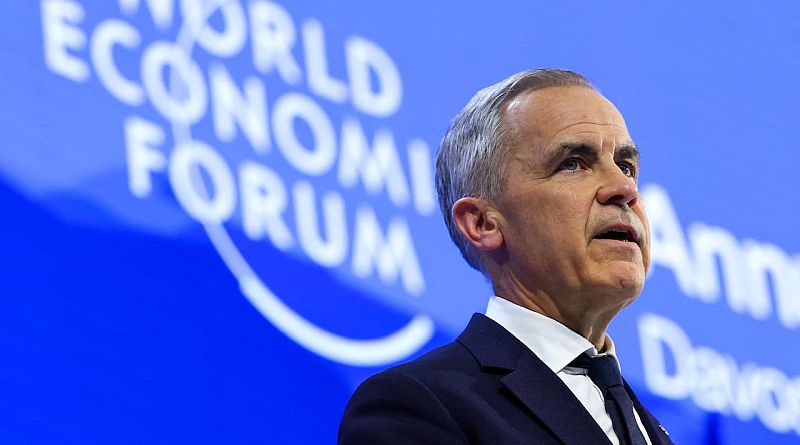
However, unexpectedly for many, the main figure at the Davos forum was Canadian Prime Minister Mark Carney. Of course, others tried to compete with him – the President of France, the Federal Chancellor of Germany, even the President of Ukraine. However, the speeches of European leaders were also predictably understood – it was clear that Macron would respond harshly to Trump, Merz would speak about Europe’s responsibility, and Zelensky, who appeared at the forum on the last day primarily for a meeting with his American counterpart, would reproach the Europeans for weakness and promise support for Ukraine.
But only Carney was able to present not just a political speech, but a true conceptual vision of the future – by the way, this is what distinguishes speeches by statesmen from those by politicians. Carney’s speech contrasted so sharply with Trump’s speech that even the American president himself noticed, who, in his characteristic manner, canceled the Canadian Prime Minister’s invitation to the newly created “Peace Council.”
It might seem strange that the response to the return of imperialism in its worst form came from a non-European politician. But this too would be an oversimplification. Firstly, Carney was not only the head of the Central Bank of Canada but also the Central Bank of Great Britain. Secondly, “Europe” is not only geography but also a system of values. From this point of view, Canada, Greenland, Australia, or New Zealand, geographically distant from Europe, are essentially European countries. Meanwhile, Russia, which occupies a large part of the continent’s territory, has always had only an indirect relationship with Europe.
It might seem strange for a professional banker to present a statesmen’s concept. But successful bankers are known for systemic thinking, which helps them rise above processes when needed. Of course, we also have such experience. In 2004, our president was also a former head of the National Bank. And yes, one can talk about the numerous political mistakes made by Viktor Yushchenko, which ultimately led to the premature end of his career. However, today no one denies the third president of Ukraine precisely state thinking, the ability to evaluate processes that would “work” already for his successors, some of whom were unable to assess risks even a day before the onset of disaster.
And yes, our historical experience also convinces us of how dangerous it is to remain alone with a great predator. That’s when you become a convenient victim, which if not destroyed, will be robbed and humiliated. In 2014, Putin attacked Ukraine, which has direct borders with several EU and NATO members. And it was immediately emphasized that the West would not engage in direct conflict with Putin under any circumstances.
And in 2026, even Trump’s statements about the possibility of annexing far-away Greenland from Europe led to unanimous condemnation by almost all the continent’s states. And this is because Greenland is an autonomous part of the Danish state. Now imagine if Greenland were independent and had not joined any alliance. What do you think its fate would be?
Therefore, in the call of the Canadian Prime Minister to unite efforts – there’s a historical chance for Ukraine. Imperialistic aspirations can only be effectively countered by large interstate unions – perhaps even new ones, not the ones functioning now. And by the way, the very existence of such unions and their readiness to respond to challenges will sooner or later lead to the devaluation of imperialistic appetites and bury politicians who are transmitters of aggression.
And this is the answer to those in Ukraine who like to talk about the “weakness of Europe,” questioning whether Ukraine really needs an alliance with Europeans, etc. As for me, with his speech in Davos, Mark Carney outlined a simple and clear prospect for us: if sooner or later we will not be in Europe, then sooner or later we will be in Russia.
