
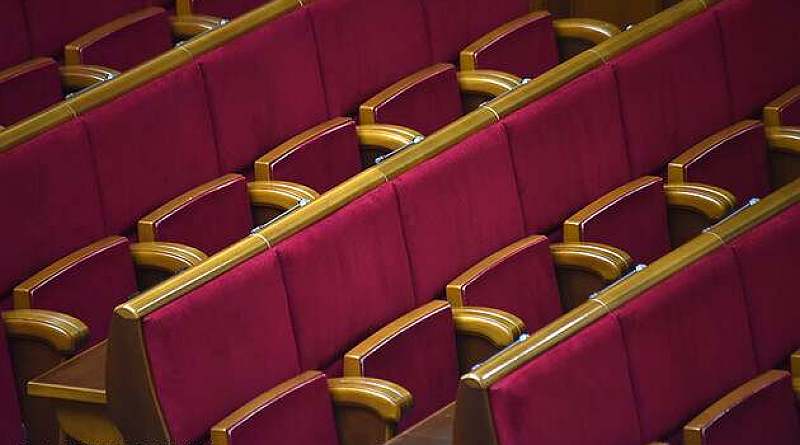
Recently, the President of Ukraine Volodymyr Zelensky stated: “Members of Parliament will either have to serve in the parliament according to Ukrainian law, or I am ready to discuss with parliamentary representatives a law on changes to mobilization so that MPs can go to the front.”
What exactly the head of state meant can likely best be explained by him. However, his words are met with caution. Especially when the autonomy and self-sufficiency of the parliament in the political system of a state that proclaims itself democratic and legal is called into question.
In this sense, it is not about separate political statements but about the gradual erosion of the parliament’s role as an independent institution of power.
Moreover, such messages from the president are voiced against the backdrop of obvious signs of a parliamentary crisis. This includes in particular investigations by anti-corruption bodies regarding possible informal mechanisms of influence on MPs, which question the parliament’s independence as an institution and amplify doubts about its real agency in decision-making.
This crisis also has a practical dimension. Specifically, it concerns difficulties in passing bills related to Ukraine’s European integration commitments. Publicly, this is often explained by a lack of proper communication between the government and parliament, while in private, anti-corruption investigations are also cited as a factor. At the same time, this only amplifies the fundamental contradiction: the parliament declares an aspiration for agency, but in practice remains vulnerable to external influence and internal dependency.
Why is it important for the parliament to remain an independent center for decision-making? What risks arise for the state if this independence is lost? And how can the parliament’s agency be restored under such conditions?
Therefore, I consider it necessary to draw attention to several important aspects, in my opinion.
Why Parliament Cannot Be a Secondary Institution
Firstly, in a democratic state, the parliament is the key institution of state power. Let me remind you that the Verkhovna Rada of Ukraine is a national representative body, which according to the Constitution has legislative, constituent, budgetary, and control functions. These functions cannot be delegated by the parliament to any other state body. Even during martial law. This places a great deal of responsibility on the Verkhovna Rada to society for the qualitative and timely execution of powers to fulfill these constitutional functions.
Secondly, according to Article 78 of the Constitution of Ukraine, Members of Parliamentwork on a permanent basis and cannot combine their activities with any other paid work, except for teaching, scientific, and creative work in their spare time. Therefore, it is not by chance that under paragraph 17 of part 1 of Article 23 of the Law of Ukraine “On Mobilization Preparation and Mobilization,” Members of Parliamentare not subject to conscription for military service during mobilization. However, this provision of the law applies only to current (effective) Members of Parliament of Ukraine and cannot be extended to members of previous parliamentary sessions and current (ninth) session Members of Parliament of Ukraine whose powers were terminated early based on Article 81 of the Constitution of Ukraine.
Thus, the Constitution of Ukraine clearly defines the parliament as a key and irreplaceable institution of state power, which cannot be replaced or displaced by other decision-making centers — even under martial law conditions. The loss of real subjectivity by the parliament not only means institutional dysfunction but also threatens the very model of democratic governance in which the representative body is to play a central role.
However, the formal establishment of these powers does not yet guarantee their real implementation. The key question is how capable the parliament is today of acting as an independent political entity, and not just as an institution with defined but actually limited powers.
Formal Majority and Loss of Political Subjectivity
It is no secret that although the numerical composition of the “Servant of the People” parliamentary faction remains a majority of the constitutional composition of the Verkhovna Rada of Ukraine and formally the faction has the rights of a parliamentary coalition, since May 2022, there has not been a single law or resolution for which 226 or more members of this faction have voted (with the exception of the vote for the appointment of Vasyl Malyuk as head of the SBU in February 2023, when SN cast 226 votes). This means that the “Servant of the People” faction is effectively ineffective, as for the last four years it has been unable to ensure successful voting results on its own without situational support from other parliamentary factions and groups.
Thus, the formal presence of a monomajority does not ensure its real political capability but indicates a loss of political subjectivity and dependence on external and situational centers of influence. In this context, the parliament virtually ceases to be an independent decision-making platform, turning into an institution where decisions are only formalized, not formed.
Separate investigations by anti-corruption bodies into possible informal mechanisms of influence on Members of Parliament during voting only reinforce these doubts. Unfortunately, this concerns not only the ruling party but also the opposition. According to the investigation, within “Servant of the People,” bribery tools might have been used for consolidating the majority, whereas in other political forces — on the contrary, for its destabilization.
In such a situation, an additional question arises: can the current parliament restore its subjectivity at all if the very practices of decision-making cast doubt on its independence?
This, in turn, highlights the issue of institutional mechanisms of responsibility and coordination in Parliament. After all, the absence of a clearly structured and politically accountable coalition only deepens the crisis of the Verkhovna Rada’s subjectivity.
Coalition as a Mechanism of Responsibility — and Its Absence
Thus, analysts and experts have repeatedly raised the issue of the feasibility of forming a national unity parliamentary coalition during martial law. A national unity coalition can be considered both in legal and political aspects.
Among lawyers, there is no consensus on the possibility of forming a parliamentary coalition based on the results of the last elections from a legal perspective. As in part 10 of Article 83 of the Constitution of Ukraine regarding the deputy faction, which includes the majority of the constitutional composition of the Verkhovna Rada of Ukraine, a categorical wording “HAS the rights of a coalition” is used, rather than a more flexible construction — “MAY HAVE the rights of a coalition.”
At the same time, from a political perspective, nothing prevents the political party “Servant of the People” from signing a political agreement (contract, memorandum, declaration, etc.) with other parliamentary and extra-parliamentary political parties, sharing responsibility for the state during the war and agreeing on approaches to forming, on the one hand, a self-sufficient and professional Cabinet of Ministers of Ukraine, and on the other — a controllable and accountable parliament.
In this case, all personnel proposals may formally be submitted by the “Servant of the People” faction, practically implementing the provisions of the political agreement. Essentially, a government of national unity could become a catalyst for the full mobilization of state resources during the war and ensure timely adoption of necessary legislative acts on the path to further integration of Ukraine into the European Union.
Thus, the issue of the coalition goes far beyond a legal discussion and acquires crucial political significance. The coalition itself is the mechanism that ensures accountability for decision-making and determines who bears political responsibility for the actions of the government and parliament.
The absence of a clearly structured and politically accountable coalition means the blurring of this responsibility and only solidifies the state in which the parliament formally exists but does not function as a full-fledged decision-making center.
Meanwhile, the political reality indicates otherwise. While publicly declaring openness to interaction, the authorities actually do not demonstrate readiness to form a full-fledged parliamentary coalition. In particular, the President of Ukraine directly stated that the situation would remain unchanged, and parliamentary factions would vote based primarily on their own interests. This implies the de facto refusal of the ruling party from the coalition model as a tool of political responsibility.
At the same time, the parliament itself does not demonstrate the ability to offer an alternative: practices of informal influence on deputies, which have become the subject of investigations by anti-corruption bodies, only undermine trust in the possibility of honest majority formation.
This results in a systemic contradiction: the coalition remains the only tool capable of ensuring political accountability and restoring parliamentary agency, yet this very tool is discredited by the practices of its application.
This creates a sense of an institutional deadlock, where the issue of parliamentary agency lacks a quick solution within the current political configuration. However, even under such conditions, abandoning the coalition logic or substituting it with populist declarations about “alternative” ways to solve the problem, such as proposals to remove members of parliament from exercising their constitutional powers, only deepens the crisis.
In practice, this already leads to situations where the parliament is sidelined from exercising its direct constitutional powers, and key personnel and management decisions are made bypassing the prescribed procedures.
SBU as an example: when parliament is excluded from its powers
It is evident that the inability of the Verkhovna Rada of Ukraine to fully exercise its legislative, constitutive, and oversight powers is caused not only by the absence of a coalition but also by a lack of proper political communication between the president and the parliament within the Constitution’s framework. A telling example is the situation with the appointment of the head of the Security Service of Ukraine.
The previous head of the SBU, Vasyl Maliuk, was dismissed over two months ago, yet the president’s submission to the Verkhovna Rada for appointing a new head has not been made. Instead, two decrees were issued, which effectively designated temporary duties — these responsibilities were assigned to Serhiy Khmara. Meanwhile, Oleksandr Poklad remains the first deputy head of the SBU.
Although the Constitution of Ukraine clearly stipulates that it is the president who submits a proposal to the parliament for appointing the head of the SBU, and the Verkhovna Rada carries out the appointment. This is a fundamental element of the balance of power because the SBU — is not a military formation but a state body with law enforcement functions.
Furthermore, the existing law since 1998 stipulates that the temporary performance of duties in such cases has a limited duration — not exceeding one month and is specifically assigned to the first deputy. In other words, the law directly specifies the mechanism of substitution and does not provide for the arbitrary appointment of another person as “acting.” However, in this situation, these requirements have not been met: the parliament did not receive the submission, and performing duties has effectively become a prolonged tool to replace the prescribed constitutional procedure.
References to martial law also do not seem to be sufficient justification, as the president’s relevant powers apply only to those positions he appoints independently. However, the appointment of the head of the SBU falls under the competency of the Verkhovna Rada. Ultimately, we have a situation where a key personnel decision in the security sphere is being implemented without parliamentary participation, despite its constitutional role in this process.
Thus, it is not just about a single procedural deviation but about a systemic trend: against the backdrop of a weakened parliament, the president strengthens control over the power bloc in a manual mode. And it is in the case of the SBU that this is most vividly manifested — the parliament loses not only political agency but also practical tools of control.
This, in turn, raises a broader question: can a democratic model of governance function when the parliament formally retains its powers but is effectively removed from exercising them?
Instead of Conclusions
It is particularly important not only to perform but also to strengthen the constitutional function of parliamentary control by the Verkhovna Rada of Ukraine under martial law conditions, when such civil rights and freedoms are limited, such as the right to the inviolability of the home, the secrecy of correspondence, freedom of movement and the free choice of residence, freedom of thought and speech, the right to peaceful assembly, and other rights and freedoms of individuals and citizens not protected under Article 64 of the Constitution of Ukraine.
Simply put, the legitimate limitation of certain constitutional rights and freedoms during martial law must be offset by strengthening the function of parliamentary control over the executive authorities, law enforcement agencies, and military formations.
However, in practice, the opposite is happening: alongside the weakening of the parliament, there is an increased concentration of power in the hands of the president, particularly through the expansion of manual control of the security sector. As a result, a dangerous imbalance arises: the limitation of rights and freedoms is not accompanied by an adequate strengthening of democratic control, which calls into question the ability of the existing model of governance to ensure proper checks and balances.
In this context, the issue of the parliament’s subjectivity goes beyond a purely institutional discussion and becomes a matter of preserving the democratic nature of the state. After all, the parliament is not just one of the branches of power but a key mechanism of representation and control, without which democracy loses its essence.
And if the parliament loses the ability to be an independent center of decision-making and control, not only the balance of power is threatened, but the democratic model of the state itself.
Cover photo: Vasyl Artyushenko/ZN.UA
