
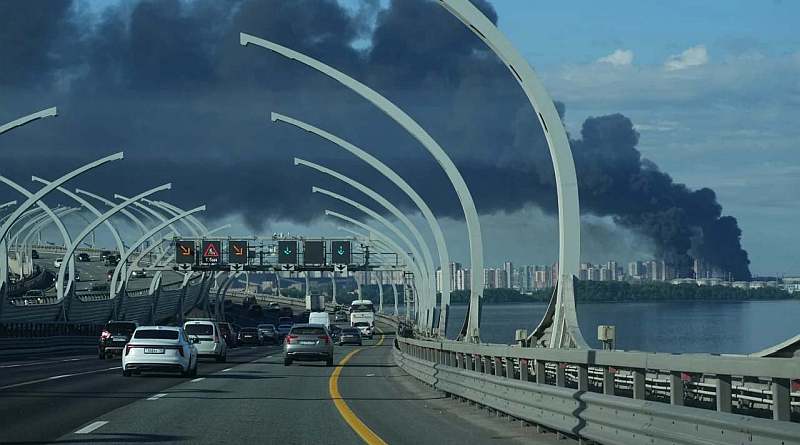
Yaroslav Trofimov, Wall Street Journal / Translation by iPress
The American Wall Street Journal writes about a significant shift in the public discourse of the Russian establishment: influential voices—from hawks and former officials to military analysts—are increasingly openly admitting that Russia is incapable of achieving a complete victory in Ukraine. Some of them openly state that the continuation of the war leads not to a “non-victory,” but to a full-fledged defeat. Meanwhile, the publication notes that despite these signals, Putin shows no signs of readiness to retreat from the initial goals of his so-called “special military operation.” Amid escalating missile strikes on Kyiv and Ukraine’s resumption of long-range attacks deep into Russia, the war is entering a new, potentially critical phase—and the question of whether Putin will heed the voices of sober judgment within his own circle remains open.
Some well-known hawks claim that the war is giving Russia less and less, and a complete victory is out of reach, writes the American Wall Street Journal.
As the publication notes, Russia’s inability to break the deadlock in Ukraine is becoming so evident that prominent representatives of the Russian establishment are now publicly calling for an end to the conflict.
The main question is whether Putin will acknowledge this reality and abandon the pursuit of destroying Ukraine’s independence.
So far, WSJ notes, there are no signs that in the fifth year of Europe’s bloodiest war in several generations, he is ready to step back from the initial goals of his “special military operation.” However, this may change if the course of the war shifts even more in favor of Kyiv.
According to the publication, such calls are coming not only from representatives of the business elite and the more liberal part of the Russian establishment. Some of the most well-known Russian hawks have also become much more outspoken about their belief that Moscow simply lacks the potential to achieve a complete victory over Ukraine.
One such figure is Oleg Tsaryov, a former Ukrainian deputy who fled to Russia in 2014 and was considered one of Putin’s main candidates to lead the pro-Russian puppet regime that the Kremlin planned to install in occupied Kyiv at the beginning of 2022. The following year, he was severely wounded in an assassination attempt attributed to Ukrainian intelligence.
In a Telegram post last month, Tsaryov warned that Russian propaganda has created a dangerous illusion of an inevitable victory over Ukraine.
“The specialists in creating alternative realities have convinced not only the population but also themselves that the illusion they invented is real,” he wrote. “Sooner or later, these worlds—the illusory and the real—must collide. And now this is happening in the most painful form.”
Another staunch supporter of the war, historian and former Kremlin official Alexei Chadayev, who leads the drone warfare research center “Ushkuyik,” noted that continuing the current course of the war “is not just a path to ‘non-victory,’ but a full-fledged defeat.” He urged for a pause so that Russia could regroup before the next round.
Vasily Kashin, director of the Center for Comprehensive European and International Studies at the Higher School of Economics in Moscow, published a widely discussed article last month in a leading Russian foreign policy journal. He argued that Ukraine will inevitably remain an anti-Russian, pro-Western country—especially after hundreds of thousands of Ukrainians have been killed or maimed in the war. According to him, the goal of establishing a friendly regime in Kyiv—one of Putin’s original war aims—is no longer realistic.
Citing the example of the US and Israeli wars against Iran, Kashin noted that even a large-scale escalation—such as the assassination of President Volodymyr Zelensky and Ukraine’s military and civilian leadership—would most likely bring to power a “more active, ambitious, and radical” generation of Ukrainian leaders.
“Nuclear brinkmanship usually leads to freezing conflicts along the existing front lines, and such freezing Moscow can ensure right now, without the risks of a full-scale nuclear crisis. Furthermore, it is disadvantageous for Russia to destroy its technological and human potential in pursuit of ‘illusory goals’ on the front line near Mala Tokmachka—a town in southern Ukraine that has become a symbol of Russia’s inability to advance,” he wrote.
As noted by the WSJ, Kashin’s views are certainly not universally accepted. In the same foreign policy journal, the militant Russian academic Sergei Karaganov has repeatedly threatened nuclear war against the West unless Ukraine capitulates. Russian researchers claim that a more pragmatic approach, recognizing the limits of the Russian army’s capabilities, is supported by part of the Kremlin apparatus—including the influential deputy head of the Presidential Administration Sergey Kiriyenko, the Foreign Intelligence Service (SVR), and the economic bloc, interested in returning to some semblance of normal life.
The WSJ emphasizes that the course toward escalation, perhaps even to the Baltics and other directions, is supported by the increasingly influential Second Department of the FSB. It is also supported by a motley crew of war propagandists, analysts, and war volunteers who want to create a historical break with the West, aiding in turning Russia into an Orthodox hybrid of Iranian theocracy and North Korean totalitarianism.
“It seems that in the fifth year of the war, some are beginning to realize that continuing the fighting for another year or two will not significantly improve Russia’s negotiating position. It is becoming increasingly clear to them that it’s time to wrap this up,” explained Alexander Gabuev, director of the Carnegie Russia and Eurasia Program in Berlin. “Discussion among the elite on this topic is beginning to become the norm—with all reservations regarding loyalty.”
But, he asks, does Putin realize that he is at a dead end and that the war is yielding diminishing returns? “That we do not know. There is no indication that he has changed his opinion,” Gabuev noted.
According to former Ukrainian Foreign Minister Pavlo Klimkin, the nature of the highly militarized Russian state makes it unlikely that Putin will listen to voices of reason. “War is the modus vivendi of this regime; it’s like riding a bicycle—if you stop, you fall,” he believes.
The WSJ reminds that Russian officials express willingness to consider ending the war if the U.S. forces Ukraine to adhere to the “Anchorage agreements”—an alleged agreement reached between Putin and Trump in Alaska in August, which would involve Ukraine surrendering a well-fortified belt of cities in the northern Donetsk region. Kyiv refused to surrender it, and after the summit, Russian forces made only minimal progress in this region.
“Peace talks have reached an impasse and have not yielded real results because the Russians are waiting for the Americans to satisfy their maximalist demands at the negotiating table—those they did not achieve through military means,” stated the EU’s High Representative for Foreign Affairs Kaja Kallas. “Of course, this is something Ukraine cannot accept. Even if President Zelensky agrees, the nation—cannot.”
As the WSJ emphasizes, Putin has intensified missile strikes on Kyiv and other Ukrainian cities in recent days. A massive shelling on Tuesday night resulted in the death of 22 and injured over 100 civilians—one of the bloodiest attacks of the entire war. At a meeting with security forces a few hours earlier, Putin stated that Ukraine would have to endure a “new quality of the entire conflict.”
On occupied Russian territories of Ukraine, the medium-range strike drones have recently paralyzed Russian logistics—this is a significant new factor in the course of the war. Often using artificial intelligence, they attack fuel tankers and military convoys on roads connecting Russia with the Crimean Peninsula and bases along the front line. In Luhansk and Donetsk, fuel rationing has been introduced, and in Crimea, supplies are already exhausted.
Russian military observers warn of a possible Ukrainian offensive soon. In recent weeks, Ukraine has achieved significant success in long-range strikes on the European part of Russia—specifically, on Wednesday, a strike was made on an oil terminal in St. Petersburg (photo—Ed.) exactly when Putin’s hometown was hosting the opening of the annual economic forum.
“Kyiv’s drone campaign demonstrates the potential for chaos that Ukrainian forces can cause in Russia, but it may take time before this penetrates society and the political decision-making process in Moscow—due to the strict authoritarian control over the population and the regime’s unity in the desire to continue the war,” believes German Deputy Defense Minister Nils Schmid.
Meanwhile, the WSJ notes that Russian ultra-hawks and security services ensure that new calls for pragmatism do not spread too widely. Last month, the pro-government newspaper “Moskovsky Komsomolets” deleted a widely discussed article that, without making direct references to Ukraine, recalled how defeats in past wars—especially the Crimean War of 1853-1856 and the Russo-Japanese War of 1904-1905—eventually brought more freedom and prosperity to ordinary Russians.
On Monday, the Telegram channel of retired General Andrey Gurulyov, a prominent Russian parliament member, featured a grim treatise about the stalemate in Ukraine and the unwarranted optimism of Russian commanders who view the world through “rose-colored glasses.”
The WSJ notes that a few hours later, Gurulyov went live on the new Russian social media messenger Max and stated that his Telegram account had been hacked. Few among other Russian commentators believed this; they hinted that the retired general was forced to self-censor inconvenient truths.
