

Information on current losses of the Russian Federation due to sanctions as of 13.10.2026.
1. At the oil terminal in Rostov-on-Don, Russia, 7 out of 12 tanks have burned down.
– A fire continues at the Novocherkassk Oil Refinery terminal in Rostov-on-Don following an attack by Ukrainian drones on Saturday.
– Preliminary reports indicate that 7 out of 12 tanks have been destroyed, with another damaged by fire.
– The total capacity of the terminal’s tanks reaches 60,000 cubic meters, with a loading capacity of 3.5 million tons of products per year.
2. Russia has effectively frozen major infrastructure projects in the west of the country for several years.
– The construction of large infrastructure facilities in the European part of Russia and in the North Caucasus is effectively being suspended for several years. Federal authorities are directing businesses to relocate new projects to the eastern regions of the country.
– Some already started constructions will be halted, while other facilities will be reconstructed to protect against external threats. Companies are advised to focus on securing existing infrastructure and its restoration after fires and destruction, rather than on building new large industrial and logistics complexes.
– Meanwhile, private businesses, even without these threats, are reducing investments due to high loan costs and low profitability of projects.
– Major infrastructure constructions are now dependent on national projects and the federal budget, which assume significant financial risks.
3. Russia’s grain sector is suffering massive losses, and farmers are losing access to loans.
– The grain sector in Russia faced losses of up to 980 billion rubles due to purchasing prices falling below production costs. Estimates indicate that with a harvest of 91–93 million tons, the total sector losses amount to 810–980 billion rubles, with 630–740 billion in the southern regions. There, the losses reach 64%, and the loss per ton of grain is 7–8 thousand rubles.
– The situation is worsened by expensive fertilizers and fuel, as well as a surplus of grain on the domestic market: 14–20 million tons found no buyers for export.
– State support of 40–60 billion rubles covers less than 1% of documented losses. Farmers’ financial issues are exacerbated by reduced lending.
– According to the Central Bank of Russia, from January to August 2026, agricultural enterprises and individual entrepreneurs received loans totaling 1.003 trillion rubles — 10% less than the same period last year.
– In August, the volume of loans decreased by 15% compared to July, to 109.2 billion rubles. At the same time, overdue debt of farmers increased by 20% over the year and by 5.3% for the month, to 67.6 billion rubles.
– Due to problems with grain sales and lack of funds, farms are reducing sowing, postponing equipment purchases, and accumulating debts to banks and suppliers.
4. The capitalization of the Russian stock market has almost halved relative to GDP over two years.
– The capitalization of the Russian stock market has decreased from approximately 47% to 23% of GDP, moving Russia away from the target set by Putin in May 2024. He then instructed to increase capitalization to 66% of GDP by 2030. Now the Central Bank and the Ministry of Finance are revising target indicators as the market moves in the opposite direction.
– Since May 2024, the total value of publicly traded companies’ shares has fallen by about a third. According to the Central Bank’s own calculations, the Moscow Exchange index has become one of the worst investment instruments since 2022: even considering reinvested dividends, it resulted in a 10.5% loss.
– To achieve the initial goal by 2030, market capitalization would now need to triple in four years. The First Deputy Chairman of the Central Bank admitted that reaching the 66% GDP figure is currently unattainable.
– The plan to develop the stock market as a source of long-term financing for companies has failed. Due to high bank deposit rates, investors prefer them over stocks.
– As a result, instead of increasing capitalization, the Russian market is losing value, and the authorities are preparing to revise the unattainable target.
5. The cost of delivering Russian oil to India has risen to a record $30 per barrel.
– The cost of transporting Russian oil from Black Sea and Baltic ports to India in early October reached a historical high — about $30 per barrel.
– Freight rates are rising due to increased risks for shipping in the Black Sea and higher tanker transportation costs globally. Record delivery expenses limit Russia’s benefit from high global oil prices.
– Due to sanctions, most raw materials from western ports have to be transported via long and expensive routes to Asian buyers, primarily India and China.
– According to traders, tanker freight costs for transporting Russian Urals oil to Asia are about $30 per barrel or more. The cost of a Suezmax class tanker voyage from the Black Sea to India increased to a record $27–30 million one-way compared to approximately $19 million in September.
– Increased logistics costs raise expenses for Russian exporters and reduce the income they can earn from selling oil at high prices.
6. France detained a tanker of the Russian shadow fleet in the Indian Ocean.
– French military forces detained the oil tanker DF Peak, suspected of using a false flag and illegally transporting fuel. This was reported by French President Emmanuel Macron.
– The vessel was inspected more than 450 nautical miles south of Reunion Island. Document checks confirmed suspicions regarding the legality of the flag used.
– At the request of the Saint-Denis prosecutor’s office, the tanker was escorted to a docking area near Reunion for further inspection. Onboard remained 21 crew members from various countries under the supervision of French military personnel.
– Macron stated that France intends to counter the shadow fleet anywhere in the world and fight illegal trade in accordance with international maritime law.
7. The European Union is still dependent on Russian hydrocarbons, but to a lesser extent than Russia claims.
– Since Russia’s full-scale invasion of Ukraine in February 2022, the EU has spent about €197 billion, or $209 billion, on Russian fossil fuels. This amount, reported by the European Commission as of July 2026, is less than Moscow’s estimate.
– On Monday, the Russian side claimed that since 2022, it sold hydrocarbons to European countries worth over $320 billion, or approximately €286 billion.
– However, Brussels reported lower figures. According to European Commission representative Anna-Kaisa Itkonen, by reducing imports of Russian oil and gas, Europe avoided additional costs of €278 billion. Without this policy, total expenses on Russian fossil fuels could have reached €475 billion.
– The European Commission emphasizes the importance of assessing not only current purchase volumes but also the long-term trend. Although the EU’s dependence on Russian energy resources still exists, it is consistently decreasing. It is the long-term reduction in imports that should limit Russia’s revenues from energy sales to European countries.
8. Europe increases pressure on Russia due to disagreements with Trump over sanctions.
– EU leaders are preparing to call for tougher sanctions against Russia at the October 15 summit due to differences with US President Donald Trump, who has agreed with Putin to ease restrictions on the export of Russian diesel fuel.
– In the draft joint statement, EU leaders urge new sanctions and measures to cut the Kremlin’s oil revenues. Polish Prime Minister Donald Tusk and German Chancellor Friedrich Merz emphasized that Russia continues to attack Ukraine’s energy infrastructure, so pressure on Moscow must be increased.
– Disagreements intensified after Trump’s decision to allow additional supplies of Russian diesel fuel to the global market. It is estimated to be about 4.8 million tons in the coming months.
– European and Ukrainian officials doubt that this will significantly reduce fuel prices in the US but are instead concerned that Russia will gain additional revenues to fund the war.
– The EU also calls on Washington to impose tougher sanctions on the Russian energy sector. Meanwhile, Brussels is preparing the 23rd package of restrictions, which are planned to be presented to EU governments by the end of the year. European officials are also worried about reports of possible US pressure on Ukraine to halt attacks on Russian oil refineries.
– Against this backdrop, European leaders are increasingly talking about the need to strengthen their own defense capabilities and reduce dependency on Washington.
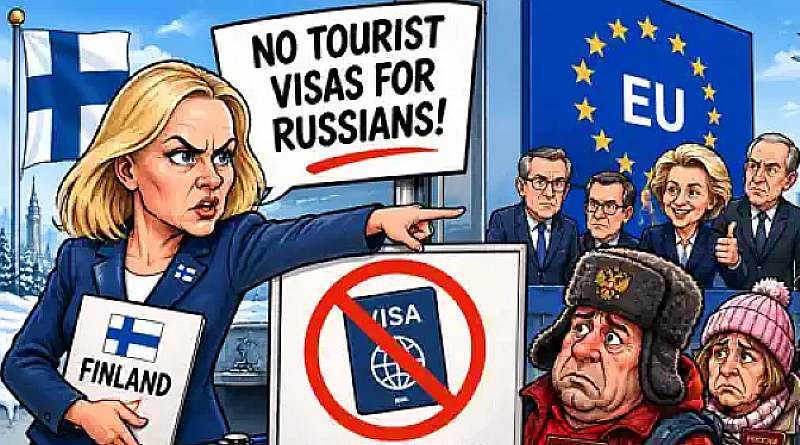
9. Finland has called on the EU to completely ban tourist visas for Russians until the end of the war.
– Finnish Foreign Minister Elina Valtonen called on the EU to stop issuing tourist visas to Russian citizens until the end of the war against Ukraine.
– She stated that Finland already banned issuing visas to Russians for non-essential trips, including tourism, in 2022. Now Helsinki insists on extending this ban to the entire European Union.
– Valtonen emphasized that Russians should not enjoy European freedoms and the standard of living while their country bombs Ukrainian cities and homes.
– The ban, according to her proposal, should remain in effect until Russia ends the war against Ukraine.
Illustration: NEWSUA ONE
