
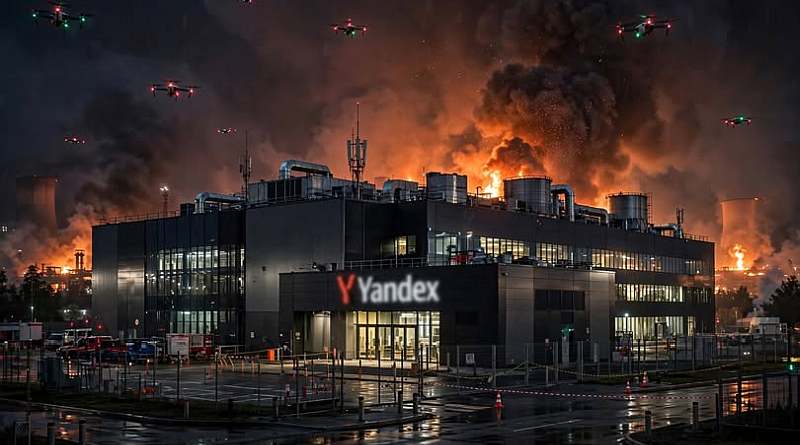

The third Yandex data center in Russia has been hit. After strikes on the data center in Sasovo, Ryazan region, and the data center in Kaluga, Yandex’s data center in Vladimir has ceased operations.
The last data center in Mytishchi remains unattacked. Until 2022, Yandex also had a data center in Mäntsälä, Finland. But on April 25, 2022, it was disconnected from the power supply due to sanctions and ceased to be part of Yandex.
However, there is a significant difference between air strikes on Ukrainian data centers and Defense Forces strikes on Russian data centers.
The Ukrainian Internet access system is built on the principle of decentralization: we do not have giant monopolists. There are large providers and data processing centers, smaller ones, and even very small ones. But there is no single “key link,” a central pillar that, if toppled, would cause the entire system to collapse.
In Russia, it’s quite the opposite: Yandex is a giant monopolist. It is so wealthy that it built its own data centers and moved practically all its resources into them. Therefore, they are colossal in size, making them an easy target for positive drones. Three out of four have received fierce Ukrainian retribution. Two out of four have suspended operations.
What will happen next?
Next, we can expect what happened with Wildberries: monopolism will play against itself and, consequently, against its users.
After all, Yandex is a browser, mail, weather, maps, e-disk (cloud), marketplace, taxi service, food delivery, and even a home device management hub (“Alisa”). These are mass public services. The corporate sector also widely uses Yandex’s services, including banks, industry, transport, energy, government structures, and the military industry.
Hyper-centralization has shown its weaknesses. And while Yandex will convulsively relocate its resources to other data centers (for all the money in the world), its users will suffer. Taxis won’t work, food won’t be delivered, navigation will glitch, and access to files in the cloud will be unstable.
By the way, the consequences of strikes on Ukrainian data centers were much less noticeable. But in Russia, it will be more evident and dramatic.
The last untouched Yandex data center is located in Mytishchi, Moscow region. This area is maximally covered by air defense systems, moreover, Mytishchi is located north of Moscow.
Overall, there are about 230 data centers in Russia, while in Ukraine, there are around 60. So completely stopping the Internet in that territory will be practically impossible, as it is in Ukraine.
But is it worth it?
On February 25, 2022, the USA imposed sanctions on the supply of communication and telecommunications equipment to Russia, including for Internet service providers. However, by April, they reversed this decision, claiming that “communication technologies are deemed by the US government as essential to humanitarian activities, along with the supply of food and medicine.” Supposedly, this separates the “ordinary people” from the Kremlin regime. They took a month and a half to decide that Russians with the Internet is preferable for the USA than Russians without.
Whether this is also better for Ukraine is a debatable question. I don’t have a clear answer. Besides, we don’t have that many capabilities for impact.
However, if needed, here is a map of Russian data centers with addresses, coordinates, status, capacity, owners, certifications, and other characteristics.
Overall, the Kremlin didn’t consider that this game can be played by two. As always. Before striking, think about whether you will receive the same in return. And whether your consequences might be more severe.
I can almost see the Magyar after the first attacks on Ukrainian data centers: “Oh, interesting idea, why don’t we try it too?”


There are questions regarding strikes on Yandex data centers. And they sound rather strange. Aren’t these strikes simply a mirror response by Ukraine to the hits on data centers in Kyiv and other Ukrainian cities? Just retaliatory actions, without particular meaning or purpose?
No, they are not. Although Russian strikes on our data centers have fully freed our hands in terms of retaliatory measures. And Russia is far more vulnerable in this matter because their centralized system forms the basis of everything, while we have decentralization and the absence of state monopoly, so to speak, in our blood.
However, when it comes to the military justification for strikes on Yandex, remember that it’s not only Yandex Taxi, Yandex Food, Yandex Go, and other services, but also providing Russian armed forces with cartographic information, targeting, and local orientation.
Furthermore, Yandex, at the request of Russian special services, fully discloses data of any user registered in any of their services.
The Russian army uses most of Yandex’s applications for its own purposes; moreover, it is a major provider of technologies for state tasks.
Yandex is the leader in Russia in AI development and has its own AI models and supercomputers used by the Russian army for its interests. Specifically, auto-guidance/mechanical vision models for kamikaze drones are based on Yandex’s developments.
This and much more Yandex supplies to the Russian Armed Forces and serves Russian special services. And I haven’t even mentioned the factor of a war of attrition, in the framework of which all monopolies that provide the budget and financing for aggression are dismantled, and Yandex is an absolute, digital, informational monopoly in Russia. In general, these strikes appear as a comprehensive impact on the enemy.
And here arises the question, what is really the point of hitting Yandex’s data centers? Hmm… Has someone still not understood?
Notably, Ukraine did not touch such a fat, important, and highly vulnerable target for the Russian army only because the Russian Armed Forces did not strike our data centers in Ukraine. But the green light was given, and the response was swift. The frenzied crowd did not enjoy the strikes on Ukrainian data centers for long, which created only situational difficulties, not global ones. But the destruction of all the largest Yandex data centers, of which only two remain fully operational, will lead to complete disaster. Small and medium data centers cannot handle such loads, and if they start getting hit as well, it will be the Stone Age, a kind of 1990s.
You wanted things as they were before – here you go. And don’t forget, when you slow down with a rake over “two counters” on a bypass, that you need to say “Thanks to Putin for this!” three times.

* * *
Ukrainian strikes on Yandex reduced bot activity in Europe.
An interesting phenomenon worth noting.
Just the day before (see above – Ed.), explaining the necessity of strikes on Yandex data centers, I listed a number of reasons why this is an absolutely legitimate target, long overdue for strikes.
And now it turns out that after the collapse of Yandex traffic in Europe, the online support for ultra-right and ultra-left parties has decreased, particularly the “Alternative for Germany”! But even more interestingly, after the strikes on Yandex, activity in the environment, incredibly, MAGA, decreased!
The overall activity of bots in these categories has decreased by more than 57% since October 8, when Ukraine attacked the Yandex data center in Sasovo, one of the largest, which housed, among other things, two supercomputers.
After the Yandex data center in Kaluga was hit, the decline in bot activity accelerated.
As of today, there are two functional large Yandex data centers remaining in Russia, in Mytishchi and Ivanteevka, and if they lose their operability for certain reasons, how much will the activity of far-left and far-right information activists on the internet decrease? How much will the views and commenting of Eurosceptics and even MAGA idols drop?
In essence, it is confirmed today that Russia has been, is, and will attempt to interfere in the shaping of public opinion both in Europe and the USA. Freedom of choice and democracy in the countries of the free West have long not been independent since the presence of the Russian shadow component is very significant here.
Ignoring this problem in the past decade has led to the democratic forces losing ground, while the opposition, using the information locomotive from a completely different, mentally and ideologically alien country, is gaining leading positions.
It creates the impression that in the 21st century, Ukraine can save the democracy of Western countries by destroying data centers across Russia.
