
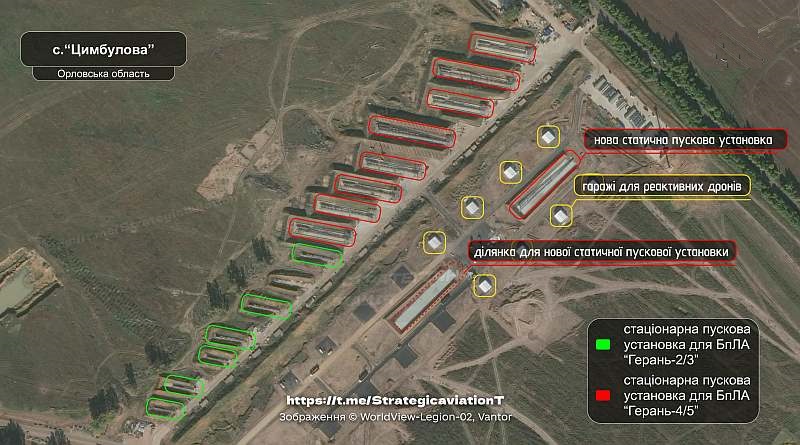
The Defense Forces of Ukraine have systematically shifted from regular strikes on refineries and airfields to precision operations specifically targeting the logistics chain of production, storage, and launch of UAVs. Similar operations were conducted earlier, in principle since 2024, but with such emphasis — for the first time.

Why? Because we have already caused significant damage, and there is no point in hitting the columns every three days. If at the start of the campaign (2024), the average repair took two to four weeks (due to quick patching of visual damages, cable replacement, and use of stock supplies), then by 2026, the downtime of damaged objects has increased to three to five months, and in the case of heavy primary processing installations — up to half a year or more (up to a year).
A recent example is Kapotnya. After paired strikes in June 2026, which disabled primary processing units (ELOU-AVT-6), Reuters, citing industry sources, reported that the plant was completely shut down for at least six months (until the end of 2026 – beginning of 2027). The estimated repair cost is about $1 billion. Then there was a second strike and at least three fire outbreaks. Is a third strike urgently needed? Not necessarily. Let them circumvent sanctions to bring in electronics, deploy repair teams, build walls from sea containers, and additional mobile fire groups (MFG) — all this costs money and resources, which are directly diverted from the line of combat contact (LCC).
The trend is clear: two to three weeks in 2024 evolved into one to two months in 2025, and three to six and more months now. Due to the inability to quickly restore refineries, the International Energy Agency (IEA) officially reduced the forecast for daily oil processing in the Russian Federation to a minimum of 4 million barrels per day in September 2026, and in 16+ regions of the Russian Federation, a systematic shortage of gasoline and diesel resumed.
Next. Despite our air defense continuing to maintain control and intercept a significant portion of targets, the enemy is progressing. Relay stations have appeared in the “Shahed” chain, jet UAVs, video channels with feedback, sensors for detonation near targets. Moreover, missiles for SAM systems are depleting, some aircraft are under repair (transferring aircraft is only the beginning, setting up a three-level repair system takes years), and there is a deficit of jet engines in the EU for interceptors.
In short, it’s necessary to work not only on the defense industry, oil refining, and chemistry, but also to directly target “drone ports” with the aim of causing damage here and now and forcing the enemy to spend time and resources on dispersion.
Drone Port “Tsymbulova” (Oryol region, RF). This is a stationary site/base near the village of Bolkhov (about 175–180 km from the border with Ukraine). The complex area is about 5 km². It served as a key point for the basing, preparation, and launch of strike UAVs of the “Geran-2” and “Geran-4” types towards Kyiv and western Ukraine.

The Armed Forces struck the site on the night of October 1 and October 3, 2026. The strikes were recorded by NASA FIRMS satellite images and OSINT channels.
At least two ground hangars-storage for UAVs, equipment, and launch sites were damaged and partially destroyed. Secondary detonations and prolonged fires were recorded on the base territory. Fires are good, as the equipment for launches and field repairs is sensitive and costs a lot of “dead presidents.” At the end of September, there had already been an arrival — at least five hangars burned, and several specialists “left the chat.”
Yeysk and Primorsko-Akhtarsk (Krasnodar Territory). Historically, these are the main coastal launching pads for “Shaheds/Gerans” in the southern direction. After several strikes with penetrating munitions, the Russians were forced to partially dismantle the stationary ramps and switch to mobile launch units based on trucks and vans.
Warehouses and launch points of the “Rubicon” center and UAV units in the TOT:
Donetsk hub and Makiivka (October 4-5, 2026). Localized places of UAV operator concentration, warehouses of ready FPV drones, as well as control equipment and launch catapults.
On October 4 and the night of October 5, the Armed Forces carried out a series of strikes with HIMARS and heavy long-range drones on targets within occupied Donetsk and adjacent industrial zones. A warehouse with FPV drones and components was destroyed, and the launch calculation unit was hit.
Zaporizhzhia and Luhansk directions (Komysh-Zoria, Uspenivka — October 4-5, 2026). These are advanced command posts and collection points for kamikaze drones targeting the logistics of the Armed Forces of Ukraine. Precision strikes were delivered on communication nodes and command posts, from which operators were directed. Antennas, cable facilities, generators — all these are quite vulnerable.
It turned out that building a large “droneport” with bunkers is a great idea only until the first arrival of a cluster or heavy explosive warhead. Bombs on “Tsymbulova” proved that concentrating hundreds of drones and launch catapults in one place within the range of enemy means is a plan as reliable as a Swiss watch. And quickly dispersing fuel and depots with warheads is not that simple.

Strikes on points like “Rubicon” are aimed not so much at destroying cheap FPV frames (pieces of plastic and fiberglass), but rather expensive complexes of antennas, communication terminals, electronic warfare stations, and trained operator crews. If money is the lifeblood of war, then we continue to hit the enemy’s veins.
In response to these strikes, the Russian Armed Forces are rapidly relocating launch sites to ordinary forest belts and industrial zones, employing mobile launch frames that constantly change location, are buried deeper underground, and work from a network of reserve positions, fragmenting crews and logistical support (LS).
What does this mean in practice for the overall architecture of the war? Decentralization always entails exponential growth of logistical costs and reduced manageability in the first months. When you move from a stationary concrete hangar with lighting, stable internet, and warm workshops to working from the back of a “Ural” truck in a forest belt, your efficiency inevitably drops.
Each fragmented mobile launch group requires its own vehicle, its own fuel supply, its own autonomous generator, and a separate communication terminal. What was previously serviced by one node for 50 people now requires five separate points for ten people each, all of which need to be supplied with provisions, ammunition, rotated, and most importantly, camouflaged. The more trucks roam the dirt roads, the easier they are to detect with reconnaissance UAVs.
The enemy’s dispersion, objectively, complicates our work as well. Using a GMLRS package or ten mid-strikes to catch a mobile launch pad in a forest strip or a single truck becomes economically unviable. This means the war is transitioning into the next, even more demanding phase: a battle of intelligence and optimization of weaponry. The defense forces are compelled to employ echeloned reconnaissance (a combination of satellite data, intelligence, and deep aerial surveys) to detect not the launch sites themselves, but the critical points of their supply. Systematic strikes are required on vehicles supplying fuel and batteries, intercepting radio communication between dispersed groups, and dismantling mobile electronic warfare stations that cover these field “jump points.”
There are no magical solutions in this war. We won’t see a rapid collapse of the enemy front simply because we burned another depot in Donetsk or a hangar near Oryol. Russia has sufficient financial resources to continue churning out carbon frames and buying Chinese electronics through gray markets for a long time. However, the essence of modern attrition warfare lies not in a single impressive strike that gets showcased from ten angles. It lies in the cold, methodical, and ongoing increase in the cost of each step for the enemy.
We have forced them to spend billions on restoring refineries and to stretch their scarce air defense across vast territories. Now we are forcing them out of cozy stationary hangars into the mud, burning scarce transportation, and breaking their own logistics. Each destroyed relay, every batch of burned fiber optic coils and batteries, and every eliminated experienced crew means fewer precise strikes on our infantry or cities. This is a harsh, utterly pragmatic war of infrastructures in full swing.
Cover photo: Telegram channel “Strategic Aviation”/Vantor
