
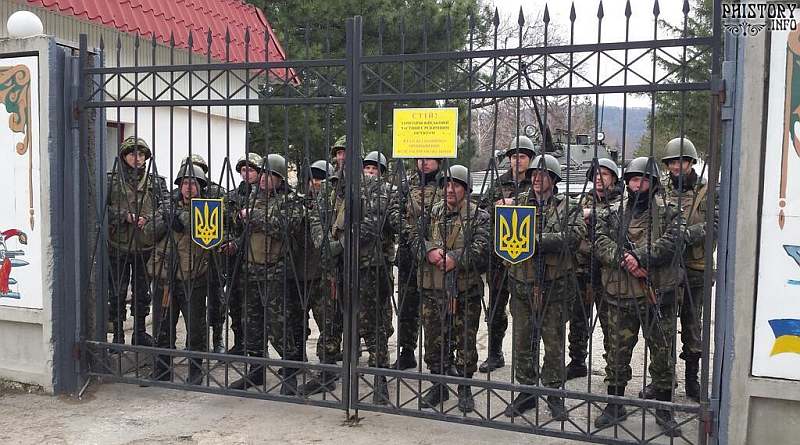

“If there had been an order to defend the country in 2014, I am confident that a full-scale war in the form we see today would not have happened. Our mistake lies in the fact that we did not push them back,” said Ukrainian President Volodymyr Zelensky in an interview with “The Diary Of A CEO” (according to TSN – tsn.ua).
According to the Commander-in-Chief, defeating the Russians at that time was not difficult at all because “dozens of people entered Crimea. Dozens. For a country like ours – that’s zero. That’s nothing…”
It’s hard to understand who provides the president with such “deep” analytics, but coincidentally, similar theses have been constantly appearing in pro-government media from various “experts” recently.
History can be twisted, touched up, concealed, but it cannot be changed. The truth about those tragic events does not fit into the widely circulated narratives and “politically calibrated accents,” because the Kremlin’s plans were for the occupation of Ukraine to be completed back in April 2014.
The details of our country’s capture by an interspecies group of troops were worked out to the smallest detail during the strategic exercises of the armed forces of the Russian Federation and Belarus “West-2013” in October 2013. Crimea was designated as the first bridgehead in the Kremlin’s expansionist plans. On February 20, 2014, when the blood of the heroes of the “Heavenly Hundred” was shed on the Maidan, Russian troops began seizing the peninsula, taking advantage of powerlessness, chaos, and large-scale crises that engulfed our country. Instead of organizing Ukraine’s defense, the president, heads of the Cabinet, Ministry of Defense, SBU, Ministry of Internal Affairs, intelligence, internal forces, GPU, ministries, many state institutions, and local administrations fled to Russia and began to assist military aggression against their own country in every possible way.
I want to reveal a terrible secret. In 2014, the same ruthless and unscrupulous Russia attacked Ukraine as in 2022. With the same military and economic potential, led by the same maniacal-mad Putin. The Kremlin’s plans at the time – to occupy and destroy independent democratic Ukraine – also did not undergo any changes.
In February 2014, just like in February 2022, the total number of all Russian armed formations was 3.4 million. Of these, about a million were in the Russian army, which Putin had tested in the localized conflicts he initiated. Two million men who had undergone military service were in the military reserve, ready for immediate deployment. To carry out the occupation tasks, the Kremlin also prepared numerous paramilitary Cossack and veteran organizations. On the eve of the aggression, the Russian Federation completed the rearmament and reformation of the armed forces and their preparation to perform complex combat tasks.
Ukraine faced the war with completely different indicators. Starting from the 1990s, the best equipment and weaponry were either sold off in a predatory manner or simply destroyed. Tanks were sold at the price of passenger cars. Anti-aircraft missile systems, invaluable for the country’s defense, were sold at prices hundreds of times lower than market value, and key air defense brigades and regiments were disbanded. By February 2014, out of the 36 anti-aircraft missile systems that had not yet been sold, only 10 could perform combat tasks. They did not even provide fragmentary protection against enemy aviation.
The third most powerful nuclear weapons in the world were handed over by Ukraine’s leadership to the aggressor country, receiving in return the empty promises of the Budapest Memorandum. All our strategic bombers were either sold to Russia or scrapped, and all cruise missiles were traded in exchange for the cancellation of recurring gas debts. Through disgraceful corruption schemes with paltry contributions to the budget, and often simply “gratuitously,” defense ministers gave away land, military facilities, and property.
Multibillion-dollar corruption profits from the insane sell-off of weapons and military equipment, combined with the professional work of Russian agents, chronic underfunding, and the thoughtless reduction of the army led to the catastrophic state of our Armed Forces. In 2011, Ukraine’s defense budget was only 1.08% of GDP, in 2012 – already 0.94%, and by 2013 – defense funding had dropped to 0.88% of GDP!
Systematically and consistently, units of the Armed Forces were liquidated in those regions identified by the Russian General Staff as priority footholds for future invasion. The 12,000-strong 32nd Army Corps stationed in the Autonomous Republic of Crimea was disbanded. The 3rd Separate Special Purpose Regiment was withdrawn from Crimea. The 1st Airmobile Division stationed in Bolhrad, Odesa region, which covered southern Ukraine, came under disbandment.
According to the Soviet military doctrine, which defined the threat to the country only from NATO countries, the main units of the Armed Forces were stationed in the western and central parts of the country. Eastern Ukraine was deliberately left without military cover. The only division (the 254th Motor Rifle Division) stationed in Donbas, as well as the operational regiment of the Internal Troops stationed in Donetsk, were disbanded without any justification.
Can the disbandment of key military command bodies in September 2013 be considered a coincidence – at the same time when the Russian General Staff was conducting large-scale preparations for invasion during the “West-2013” military exercises? The Russian army was thoroughly practicing the occupation of Ukraine, while the Ukrainian military leadership systematically dismantled the existing defense management system, “failing” to replace it with a new one by 2014. In October 2013 (four months before the start of Russian aggression), the Ministry of Defense and the General Staff decided to liquidate the last combat-ready 8th Army Corps in the Armed Forces.
The Kharkiv Agreements signed by Yanukovych not only extended the presence of Russian troops in Crimea, whose numbers and weapons power significantly exceeded the Ukrainian contingent there, but also removed any restrictions on their movement around the peninsula, creating all necessary prerequisites for its occupation.
The ministers of defense and chiefs of the General Staff appointed by Yanukovych destroyed the country’s mobilization system with particular fury. From 2010, the Ministry of Defense and the General Staff halted the preparation of reservists and stopped conducting reservist training. In 2012-2013, the system of military registration was completely destroyed. The staff of military commissariats was reduced by 80%! Premises were sold off and card files disappeared. Only three people remained in the staff of military commissariats, unable to perform basic mobilization tasks. In 2013, a cessation of conscription for compulsory military service was announced.
According to an annual report prepared by the General Staff for President Yanukovych, as of January 1, 2014, the Armed Forces of Ukraine numbered only 103,077 servicemen (34,265 officers, 63,485 soldiers, sergeants, and warrant officers, 5,327 cadets). That is, only two soldiers per officer. To hide the catastrophic decline in the combat readiness of the Ukrainian army, the General Staff introduced a new, more lenient system of criteria for combat and mobilization readiness. But even with clearly inflated figures, at the beginning of 2014 only about 20% of military units were assessed as combat-ready. The remaining 80% were defined in the General Staff report as “partially ready” or “completely unprepared” to perform combat tasks.
The lowest combat readiness was in the Ground Forces—the main core of the Armed Forces. Understaffed, unprepared to perform basic tasks, the units had terrible problems with the condition of military equipment. Most tanks, BMPs, and APCs were unfit for operation, required repairs, lacked batteries, and had no trained crews.
For the capture of the Autonomous Republic of Crimea, the powerful 25,000-strong grouping of Russian troops stationed there under the Kharkiv Agreements was significantly reinforced by the General Staff of Russia by deploying to the peninsula:
The 31st Separate Guards Air Assault Brigade (Ulyanovsk);
The 45th Separate Guards Special Purpose Regiment (Kubinka, Moscow);
The 18th Separate Guards Motor Rifle Brigade (Khankala);
The 98th Guards Airborne Division (Pskov);
The 15th Separate Guards Motor Rifle Brigade (Samara oblast);
The 382nd Separate Marine Brigade (Temryuk);
Units of the Caspian Flotilla Marines;
Units of the 7th Air Assault Division (Novorossiysk);
Combined units of the 58th Army of the Southern Military District of the Russian Armed Forces;
The 22nd Guards Separate Special Purpose Brigade of the GRU of the General Staff of Russia;
Special units of the FSB;
Numerous paramilitary Cossack detachments…
Such “dozens of people” or “nothing” seized Crimea. To cover the massive concentration and advance of occupation forces, “self-defense” units were formed from members of pro-Russian organizations, enlisting primarily those Crimeans who had served in the military. They were provided with weapons from Russian Black Sea Fleet bases and arsenals without restrictions.
The control established by the Russian army over sea and air corridors allowed the rapid buildup of a multi-thousand-strong group in the event of an offensive operation in the southern part of continental Ukraine. To enhance the fleet’s capabilities for landing operations, landing ships from the Northern and Baltic Fleets of the Russian Navy, as well as combat ships from the Caspian Flotilla, arrived in the Black Sea.
Assault aviation and combat strike helicopters relocated to Crimean military airfields controlled by the occupiers. To blockade the peninsula from the sea, Black Sea Fleet ships left Sevastopol bays and went on combat duty.
The missile systems transferred to Crimea took control of the entire maritime area, monitoring any activity of NATO countries’ naval forces. The US destroyer “Donald Cook,” which was in the Black Sea at that time, was particularly targeted by the missile radar.
This “heroism” of the Russian troops is detailed in the documentary propaganda film “Crimea. The Way Home,” which was released in 2015. The main character of this televised propaganda, Putin, pompously states that he personally directed the occupation of the peninsula by Russian troops and was ready to use nuclear weapons in case of NATO countries’ intervention.
However, there was no need to scare the leadership of these countries. They were in a stupor from the Kremlin’s aggressive cynicism, were not prepared, and did not plan to intervene in the tragedy unfolding in the center of Europe.
About 14,000 Ukrainian military personnel nominally opposed the Russian invasion in Crimea, most of them unmotivated local contractors and 18-year-old conscripts. Political disorientation, low morale, poverty-level financial and logistical support, and systemic work of Russian agents in the command structure of the security bloc led to mass desertion and defecting to the aggressor’s side by most Ukrainian soldiers and officers stationed in occupied Crimea. In the first days of the occupation, over 70% of the military personnel of the Armed Forces of Ukraine betrayed their country along with the Naval Command led by Admiral Berezovsky. Only 3,990 Ukrainian warriors, scattered across the peninsula without communication and support, surrounded by overwhelmingly superior enemy forces, did not betray Ukraine.
The situation in other law enforcement structures of the Autonomous Republic of Crimea was even more tragic. 99% of the Crimea police personnel defected to the enemy, 73% of border guards betrayed Ukraine, 90% of the Security Service employees, and 96% of the State Security Administration staff.
Having realized that no one was going to provide military aid to a Ukraine exhausted by crises and conflicts, the Kremlin started the countdown for a full-scale continental invasion.
On February 28, 2014, a “sudden” combat readiness check of the Southern and Western Military Districts of the Russian armed forces, located along the northeastern border of our country, began.
About 200,000 personnel from several armies with aviation, armored vehicles, and artillery began the combat deployment of strike units in the Rostov, Voronezh, Kursk, Belgorod, and Bryansk regions.
Powerful strike groups were deployed in the Kyiv, Slobozhansky, Donetsk, and Odessa operational directions, fully combat-ready for an invasion into mainland Ukraine.
On March 1, the Russian parliament authorized Putin to send troops into Ukraine, using a written appeal from President Yanukovych for political cover and justification of the military invasion.
On the other hand, in Ukraine, the Government was only able to be formed on February 27, and the next day I convened the first meeting of the National Security and Defense Council. According to information provided by the military leadership and intelligence, despite the unfolding tragedy in Crimea, the greatest threat to the country was in the north and east, where a powerful multithousand Russian military grouping was deployed along our border, ready to invade the unprotected mainland of Ukraine.
The number of Ground Forces from the total Armed Forces was less than a third, and according to official reports, eighty percent of the ground units were non-operational. Thus, our General Staff could only counter the entire Russian military might with a few consolidated battalion-tactical groups at that time. About five thousand poorly armed, unprepared servicemen with faulty military equipment constituted a conditionally combat-ready resource ready for use. Most of them were eighteen-year-old conscript boys.
To push this consolidated group of soldiers into a breakthrough in Crimea through the narrow neck against the elite Russian forces, vastly outnumbering us in both manpower and armament, would mean losing even the meager reserves and leaving not just the country but even the capital without cover and any semblance of defense.
Our military contingent in Crimea significantly dwindled due to massive defection and transition of soldiers and officers to the aggressor’s side. However, those who remained loyal to their oath, being encircled, needed to tie down the enemy’s superior forces and buy us time. In these circumstances, I made the only possible decision—to have the military units in Crimea take up defense and use weapons to protect their positions in case of Russian assault actions and provocations. This order was recorded in the protocol of the NSDC meeting.
How long our military could hold out on the peninsula, I did not know. But during this time, we needed to somehow restore the army’s combat potential, conduct mobilization, arm, and prepare our soldiers to perform basic combat tasks. Since the main units of the Armed Forces were in the western and central parts of Ukraine, I ordered them to be urgently transferred to the north and east to cover the most likely strike directions by the Russian army.
By my decree on March 1, 2014, I ordered the Armed Forces of Ukraine to be brought to the state of “Full” combat readiness. This is the highest readiness state of all military units and divisions, involving the full range of measures for transitioning troops from peacetime to wartime, including direct preparation for combat actions, such as the distribution of weapons and ammunition, and the occupation of defensive lines.
According to Ukrainian legislation, it is the NSDC that submits a proposal to the president to impose martial law. Only I voted for this. The decision on martial law was not supported by the leaders of the parties of the new parliamentary majority, which meant that the parliament would not give its consent to its imposition.
The main reason this proposal was not supported was the martial law, which blocked presidential and parliamentary elections. Ukraine truly needed a legitimate government recognized by the civilized world. It could only be established through fair, transparent national elections. As long as Yanukovych’s legal legitimacy persisted, so did the mortal threat to the country. By bringing the “legally elected” puppet Yanukovych to Kyiv in the convoy of their tank columns, the Kremlin would silence the already not very active indignation of key international political subjects.
Stories about the possibility of conducting military operations in Crimea with the forces present on the peninsula are without any sense. Most of the surrounded and scattered remnants of our military units on the peninsula were unable to even follow orders and the elementary requirements of military statutes to defend their positions. During assaults, they surrendered without a fight, explaining it with the significant superiority of enemy forces, demoralization of personnel, low level of military training, hopelessness of resisting in encirclement, and the immense risk to the lives of military personnel’s families, who became hostages of Russian occupiers and aggressively inclined local collaborators.
The order to use weapons was duplicated by me and, accordingly, by the Commander-in-Chief of the Armed Forces of Ukraine on March 18, 2014, after the death of a Ukrainian serviceman during the storming of the 13th Photogrammetric Center in Simferopol. At my demand, the order to use weapons was made public, and therefore the information about this could not be “cleansed” along with many documents of that time.
Unfortunately, even after the repeated order, the situation did not change: even during the assault on the Ukrainian Navy Headquarters, none of the Ukrainian soldiers and officers managed to use their weapons!
Therefore, all the stories that “there were no clear orders from the Ukrainian authorities, and that is why Crimea was not liberated” are meaningless and distort historical truth. In February-March 2014, the country simply lacked the strength to counter the insidious aggression of the nuclear monster. The thesis that no resistance was offered in Crimea is also untrue. True heroes were not hindered from honorably fulfilling their military duty.
The marines of the Feodosia Battalion, despite the significant superiority of the Russian assault forces surrounding the unit, engaged in hand-to-hand combat. The brave sailors of the large landing ship “Konstantin Olshansky” refused the occupiers’ ultimatum and did not lay down their arms, although most of the crew left the ship and sided with the Russians. Together with the commander, Captain 1st Rank Dmytro Kovalenko, only 20 naval servicemen remained on the ship, who took a circular defense and engaged in battle. For four days they fought in complete encirclement against the superior enemy forces.
The crew of the small minesweeper “Henichesk,” led by Senior Midshipman Oleksandr Boichuk, did not lay down their arms and bravely broke through the blockade. The heroic multi-day struggle of the crew of the minesweeper “Cherkasy,” led by Captain 3rd Rank Yurii Fedash, became the plot of a feature film.
In those tragic days, we received another stab in the back. The strategic partners not only failed to fulfill the security guarantees they committed to under the Budapest Memorandum, but also categorically refused to provide Ukraine with any military-technical assistance. They explained this by saying they did not want to provoke Putin and trigger a full-scale war in the center of Europe. Ukraine was given not a single bullet, not a single dollar or euro for restoring defense capabilities. Shipments of not only weapons and military equipment but also equipment that could be used for weapons production were blocked. The insane “partner embargo,” organized by Obama, Merkel, and other leaders of leading democratic countries, lasted until the end of 2017. Had Ukraine received even a tenth of the modern aid volumes, the situation in 2014 could have changed dramatically, and Russia would have forever forgotten the way to our border.
Despite all these circumstances, 103 cadets, 2,239 soldiers and sailors, and 1,649 officers of the Armed Forces of Ukraine, who did not betray their country in Crimea and remained faithful to their oath, accomplished a crucial task. Holding out for almost a month in complete encirclement, they gave us the vital time needed to prepare for the defense of the country, begin mobilization, somehow arm our army, repair equipment, and take positions in the most likely directions of the Russian advance. We suppressed separatist rebellions in the Kharkiv, Odessa, Mykolaiv, Kherson, Dnipropetrovsk, and Zaporizhzhia regions and stopped the Russian advance in Donbas. Thus, the Kremlin’s plans for a military blitzkrieg, division, and occupation of Ukraine in 2014 were thwarted. We stood firm and, relying solely on our own forces, protected the country, created a capable Armed Forces that stopped the enemy in both 2014 and 2022.
