

Hungary, before the fateful State Assembly elections on April 12, 2026, has finally turned into the main European testing ground for the Kremlin’s hybrid technologies. What began as Viktor Orbán’s “special path” in the early 2000s transformed by the spring of 2026 into open collaboration in Russian special services operations. Therefore, Orbán’s supporters no longer play the sovereignty card but act according to GRU and SVR guidelines.
In light of this, the high-profile March scandal involving the capture of seven Ukrainian Oschadbank cashiers in a suburb of Budapest became the point of no return. Under the guise of fighting “money laundering,” the Hungarian Counter Terrorism Center (TEK), effectively Orbán’s new secret police since 2012, conducted an operation that resembled a hostage-taking.
The most horrifying aspect of this story is the investigation data, for example, from The Guardian, which confirms that psychological and physical pressure methods were applied to the detainees, characteristic of Soviet special services. This includes forced injections of substances, the notorious “truth serum.” The use of psychotropic drugs during interrogations is not just a violation of human rights but a direct copy of KGB torture practices, which Hungarian law enforcement likely adopted from their Russian “curators.”
Furthermore, the cynical interaction between Budapest and Moscow reached a peak when Darya Boyarskaya unexpectedly became part of the OSCE observer mission for the elections in Hungary. She is the former personal interpreter of Putin, whom the Kremlin used for years as an instrument of “soft power” and distraction during international negotiations.
Her presence in the official mission is not just a “troll” of the West. It is the embedding of a direct influence agent in a structure that must confirm Orbán’s legitimacy. It is hard to imagine a more blatant mockery of the institution of democratic elections than “supervision” by a person whose career is built on serving the interests of the Russian dictator.
No surprise here: while Orbán talks about “peace,” a full-fledged operational headquarters of Russian political technologists and GRU officers has already been deployed in Budapest, according to VSquare investigators. This group is personally overseen by Kremlin official Sergey Kiriyenko.
The task of the “landing team” is simple: amplifying the info-noise about “Ukraine’s interference” in Hungarian affairs; using bot networks to discredit the opposition, especially the Tisza Party of Péter Magyar; direct coordination of actions by Hungarian special services with the Kremlin’s goals to split the EU.
To finally cement the electorate around the figure of the “nation’s defender,” the Fidesz propaganda machine launched a dirty campaign about a supposed assassination attempt being prepared on Orbán by Ukrainian special services. Despite the lack of any evidence, this narrative is actively propelled through Orbán-controlled media. However, recent leaks indicated that the “assassination simulation” scenario was developed within the Russian SVR to shock Hungarians and justify any repressive measures against the opposition and Ukrainian activists just days before the vote.
Today’s Orbán has become a functionary working to expand the influence of the Russian power apparatus within NATO and the EU. The elections on April 12 have ceased to be a battle of programs; it is a fight over whether Hungary remains part of the civilized world or becomes a “western branch” of Lubyanka.
The anti-Ukrainian hysteria in Budapest is merely a smokescreen, concealing Orbán’s de facto surrender of Hungarian sovereignty in favor of Moscow.
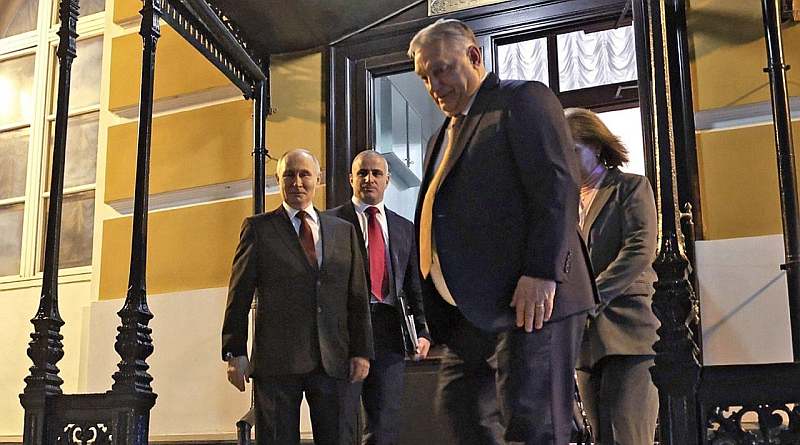
In the image: Hungarian Prime Minister Viktor Orbán leaves the Moscow Kremlin after a meeting with Putin, November 28, 2025.
