
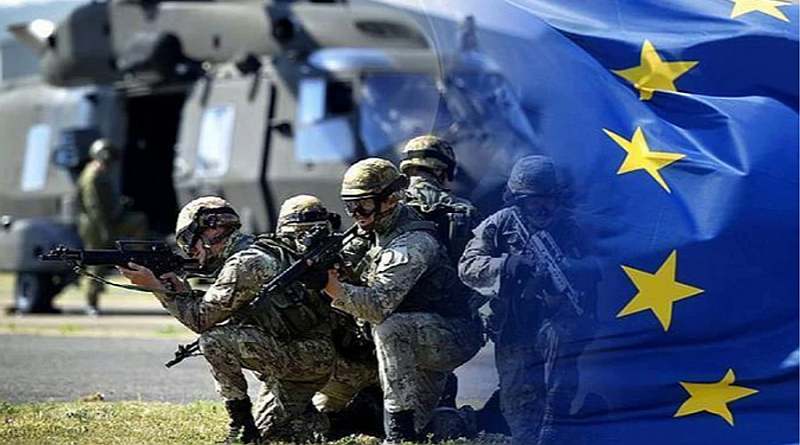

The likelihood of a Russian invasion of European countries is increasing. This is facilitated by the problems faced by the American army in Iran, as well as open disputes between the US president and European NATO members over their refusal to support the Americans in the Iranian operation.
For organizing such an invasion, Russia does not necessarily need to conclude the war in Ukraine. Under current conditions, a Russian invasion of the Baltic countries could become part of the war against Ukraine, and Putin could propose the cessation of hostilities in Europe in exchange for European cessation of support for Ukraine.
The foundation of the modern security system of European countries is NATO and the US army as its key element. America’s involvement in the Iranian operation, which is currently only in its initial stages and holds potential for escalation, creates obvious limitations for its possible involvement in another war in Europe. And the public insults by President Trump towards European allies due to their stance on Iran increase the likelihood that the US will not want to get involved in another war in Europe and help those who refused to support Trump himself.
In other words, throughout NATO’s history, there has probably never been a period when this organization was weaker than it is now. Meanwhile, Russia is at the peak of its military strength: it has a million-strong army, a developed military industry, and current combat experience from modern warfare. There are only two forces in the world capable of countering this — the Armed Forces of Ukraine and the US army. The main risk for Europeans is that in the event of a Russian invasion, neither of these armies will come to help: one will be forced to defend its own country, and the other will remain engaged in the war in Iran.
On Thursday, March 19, the Russian government registered a bill in the State Duma regarding the use of the Russian army abroad “to protect Russians.” Before this, the State Duma had only twice made decisions on the use of the army outside the country — in 2014 and 2022. Both times, it resulted in an invasion of Ukraine.
Clearly, for Europe, there is only one reliable type of security guarantee — their own armies. The experience of the European Union shows that Europe is truly strong when it is united. Therefore, the creation of a united European army should become a key objective for all European countries in the near future.
The formation of such an army based on the Armed Forces of Ukraine would not only provide Europeans with real combat experience necessary for the defense of their countries, but also help to end the war in Ukraine and genuinely guarantee that Russia will no longer be able or willing to repeat anything.

An attack on the Baltic countries is entirely realistic, and here’s why. There are at least THREE reasons for an attack.
First and foremost: Russia risks NOTHING. Whatever happens with the occupation of the Baltic countries, Russia won’t be worse off. Sanctions have already been imposed on Russia. Europe doesn’t buy its oil products and gas. It provides weapons to Ukraine.
From purely military aspects, Russia also risks nothing. It has nuclear weapons, so if it wins and occupies the Baltics or some parts of it, no one will drive it out. And if it loses, it won’t lose its territory, just withdraw to the border, and NATO won’t conquer Russian territories, because of the nuclear threat.
So why not try?
The second reason lies in the goals of the war. The objectives of the fascist federation go far beyond the occupation of the Baltics. Primarily, Russia is interested in the collapse of NATO and the EU. Based on this, any territorial gain in the Baltics will be a victory for Russia. Even if Russia does not occupy Vilnius or Tallinn, but only some border villages, this will be a victory for Russia, as it will show NATO’s INABILITY to protect its members.
Thus, why not try – 2?
The third reason: Russia has enough forces and means in the probable conflict zone to solve military tasks and achieve an acceptable result for itself.
In the Leningrad Military District, there is a combat-ready group of about 70,000 soldiers, which can easily be reinforced with reserves from the Ukrainian front. The group is mechanized, with about 700 tanks and lots of armored vehicles. Notably, the drone component, which has no equivalents in NATO, can radically change the balance of power in case of invasion.
If there are enough forces, then why not try – 3?
Thus, as of now, we have the following situation: Russia has enough forces and means to achieve its objectives in the Baltics, and there are no bad scenarios in ANY development of events.
The situation is very similar to the situation before the attack on Ukraine. Especially considering the law that allows Putin to protect Russians abroad, promptly submitted to the State Duma.
The Baltic countries helped us more than anyone else, so I sincerely wish our friends to remain at peace.
But for peace, one must prepare for a great war. It’s very good that our Baltic friends have taken into account Ukraine’s mistakes and built defensive lines and fortified areas to repel the occupiers. I really hope that the fascist federation will break its teeth on the Baltics, as it did on Ukraine.

By analogy with World War II and the actions of the allies, it may be time to open a second anti-rashist front…
Will it happen or not? There are objective factors that will lead to this, sooner or later. The enemy will not hold back—they will indeed attack one of the NATO countries directly.
They will do this not when they are ready, but when the Europeans are not yet prepared. Therefore, all thoughts about 2-3 years should already be left in the past. Everything can happen much faster.
This does not mean that Europeans should keep all the weapons to themselves now! It means that military support should be actively provided to Ukraine now, so they do not face a well-prepared Russian army that has been battle-tested against Ukrainians.
And yes, it is time to direct troops not to the Middle East, but specifically to Ukraine. The responsibility to counter the aggressor in Europe is a sensible explanation for American allies.
Enough procrastinating. Those willing should finally become decisive!
Collage: Foreign Intelligence Service of Ukraine
