
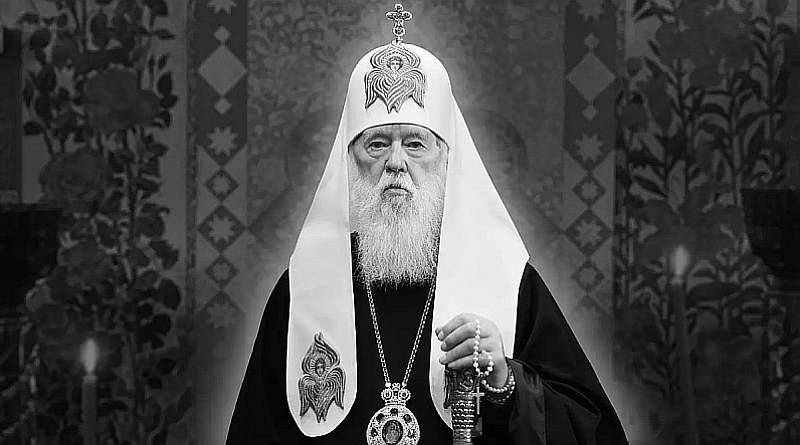
Probably, there has not been a figure in the post-war church history of Ukraine as significant and as controversial as Filaret. Even on the day of his death, some spoke with admiration about his spiritual feat and zeal, while others reminded of his collaboration with the KGB, his thirst for power, or even having a family – all the usual accusations we heard about Filaret from Moscow clerics, and which they somehow never mentioned when this handsome and tough man was the de facto head of the Russian Orthodox Church – and he was.
However, now, when he is no longer among us, one simple thing must be acknowledged: it was this priest, who reached heights in the Russian Orthodox Church and led it as a “shadow patriarch” and transitional leader, it was this priest on whom Moscow could rely in the matter of keeping the Ukrainian Church under Moscow’s subordination, who revived the oppressed and Moscow-bound Ukrainian Orthodoxy. And you can say whatever you want about Filaret’s motives, but what matters is not the motive – what matters is the historical result: the canonical Orthodox Church of Ukraine exists and will exist forever. And if Filaret had not dared to oppose the Russian Church and the entire world Orthodoxy, if he had been afraid to create the Kyiv Patriarchate outside of its confines – who, tell me, would have received the Tomos in a situation where the UOC of the Moscow Patriarchate is afraid to break the “spiritual connection” with Moscow even in the fifth year of the great war, and the foreign Ukrainian Church could have been satisfied with autonomous status under the Ecumenical Patriarchate (which, after all, happened even before obtaining the Tomos)?
Many who call this rebuilding of the Church a spiritual feat may not realize what an unbearable torment it must have been for him – complete severance from the environment in which he grew up and took place. After all, he became the Metropolitan of Kyiv when most of us were not yet born. All these decades he was one of them, not one of us. He led them – and, by the way, he could have hoped they would appreciate him if not as a pastor, then as a capable church administrator.
This did not happen. It was the first great betrayal in his life – when he ran for patriarch and was rejected. I was, by the way, at that Council in the summer of 1990, when many were confident that it was indeed Filaret, who had the “keys to the Church” during the reign of Patriarch Pimen (one of the main lobbyists for whose election he was), who would become the successor of the deceased head of the ROC.
This did not happen. I must say, it was primarily an anti-Ukrainian Council. Its participants did not want to vote for either Filaret or the future head of the UOC MP, Vladimir, precisely because both metropolitans were Ukrainians. The slogan “better a German than a khokhol” I heard more than once, and as a result, Alexy II, indeed an ethnic German by origin, became the patriarch, with whose election Russian clerics associated the end of the “domination” of Ukrainian colleagues. And granting autonomy to the UOC was primarily associated with the desire to “lock” Ukrainians at home and no longer let them into Russia and other Soviet republics, not out of respect for Filaret or the Ukrainian church tradition.
But when Filaret went further—logically concluding that an independent state should have its own Church, and that Moscow should grant autocephaly to this Church—he faced further betrayals. The first was the betrayal by his colleagues in the Russian Synod, who declared him a renegade—even though I have no doubt that this experienced church politician discussed his intentions with them. But Alexy II consulted in the Kremlin, and of course, he was made to understand what was obvious to every Russian leader: Ukrainian statehood was a temporary phenomenon. And it seemed strange if once again there would be a single state—and some sort of independent Ukrainian Church. Why?
Then there was the betrayal by his colleagues in the Ukrainian Synod, the vast majority of whom he had made priests, metropolitans, figures in the new autonomous Church. Naturally, they all supported his proposal for autocephaly, understanding it to be the result of previous consultations. But when they saw that Moscow had changed its mind, they betrayed their primate, held a non-canonical unlawful Synod, and expelled him from the Church just to please their Moscow curators. And this was not the greatest betrayal. The greatest was the betrayal of the congregation that remained with those traitors.
The story of life in such an atmosphere of betrayals could be written as a novel rather than a text. From our conversations, it seemed to me that he also perceived the behavior of the new Moscow Patriarch Kirill as a betrayal. During his time in the ROC Synod, Filaret had considered Metropolitan Nikodim, Kirill’s mentor, his best friend and political partner. Nikodim had a complex reputation; most colleagues believed he tended towards a Catholic approach in building the Church (Kirill would later turn himself into a Moscow Pope). And when Nikodim died in the hands of Roman Pope John Paul I (he was congratulating him on his election, and a heart attack overtook him in the pontiff’s chambers, who also died weeks later), the ROC decided to rid itself of the late metropolitan’s pupils. And Filaret, who had ordained a young Kirill together with Nikodim, literally saved him from inevitable downfall. So, how did Kirill repay his savior? Not just by intensifying the struggle against his Church but also by attempting to turn Ukraine into his own territory—conditions in health of Metropolitan Volodymyr and Yanukovych only facilitated this. And this was even before Kirill became the patriarch of war.
How does one survive in such an atmosphere and not lose faith? But he was always as a rock. His confidence in his own mission was unshakable. Yes, the mission might change, but he never wavered in his faith in his own path, which only he could and had to walk. And only once in all these long years did I see him moved—when he reached reconciliation with Metropolitan Epiphanius and other members of the OCU Synod.
But that was already farewell.
