
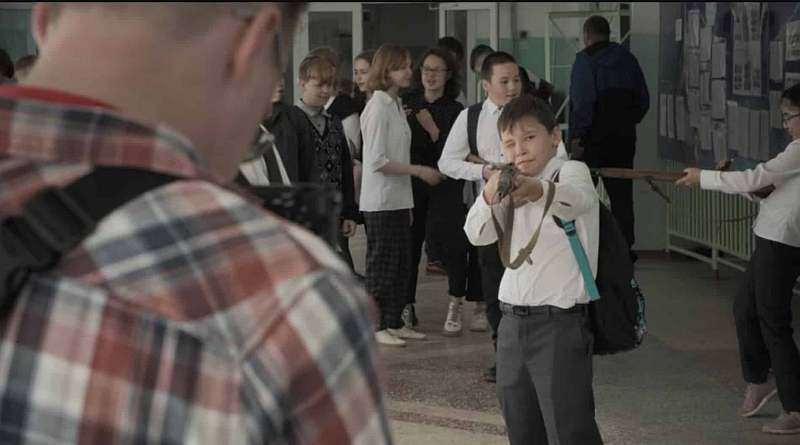
I watched the film “Mr. Nobody vs. Putin,” which won an Oscar. It is not a Russian film — it is Danish-Czech. The director is American, and the co-author and main character is Russian Pavel Talankin. Essentially, he tells about his small town with a population of ten thousand and a city-forming plant among the Ural mountains.
I will not write here that it would have been better if a Ukrainian film or a film about Ukraine had won. Obviously, it would be better. But this film won — where a lonely hero makes a moral choice: not to accept Putin, his propaganda, and ultimately, to flee Russia.
This is a film about Russians. And that’s why I was interested in watching it.
Once, in the Soviet army, a political officer interrogated me about whether I listened to foreign radio stations.
— Of course, — I told the truth because perestroika had already begun.
— Why?
— Because one must know the enemy deeply, — I replied with the usual ironic Soviet formula, with a cold face.
That’s why I watched this film.
To feel Russia, not to enjoy the art of cinema.
Not to live in myths: that Russia will soon collapse, rise against Putin, or, on the contrary, that they are all orcs who hate Ukrainians.
Everything is much worse. And we must study and understand this “worse.”
The main character himself says he has been lonely since childhood, different from others. His view of the world is unique, incomprehensible to most of his compatriots. However, it is much more interesting to look at his characters — the children and adults from this Ural small town.
Here is a history teacher who would dream of meeting his idols Beria and Sudoplatov. For the author — a “white crow” — this is incomprehensible. Beria killed hundreds of thousands in the Gulag. Sudoplatov organized the murder of Trotsky with an axe, the assassination of Konovalets, whom the author calls a prominent Ukrainian hero. And this teacher — with a look of either a sick person or an alcoholic — is considered the best in the city.
The author himself, under directive from leadership, shoots propaganda lessons in schools after the start of the Russian-Ukrainian war. These videos are sent “upstairs” for reporting on loyalty to the Putin course.
Students grow up, attend victory celebrations, are mobilized for war against us. Some go voluntarily.
They still think in Soviet clichés, slavishly fear and respect authority. Who and why to fight with — they don’t care. Authority said: against “Ukrainian Nazis,” — so against them.
This Putin propaganda is straightforward, simple, pushy. Its goal is to provide at least some explanation of the meaning of life and existence. Ultimately — of death. Because some of them die in the war.
But the main problem is that this society does not think about who is right, why live, why kill. They just live: eat, drink beer, confess love to each other — regardless of gender, go to war, die, give birth to the same children. And are afraid to think.
Authoritarianism and dictatorship lead to degeneration and degradation of the people. This is exactly what the author captures.
He loves his characters, as they love him, although they consider him strange. And he is the only one in the entire town who does not accept war and propaganda, but fears to say it out loud. Not because he would be imprisoned. But because he wouldn’t be understood. By these people he loves, drinks with, and films.
He takes action: films all this, wants to show the world propaganda lessons in schools, escapes. But even at the Oscars, he fears publicly condemning the Russian-Ukrainian war. He talks about “all wars.” Because what difference does it make: Russia’s attack on Ukraine, Americans on Iran, or Trump’s policy on immigrants in the USA?
For him — the author, director, part of the Oscar jury — there’s no difference. But it is huge.
Interestingly, in the film, they don’t “blur” faces, not even of children, mention names, don’t think about consequences. And if it weren’t for this, we wouldn’t see this terrifying picture of the Russian hinterland so clearly.
No one “busses” these Russians. They calmly submit to mobilization, go as volunteers, destroy everything like robots, and are not afraid of death. Such people.
I see nothing outstanding in this film as an artistic phenomenon. But I consider the work itself useful — for us and for the world.
As well as the strange life of its author — a hero who in his own way does not accept the aggression of his people against us. He does not fight, but he is outraged. So that the world hears it.
On the cover: still from the film
