
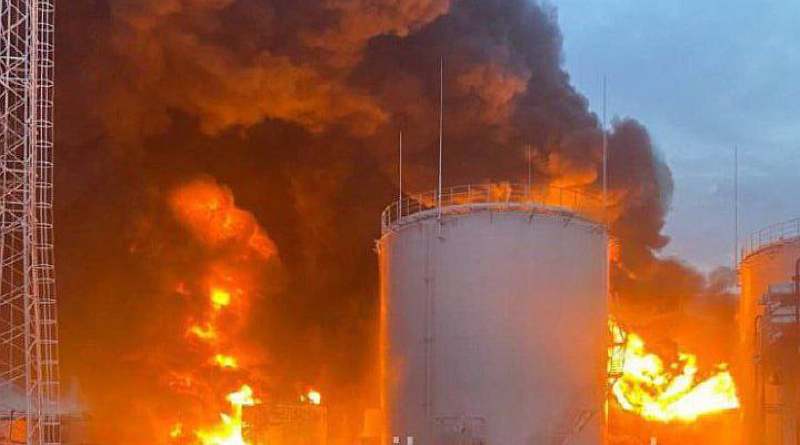
In just the first two weeks of March, the Defense Forces’ drones issued a check to Russia for an amount ranging from $500 to $600 million in direct losses. Adding the cost of the launched missiles (which detonated in warehouses and launch air defense systems) and the economic paralysis from the halt of oil ferrying and transshipment, the amount confidently exceeds a billion dollars.
Isolation of the AOO and strikes on Russia’s pocket in action.
The Air Defense Slaughter and Crimean Clean-up
In the first two weeks of March, the Unmanned Systems Forces took out 19 enemy SAMs — a real jackpot. The targets included heavy S-300V, “Pantsir” systems, and “Tor” systems. To understand the pace: on the night of March 6 alone, in the Zaporizhzhia direction, they eliminated four self-propelled SAM components.
All elements of the layered air defense – long-range (capable of shooting down ballistics), medium, and short-range – were knocked out. Just “Pantsir” systems alone, priced at $20 million each, saw five units destroyed.
The GUR special unit “Ghosts” published a large report on the methodical shaving off of Crimean radars. They confirmed the destruction of the enemy’s most expensive eyes: radar stations “Podlyot,” “Sopka-2,” P-18 “Terek,” “Kasta-2E2,” as well as ground relays for “Shaheds.”
Practically, the radar dome over the peninsula physically does not exist.
Logistical Noose and Fuel Hunger
March 14, the Defense Forces hit the Kerch Ferry. They completely disabled the railway ferry “Slavyanin” (which carried fuel and equipment trains) and seriously damaged the vessel “Vanguard.” The lifeline was cut. This means months of repairs, as after the first strike.
March 14 — a targeted strike on the Port Kavkaz infrastructure in the Chushka Spit area. All supplies for the southern group and Crimea come from here via ferry.
March 12 and 15 — within four days, strategic oil depot infrastructure of “Transneft” in Tikhoretsk was hit twice. Satellites recorded fires and destroyed tanks. This location is a crucial transshipment point. We continue to target oil transshipment and storage.
March 10, local fuel depots in occupied Makiivka and Koptievo were targeted. Fuel is being burned at all levels: from giant bases in the rear to tankers on the front line.
Strikes on the Military-Industrial Complex and Bases
March 10, drones successfully illuminated the arrival of cruise missiles at the microelectronics plant “Kremniy El” in Bryansk. This is a critical link in the production of parts for their missiles and the same air defense systems. The Russians are panicking — the second-largest military electronics plant is being shot at, with zero interceptions, direct hits on workshops wiping out shifts and burning scarce machines.
They came to their senses and calculated, how many such Bryansks can the EU make for you in a week?
March 12 — a strike on the infrastructure at Donetsk airport, from where the occupiers regularly launched attack drones. It was a hit.
While this article was being written: The Rosneft oil depot in the city of Labinsk (Krasnodar Krai) has been burning for many hours. Local emergency services are powerless: classic burnout is happening, there’s a shortage of foam generators, and fire crews are afraid to approach due to the risk of repeat hits and secondary detonation.
Reasons for Success — We Are Growing Structurally, Technologically, and Tactically
It looks quite systematic.
Relay Drones and Horizon Bypass — a heavy relay drone hovers a few kilometers from the combat line and distributes the signal. This has shifted the operational depth of FPV from 5–10 km to 30–40 km. Now logistics and rear columns are being targeted deep behind the front line, where they previously felt safe.
Satellite Communication — Starlink terminals are placed on heavy strike drones and naval drones. This provides a stable management channel and real-time telemetry hundreds of kilometers into the deep rear, beyond the range of ground towers. The enemy, who previously broadcasted videos of our damaged trains, has lost this option. Now we are showing videos of burning wagons and disrupted logistics in their deep rear.
Terminal Auto-Capture — upon approaching the target, where electronic warfare is at its maximum, the operator no longer needs to guide the drone to the strike. They simply highlight the tank, SAM, or oil tank in a square on the screen. Connection might be lost afterward — the drone flies on its own via optics, turning into a self-guided missile. Jamming it is futile.
Optical Navigation Without GPS (DSM)— long-range drones fly in radio silence mode. A terrain map is embedded in their memory, and the bottom camera matches the view with the ground. Electronic warfare does not see this drone and cannot misdirect it by altering coordinates.
Scaling and Standardizing Warheads — from using tape to attach RPG grenades, we have moved to powerful factory-made warheads.
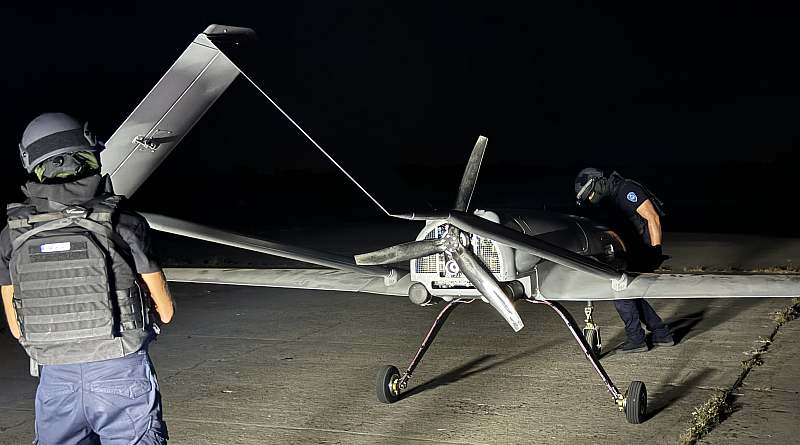
Target Specification — for oil refineries and bases, thermobaric and incendiary warheads are used (they provoke a volumetric explosion inside the tank). For shelters and armor — tandem and fragmentation-explosive with high armor penetration.
Weight Increase — middle-strike and long-range kamikaze (like FP-1 “Lyutyi”) now carry not 5–10 kg, but 50, 75, and more kilograms of explosives. A single precise hit of such a warhead on a rectification column stops the plant for a long time. In terms of destructive power, this can already be compared to a cruise missile. When we began to use them at medium range, it became a serious threat to air defense.
Therefore, we are increasing strikes, because the system has learned to overcome obstacles both hardware and software. Cheap mass spam to exhaust air defense, plus decoys, plus heavy warheads, plus bypassing electronic warfare through machine vision and satellite communication.
This is a pure mathematical algorithm, multiplied by the experience of our pilots, the Soviet concept of layered air defense is simply not designed for this. We punch corridors, blind radar eyes, overload their channels, and into the formed gap in the enemy’s rear go cruise missiles and long-range drones with 50+ kg of explosives.
On the cover: Fire at the Rosneft oil depot in the city of Labinsk (Krasnodar Krai). Photo: video screenshot
