
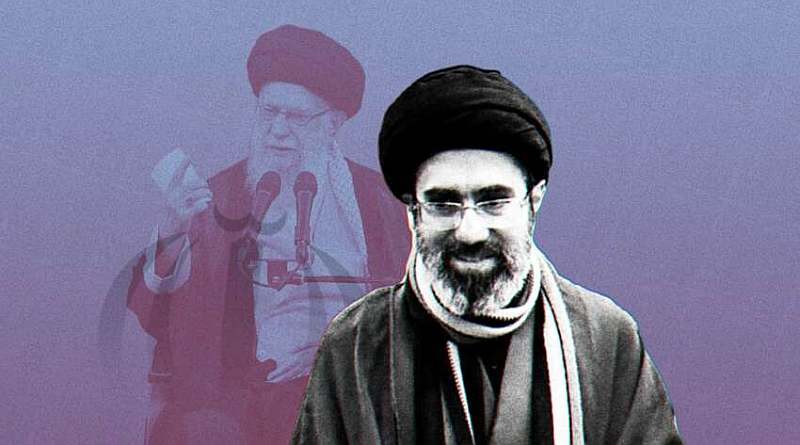

The death of Iran’s Supreme Leader Ali Khamenei on the first day of US-Israeli strikes brought a figure long kept in the shadows to the forefront. Mojtaba Khamenei, the son of the current leader, is no longer just a shadow of his father. His rise to the highest office marks the definitive triumph of Iran’s “deep state,” a symbiosis of radical clergy and the IRGC’s elite.
However, Mojtaba’s political program, announced on Iranian television recently, is not a plan for saving the country but a manifesto for accelerated self-destruction, dragging along his few “allies,” including the Kremlin.
Mojtaba’s programmatic ambitions, rumored to have been injured in recent shelling, seem realistic only within intelligence agency offices. His main goal is the preservation of the “velayat-e faqih” system amidst total disdain from Generation Z and economic collapse.
For the new leader, nuclear weapons are practically the only guarantee that he won’t meet the fate of Libyan Colonel Gaddafi. All signals from Tehran indicate that the regime is ready to cross the “red line.” This is not a strategy of deterrence; it’s direct blackmail of the international community.
Mojtaba bets on the “axis of resistance.” But whereas proxy wars were once a tool of influence, they are now becoming the regime’s sole reason for existence. The risk of a large regional war today is higher than ever, as Khamenei II has no other way to legitimize his power except through a “fortress under siege” scheme.
The implementation of Tehran’s new plans crashes against the firm stance of key global players. Washington has finally buried hopes for a “moderate Iran.” Any attempt by Mojtaba to accelerate the nuclear program will lead to the destruction of Iran’s oil infrastructure.
Saudi Arabia and the UAE understand well that behind diplomatic smiles lies preparation for expansion. The “Abraham Accords” and the Arab-Israeli rapprochement are a direct response to Khamenei Jr.’s “program.”
Brussels, long trying to “appease” Tehran, seems to have finally awakened. Iranian drones in Ukrainian skies became the point of no return. Now Europe discusses not the lifting of sanctions but the recognition of the IRGC as a terrorist organization.
The most shameful aspect of this story is the role of Putin’s regime.
Putin’s entire policy in the Middle East is nothing but a series of strategic failures, disguised as “complex maneuvers.” The Kremlin has become so engrossed in anti-Western hysteria that it has failed to notice becoming hostage to Tehran’s plans.
Support for Iranian proxies like Hezbollah and Hamas has completely buried Moscow’s relations with Jerusalem. Now Israel has full moral and political rights to respond symmetrically to Russia, as seen in the degradation of Russian influence in Syria.
The radicalization of Iran under Mojtaba’s leadership unavoidably leads it to clash with Erdogan’s ambitions. Turkey will not tolerate Iranian dominance in the Caucasus and Syria. By supporting Tehran, Putin effectively pushes Russia toward direct conflict with Ankara, a crucial economic partner of Russia.
Mojtaba Khamenei’s program resembles a utopia built on fear and repression. It disregards both Iran’s internal disintegration and the technological superiority of its enemies. Meanwhile, Putin’s regime, having finally lost touch with reality, has tied Russia’s future to Iran’s sinking ship. Soon Iranian adventures will begin to hit Russian interests with doubled force, and the “friendly” Tehran will push the falling neighbor into the abyss.
