
Jamie Dettmer, Politico / Translation iPress
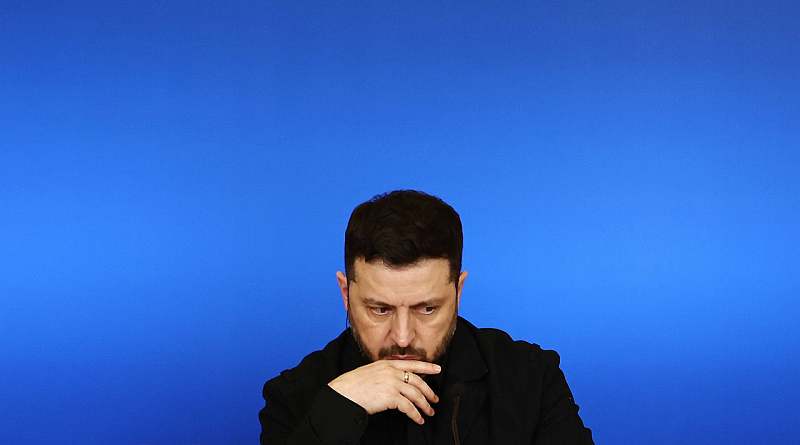
Amidst the prolongation of the war, stalled peace talks, and uncertainty regarding further Western assistance, Volodymyr Zelenskyy is speaking more sharply about both opponents and allies. This is reported in today’s article by Politico. In its opinion, such rhetoric reflects growing frustration in Kyiv but may simultaneously complicate relations with the very partners on whom Ukraine depends for weapons, funding, and diplomatic support.
The patience of Ukrainian President Volodymyr Zelenskyy appears to be wearing thin, and this is becoming evident, according to the publication Politico. Amidst the prolongation of the war, stagnant peace negotiations, and uncertainty over future financial and military support from the West, the Ukrainian leader has significantly intensified his rhetoric toward both critics and allies in recent weeks.
Zelenskyy is becoming increasingly outspoken toward European partners, accusing them of being slow to provide aid to Ukraine, exchanging sharp statements with Hungarian Prime Minister Viktor Orbán, and openly expressing skepticism about Donald Trump’s approach to the war, Politico notes.
This escalation of tone reflects growing frustration in Kyiv over the fact that peace talks have essentially reached a deadlock, and the issue of financial support remains unresolved. At the same time, even people close to Zelenskyy warn: such rhetoric could alienate the very partners on whom Ukraine depends for money, weapons, and diplomatic support.
According to a former foreign policy advisor to Zelenskyy, accumulated disappointment is increasingly affecting the president’s public statements. He noted that this frustration is pushing the head of state toward harsher rhetoric, but at the same time, this dynamic is beginning to work against Kyiv itself.
Opposition Member of Parliament Mykola Kniazhytsky believes that the change in Zelenskyy’s tone is also related to pressure on Ukraine within the framework of paralyzed peace negotiations. According to him, the president understands that he cannot sacrifice national interests and agree to relinquish eastern territories, as demanded by the Kremlin. This is why, Kniazhytsky says, in conversations with Western leaders, Zelenskyy’s statements have become more explicit and direct, writes Politico.
Kniazhytsky added that the president is simultaneously trying to demonstrate internal toughness. In his words, according to the deputy, there is a combination of attempts to emotionally influence the partners involved in the negotiations and to strengthen his own position within the country as a staunch defender of Ukraine’s national interests.
The tension particularly manifested last week when the European Union publicly reproached Zelensky for his statement, perceived as a veiled threat towards Viktor Orban. The President of Ukraine stated that he could give the Ukrainian military the address of “one person” so they could speak to him “in their own language.”
Although Zelensky did not explicitly name Orban, it was clear he was referring to him. The Hungarian prime minister is blocking a 90 billion euro EU aid package that is critically needed by Kyiv due to the risk of a lack of funds as early as spring. Additional frustration for Zelensky was caused by Orban’s statements claiming that Ukrainians allegedly deliberately halted the transit of Russian oil through the “Druzhba” pipeline.
According to the publication, the Ukrainian President’s statement not only caused discontent in the European Commission, which in a rare public denunciation emphasized that Zelensky should not allow “threats to EU member states,” but also displeased the Hungarian opposition and Orban’s critics in Budapest. They fear that Zelensky is effectively being drawn into rhetorical escalation beneficial to Orban, which may aid the Hungarian prime minister ahead of parliamentary elections.
Peter Kreko, an analyst at the independent Budapest consulting firm Political Capital, quoted by Politico, called Zelensky’s comment unwise. According to him, even if the Hungarian government itself is contributing to the escalation of the situation, including threats to take oil by force, the Ukrainian President’s words were extremely irresponsible. He added that such a war of words provides Orban’s campaign with additional “proof” for promoting the narrative that Ukraine supposedly threatens Hungary.
In an interview with Politico and WELT, Zelensky rejected accusations that his words play into Orban’s hands and explicitly stated that the Hungarian prime minister is siding with the Russian leader. According to the President of Ukraine, Orban tried to block sanctions against Russia and obstructed the transit of Western weapons through Hungary’s territory.
Zelensky emphasized that Hungary hadn’t helped Ukraine militarily since the beginning of the full-scale war because Orban’s “friends” and “strategic partners” are in Russia. According to him, diplomatic silence would change nothing.
Separately, the President expressed disappointment with the European Union itself, which, in his view, did not demonstrate a sufficiently tough response to Orban’s actions. Zelensky stated that he did not see strong signals from European leaders and that this conflict is not personal but concerns Ukrainian lives, Ukraine’s security, and all of Europe.
However, the publication notes that Zelensky’s harsher rhetoric is not only evident in relations with Orban. At the World Economic Forum in Davos in February, he also surprised European leaders when he devoted a significant part of his speech to reproaches of Europe for insufficient assistance to Ukraine and attention to its own defense.
The Ukrainian President then stated that in Europe there are too often “more urgent” matters, and the European Union itself enjoys talking about the future but avoids actions today. These words were spoken the day after Donald Trump had already harshly criticized European leaders, so Zelensky’s new wave of criticism frankly shocked the audience.
The publication also quotes Royal United Services Institute analyst Natia Seskuria, who noted that such a tone was unexpected, yet it also indicates Zelensky’s dissatisfaction with how Europeans have mobilized support for Ukraine.
Politico reminds that Zelensky has previously reproached European leaders, especially in the initial months of the war and last year in Davos. However, this time his tone, according to the publication, was almost mocking as he listed long grievances, starting with the EU’s decision not to use frozen Russian assets in Europe to finance Ukraine.
Zelensky has also become less restrained in his remarks about Donald Trump. This marks a noticeable deviation from the cautious line he adhered to last year following a tense episode in the Oval Office. At that time, he veered from a pre-prepared position, especially after provocations from U.S. Vice President J.D. Vance, who reproached him for “ingratitude.”
After that incident, Zelensky mostly adhered to a strategy of avoiding direct conflict with Trump, hoping that it would be Putin who first breaks the logic of the peace process and irritates the American president by refusing to take real steps toward peace.
At one point in the diplomatic standoff between Zelensky and Putin, where each tried to portray the other as the main obstacle to peace, it seemed Kyiv was beginning to win. After Ukraine, with the support of British Prime Minister Keir Starmer and other European leaders, partially restored relations with Washington, Kyiv considered it a breakthrough when Trump signaled willingness to join security guarantees for post-war Ukraine.
However, as Politico notes, in recent weeks, the tone has once again changed. Zelensky publicly criticizes Trump’s repeated attempts to pressure Kyiv, rather than Moscow, to make concessions, calling such an approach unfair. This week, the President of Ukraine also stated that Trump has yet to exert serious pressure on Russia.
In an interview with Politico, Zelensky openly suggested that Washington is effectively sidestepping the issue of Russia’s responsibility for starting the war. According to him, currently President Trump does not raise the issue of responsibility, and no one talks about it at all. Meanwhile, Ukraine, as Zelensky emphasized, has already demonstrated many compromises in the search for peace.
The President of Ukraine also allows himself more subtle jabs at Trump. After the American leader asked Kyiv for help in intercepting Iranian drones, Zelensky was asked at a press conference whether this means that Ukraine is now “holding the cards.” To this, he replied with a smile: “You tell me.”
However, as a former advisor to Zelensky on foreign policy noted, additional criticism does not yield tangible results. Last week, alongside a public rebuke from the European Commission, Trump once again strengthened his position by portraying Zelensky as the main obstacle to a deal with Russia. He described Putin as willing to cooperate and stated that the Ukrainian president “needs to move” and make compromises.
All of this demonstrates, according to Politico, how quickly Zelensky’s harsh rhetoric extends far beyond Kyiv and begins to impact how Ukraine is perceived in other capitals. In Washington and some European centers, his critics might use these words to reinforce the argument that it is Ukraine, rather than Russia, that stands in the way of an agreement.
That is why, according to Natia Seskuria, Zelensky should be more cautious in criticizing allies. For Ukraine, she emphasized, it is critically important to maintain the unity of all European partners regarding how to interact with the Trump administration.
