
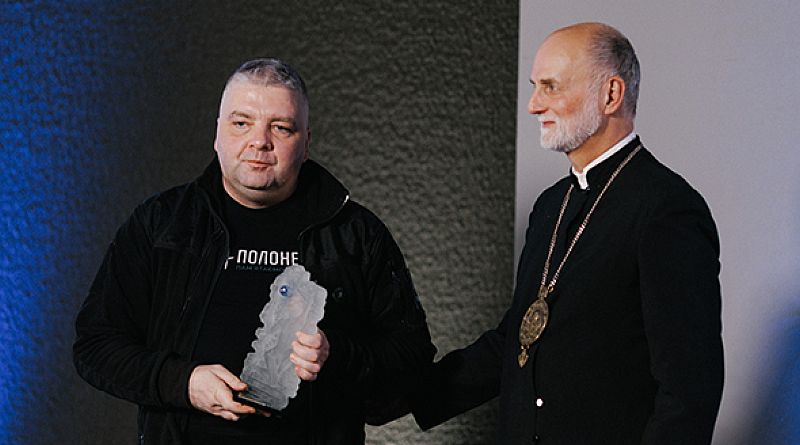
Maksym Butkevych became this year’s laureate of the “Light of Justice” award for moral and ethical leadership, which was presented on January 22 at the Ukrainian Catholic University. With the onset of Russia’s full-scale invasion of Ukraine, Maksym joined the defense of our state by joining the ranks of the Armed Forces of Ukraine. In June 2022, he was taken captive by Russia as an officer of the Armed Forces, where he spent 2 years and 4 months. He was released on October 18, 2024. Maksym is now actively engaged in international advocacy, amplifying Ukraine’s voice globally.
We present the full text of Maksym Butkevych’s speech during the award ceremony at UCU.
While I was in captivity, one of the sources that kept me sane, sustained hope, and gave me strength was thinking about other people. About those who were with me in captivity in the same cell, in the same barrack. From the very first days of captivity, I was supported by memories of people I met along the way: my colleagues, loved ones, friends, human rights defenders, volunteers, people involved in various activities whose encounters were very important to me. As I went through these encounters in my mind like a string of beads, trying to remember each one, I realized that I could not remember them all; there were so many. Then I understood how truly lucky I am to have met so many wonderful people.
Over the year since my release (from Russian captivity, – ed.), I have traveled extensively. I’ve met, probably, thousands of people with whom I’ve spoken: some for longer, some shorter, both in groups and individually. Among them were many who do indescribable things. It so happened that in September last year, I found myself on the short list for the Václav Havel Human Rights Prize of the Parliamentary Assembly of the Council of Europe. With me on this list were two journalists: Mzia Amaglobeli from Georgia and Ulvi Hasanli from Azerbaijan. Both are imprisoned in Azerbaijan and Georgia for upholding the principles of freedom of speech, thought expression, and journalistic standards.
During these international trips, I met many non-Ukrainian people who are doing important things for Ukraine. And I can say this even more about my fellow citizens – Ukrainians. At some point, a song by a French rock band came to mind, called “Aux sombres héros de l’amer.” The title plays with words, as it sounds like “To the Sad Heroes of the Sea.” It seems like a sailor’s song. In reality, l’amer means bitterness. It’s about people who crossed oceans of emptiness, being heroes of bitterness.
This song came to mind when I thought about the people I met. They all, in one way or another, are working to correct injustices, help others, document Russian war crimes, host displaced individuals, and assist those liberated from captivity or still imprisoned. They deal with extremely painful, terrifying, sometimes nearly unbearable bitter experiences. They do this not because it’s their job; it’s their calling. Most of them remain invisible to the world. Does this mean their work is futile? Of course not! Does this mean it is limited only to those they directly help? Also no!
I will refer to a text from the Book of Genesis about a city (Sodom, – ed.) that was destroyed because ten righteous people couldn’t be found there. We have many more righteous people. And we exist thanks to them. We stand because there are people who help others, who embody the ideal of love, as love is the ultimate affirmation of another person’s existence. Striving to provide everything possible, all resources, for someone to correct blatant injustices, continue their life, or even, in some cases, start anew – this is the embodiment of love. It is precisely through this embodiment of love that we continue to exist, live as a community, and resist the nonexistence, deception, and emptiness brought by Russian aggression.
Therefore, I would like to mention all those who defend us on the front lines and give us the opportunity to hold this ceremony; those who help and volunteer at the rear, those who help other living beings – both people and animals. These are our righteous ones, thanks to whom we exist. They are the lamps that are not hidden but placed where they illuminate the house. Thanks to them, we are a city on a hill. (Luke 8:16. “No one lights a lamp and hides it in a jar or puts it under a bed. Instead, they put it on a stand, so that those who come in can see the light,” – ed.).
For many abroad, not just for ourselves, we Ukrainians are an example. Four years after the start of the full-scale war, we remain an example of resilience, dedication to our ideals and values, which we share with many other nations on this planet. But the greatest and most important value for us is love. And it is this value that those who made possible all the things we receive today embody.
I want us to remember them, and whenever possible, each one should take their place among these righteous ones. This is the best thing that can happen to a person, to our community, and our country. It is thanks to such people that Ukraine is what it is.
With immense gratitude, I accept this award, but I think foremost of all those thousands, tens, hundreds of thousands of people who are the righteous ones, who have all earned such an award and make us who we are in the community.
Glory to Ukraine!
For reference:
Maksym Butkevych is a human rights defender, journalist, co-founder, and board member of the Human Rights Center ZMINA. He has consistently worked to protect human rights, engage in international advocacy, speak on global platforms, and testify about what our country is experiencing today. With the onset of Russia’s full-scale invasion of Ukraine, Maksym joined the defense of our state by joining the Armed Forces of Ukraine. In June 2022, he was taken captive by Russia as an officer of the Armed Forces, where he spent 2 years and 4 months. He was released on October 18, 2024. Maksym now actively engages in international advocacy, amplifying Ukraine’s voice globally.
The laureate began his path in journalism. Later, as a human rights defender, he worked on protecting the rights of refugees, internally displaced people, and stateless individuals, and researched manifestations of hate speech. According to the Award’s Chapter, such service is a living embodiment of the values laid out by its founder, Ms. Anastasia Shkilnyk. Maksym Butkevych’s activities once again testify that moral leadership can change reality even in the most challenging times.
The “Light of Justice” award was established in 2010 by Canadian of Ukrainian descent Anastasia Shkilnyk (who passed away in 2014) and Bishop Borys Gudziak, Metropolitan of the Ukrainian Greek Catholic Church, head of the Philadelphia Archdiocese of the UGCC in the USA, president of UCU. The award is founded in honor of Anastasia’s father, Dr. Mykhailo Shkilnyk – a lawyer, public and political figure during Ukraine’s liberation movement of 1917–1920. The endowed fund was created and administered by the Ukrainian Catholic Education Foundation in Canada.
The decision regarding the laureate is made by the Chapter, which includes: Metropolitan Borys Gudziak; Myroslav Marynovych, human rights defender, advisor to the rector of UCU; Volodymyr Turchynovskyi, Dean of the Faculty of Social Sciences of UCU; Oleksandr Kuzma, Development Director of the Ukrainian Catholic University Foundation in the USA; Vasyl Miroshnychenko, family representative of the Shkilnyk family in Ukraine, Ambassador Extraordinary and Plenipotentiary of Ukraine to Australia and New Zealand; Renata Roman, head of the Sports Committee of the World Congress of Ukraine (UWC), director of the Ukrainian National Association of Canada (UNO); Mykhailo Botsiurkiw, Canadian journalist of Ukrainian descent, writer; Iryna Starovoyt, poet, essayist, culture researcher, associate professor of the Department of Cultural Studies at the Ukrainian Catholic University.
Since the establishment of the award in 2010, the Chapter has recognized 15 individuals, including: Soviet regime political prisoner, publicist Yevhen Sverstiuk; leader of the Crimean Tatar national movement Mustafa Dzhemilev; civil activist Larysa Zalivna; former Ukrainian military captain of the Armed Forces, Nadiya Savchenko; journalist and corruption investigator Natalia Sedletska; editor-in-chief of “Dukh i Litera” publishing house Leonid Finberg; head of the NGO “Forest Initiatives and Society” Dmytro Karabchuk; eco-activist Yulia Melnyk-Pashkovska. During the global pandemic of COVID-19, the award was presented to two doctors: head of the infectious department of the central city hospital in Rubizhne Olga Martynenko and family therapist physician Ivan Venzhynovych from Pochayiv (posthumously). The laureate in 2021 was Hennadiy Mokhnenko, public figure, pastor of the “Church of Good Changes,” father of 38 children. In 2022, the laureates were head of the “Come Back Alive” Foundation Taras Chmut and public figure Maria Berlinska, founder of the “Center for Support of Aeroreconnaissance.” The 2023 laureates were Alina Mykhailova, officer of the Armed Forces, volunteer, founder and head of the “Ulf” medical service of the “Da Vinci Wolves” battalion, and Kateryna Prokopenko, public figure and volunteer, head of the NGO “Association of Families of Azovstal Defenders”.
The Institute of Leadership and Management (ILM) is a structural unit of the Ukrainian Catholic University. For over 10 years, ILM has strengthened civil society by educating and developing leaders of the non-profit sector and their teams. The Institute is the only one in Ukraine to offer a master’s program in non-profit management. Experts from the Institute develop and conduct individual training programs to enhance the capabilities of communities and organizations.
Photo and video: Ukrainian Catholic University
