
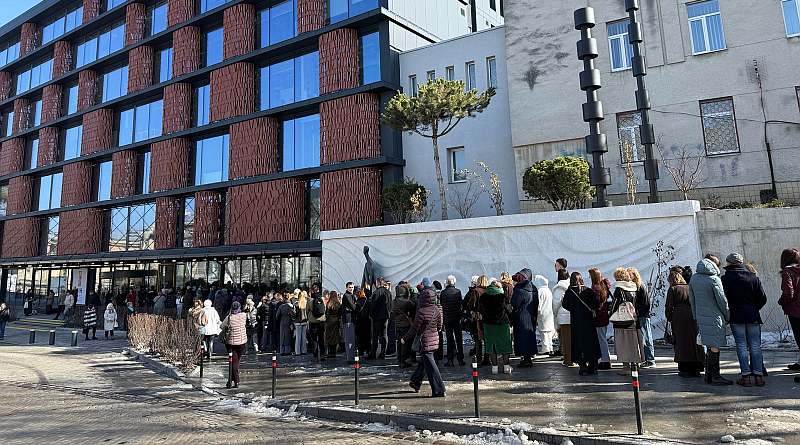
One of the most unexpected impressions of my recent difficult days of the “meeting of two wars” is the queues in Lviv for Taras Shevchenko’s paintings. Of course, this is not the first long queue for an artist’s exhibition I have observed in my life. But mostly these long queues are associated with the desire to see something you may never encounter in the rest of your life – that’s how it is with major personal exhibitions of artists, where works are collected from literally all continents, and a painting displayed in a museum in Rome may neighbor a work from a private collection in Detroit. However, here it is about the desire to see paintings that have been on the walls of the National Museum of Taras Shevchenko for decades – and in its halls, there are usually not many visitors, not to mention queues.
But I believe that among those coming to the exhibition at the ZAG gallery, there are many people who have never seen the paintings in Kyiv. And there might be people who saw these works differently in the context of a modern gallery – and discovered Shevchenko anew. In this case, we can talk about the need to “modernize” the presentation of Taras’s creative legacy both as an artist and poet, and about the underestimation of his creativity and personality. This also happens when a person is turned into an icon, their true scale begins to hide behind the canonical image.
Anyone who stood in this Lviv queue could once again be convinced of what Shevchenko sacrificed for his dream of Ukraine and the Ukrainian people, what an extraordinary gift he possessed, and the subtle psychology inherent in his portraits. Yes, he was bought out of serfdom not out of pity for the hard fate of a peasant boy, but due to admiration for the scale and prospects of his talent. But Shevchenko’s sacrifice was primarily a political sacrifice rather than an artistic one – because for the sake of Ukraine, he entered into conflict with the empire itself. The thought that Taras could have become a great artist (a great Russian artist, of course) had it not been for the military service and exile, and instead became a great, albeit Ukrainian (i.e., provincial), poet, is a typical imperial narrative, even instilled in the late Communist era.
The focus is that during his lifetime, Shevchenko was not a provincial poet for the simple reason that the empire’s ideology recognized the existence of a single Russian people with Great Russians, Little Russians, and Belarusians and their “dialects” (although St. Petersburg consistently sought to eradicate the “Little Russian” and Belarusian, but this is not the first nor the last Russian imperial “consistency”). In any case, for his contemporaries, Shevchenko was not just a “Little Russian Kobzar,” but also a writer of the Russian Empire. This approach to him – and only him – continued to spread even in Soviet times. Ukrainians, it seemed, were no longer denied the right to exist as an independent nation, but Shevchenko – until the collapse of the Soviet Union – continued to be studied in the school course in Russian literature. And yes, there was no other non-Russian writer in this course. And why?
Of course, one could say: because Shevchenko was a genius, and the Russians, as is often the case with them, wanted to claim him as well—Gogol was not enough for them. But the Russians have plenty of great writers in their pantheon, so they do not need to claim Shevchenko as well. The issue here is not about genius but about scale. Because before and especially after the collapse of the Russian Empire, there was no writer with such a clear and vivid anti-imperial agenda. There was no one capable of diagnosing Russia with such clarity, capable of reminding everyone of the oppression of “foreigners,” capable of understanding that as long as Russia remains an empire, it will remain an unspeakable evil.
You will not find such a perspective among Shevchenko’s Russian contemporaries. Even the “most progressive” would only sympathize with the unfortunate peasants or describe the cruelty of the Russian army in the Caucasus—but they would also sympathize with the empire’s goals. Russia, its army, its secret services committed unspeakable atrocities against the peoples who found themselves in the shadow of the empire—and this entire history of crimes passed by the “great Russian culture,” with journalistic evidence of them appearing only in émigré publications like Alexander Herzen’s “Kolokol.” Of the writers who spoke about the evil of the empire within the empire itself, only Shevchenko remained—and that is why the Russian Bolsheviks simply had to include his works in their literary course because they simply had no writers of their own who could create a truthful portrait of the “prison of peoples” in accordance with their then pseudo-internationalist ideology.
And this presence of Taras in a foreign school course, due to its scale and prophecy (after all, Shevchenko’s view of the Russian empire is still relevant today), helps dispel another stereotype—the myth of Shevchenko as a “peasant poet.” No, he was not a peasant poet, and this is also evident in his art exhibition. Yes, he was born into a peasant family, and a large portion of his readers were peasants (which was phenomenal for the then Russian Empire, where Nikolai Nekrasov only dreamed that peasants would read “their” writers, bringing Belinsky and Gogol from the market—while Ukrainians were already reading and copying Shevchenko without any of Nekrasov’s calls), but this is simply because in the country where Shevchenko was creating, there was basically no industrial revolution.
But Shevchenko was not a poet focused on glorifying rural life—he literally rose above it. Above history, above the everyday, above religion. This was one of the first such rises in world literature, and Ukrainians were literally fortunate that their first national classic possessed such scale of thought and so accurately saw the world and the state in which he lived. Maybe this vision would not have happened if Shevchenko looked at the world only through the eyes of a poet—but he also knew how to look through the eyes of an extraordinary painter. A painter to whose works, in the most difficult times for the Ukrainian people, queues gather because people now know what they are going for.
Header photo: LVIV.MEDIA
