
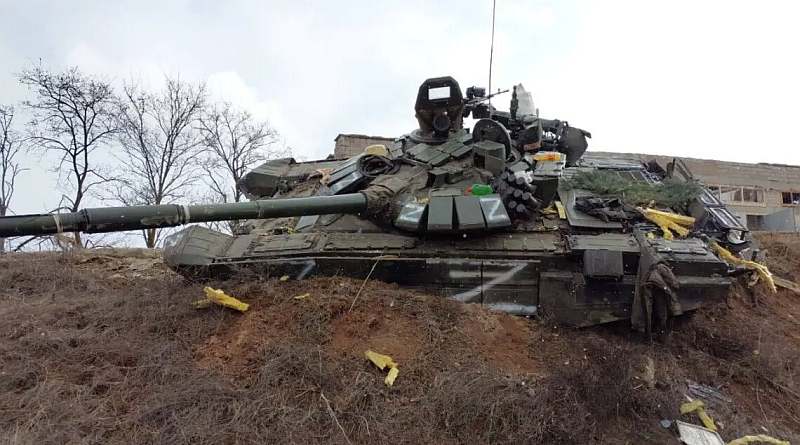
Oleksandr Kovalenko / Obozrevatel
As of February 23, 2022, Russia was considered a country with one of the largest active and stored tank fleets in the world. However, by the beginning of 2026, the aggressor country not only lost these positions, but also reached the point of no return, turning into a tank production underperformer in terms of production pace from scratch. Moreover, some tank-building and maintenance enterprises may completely disappear.
Read more about this in the joint project of OBOZ.UA and the group “Information Resistance”.
At the beginning of the full-scale invasion of Ukraine, the Russian tank-building industry was experiencing a very strange phase of its existence, which could be characterized as imitation.
The fact is, since the late 1980s and throughout the 1990s, tank-building in Russia had massively degraded. So much so that the only enterprise capable of producing new products from scratch was “Uralvagonzavod” – the manufacturer of T-72 and T-90 tanks.
Meanwhile, “Omsktransmash”, the main producer of T-80 tanks, had critically lost the ability to load production lines with new, ready products by the late 90s.
It is worth clarifying that “Uralvagonzavod” since Soviet times attempted to maintain an exclusive monopoly position in the production of main battle tanks, sabotaging its competitors and stealing progressive ideas. For example, from Oleksandr Morozov and his T-64.
In the 1990s, this budget battle in impoverished Russia only intensified. With strong lobbying in the higher echelons of power, “Uralvagonzavod” contributed to the elimination of its competitors (such as “Omsktransmash”) so that they were nothing more than repair factories, incapable of producing or participating in the production of completely new, ready products.
That is, the lobbying and monopoly ambition of “Uralvagonzavod” led to the technical and technological degradation of tank-building in Russia.
However, as strange as it may sound, literally every quarter, six months, or year, Russian propaganda claimed that for the needs of the Russian Armed Forces new batches of T-72, T-80 tanks and others were being shipped – in a variety of modifications.
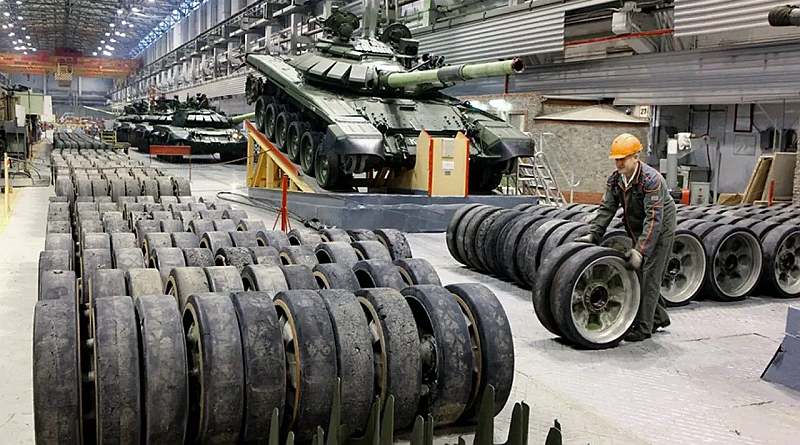
If by the time of the full-scale invasion of Ukraine, tank manufacturing in Russia had indeed degraded as much as I claimed above, then how did it happen that tank supplies continued?
Great Deception
At the beginning of the full-scale war in Ukraine, around 3,200 tanks of various modifications were listed as operational in the Russian Armed Forces. At the same time, over 7,200 main battle tanks were in storage, the vast majority of which were produced during the USSR era and inherited by Russia.
The only tank that Russian factories could produce from scratch after the 1990s (i.e., completely new production) was only the T-90. This is an extremely unsuccessful modernization of the T-72B, but it was given the “green light” personally by Boris Yeltsin, to show the whole world that modern Russia has its own new tank, which is “unmatched.”
It is possible to talk at length about how the T-90 was defective from the start and much more vulnerable (especially in the area of the turret) compared to even the already archaic predecessor T-72B. But in Russia, mistakes are not admitted but are covered with dazzling wrappers or grandiose advertising campaigns and paid tank biathlons.
But the point is that the primary share of tanks supplied to the Russian Armed Forces were precisely T-72, T-80, and sometimes even T-62, which were characterized as “new.” However, I repeat, starting from the 2000s, Russian tank production enterprises could not produce new products except for the T-90 at “Uralvagonzavod.” So where did the other new modifications come from?
In reality, it is simple. At Russian enterprises, Soviet reserves of MBTs were decommissioned, repaired, modernized, and supplied to the troops as new products.
For example, decommissioning, repairing, and modernizing the T-72 to the T-72B3 level was estimated at up to $400,000 on average until 2022, while the average price of such a type of tank is $3-4 million.
The tank was supplied as new, although in reality, it was decommissioned and modernized. Sometimes the same tank could undergo several stages of modernization: for example, a T-72B3 from 2011, then 2014, 2016, and so on. And they were always recorded as “new” in reports.
Therefore, the same tank, released in 1982, could be sent for storage, wait two decades under a layer of dust, and then be called “new” three times due to successive modernizations. And this with total budget costs of less than $1 million allowed “slicing” up to $10 million and more!
Thus, in simulating the production of new tanks, it has practically not existed in Russia for more than two decades. The only tank that was produced from scratch in the Russian Federation (i.e., completely new finished products) is the T-90 at “Uralvagonzavod” — in quantities less than a company set (11) per month, averaging 6-7 MBTs.
Russia entered the war with Ukraine in a state of lacking tank production, but with colossal stocks of Soviet-era MBTs. Stocks that, although colossal, were not infinite. And in four years, they were critically exhausted.
Losses and Consequences
During the period from the start of the full-scale invasion, Russian occupation forces, according to the General Staff of the Armed Forces of Ukraine, lost over 11,700 tanks. Meanwhile, according to verified data from monitoring groups, MBT losses in the Russian Armed Forces are from 4,300 to 4,500.
It should be noted that verified data often differs by 2-2.5 times from actual figures due to the impossibility of documenting all losses. Additionally, both in the statistics of the General Staff of Ukraine and monitoring groups, destroyed combat units, as well as damaged and captured ones, are counted. In other words, a tank damaged in 2022 could have been sent for repair and returned to the battlefield in 2023 and destroyed there. However, such cases are not many.
To understand the number of irreversible losses, let’s take the data from monitoring groups again, which is in the range of 3,200 to 3,500 destroyed MBTs, and multiply by a coefficient of 2-2.5. And we get at least 6,400 or at most 8,750 destroyed tanks.
Let me remind you that on the eve of the full-scale invasion, the Russian Armed Forces had 3,200 combat-ready tanks and over 7,200 in storage — or a total of 10,400. But these figures should also be considered with the capacity for restoration after long-term storage — often in extremely adverse conditions.
To date, most of the equipment stored in the open at Central Tank Reserve Bases (CTRB) is already in an unsuitable state for restoration. In other words, in four years of full-scale war, Russian tank enterprises have scraped everything that could be restored. Moreover, some types of tanks have disappeared completely or are on the verge of disappearing.
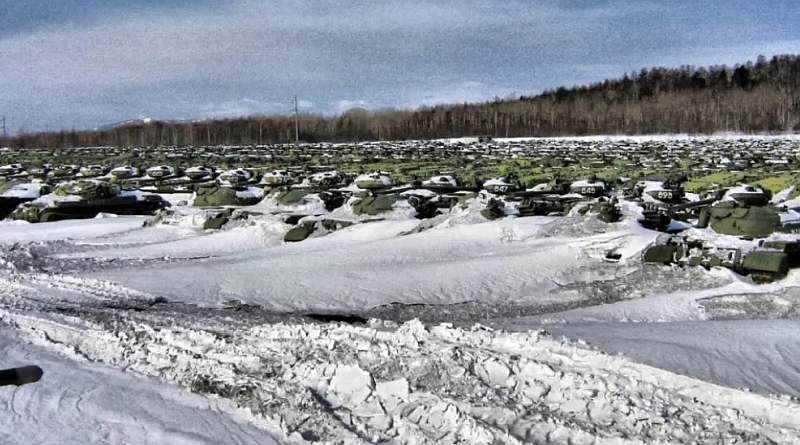
For example, on storage bases, T-90A and T-90C tanks have practically disappeared. T-80U are absent, and the main combat vehicle that allowed “Omsktransmash” to exist – T-80BV – remains in warehouses in a quantity of less than 100 units. Moreover, these are units not in the best repairable condition.
I am confident that 2026 will be the year of the final demise of “Omsktransmash”.
The situation is no better at the Russian monopoly “Uralvagonzavod”, which has been stifling its competitors for years. Its production line can with great difficulty produce up to a company set of T-90M “Proryv” per month (as of the end of 2025). Meanwhile, restoration and modernization have faced the depletion of T-72B tank stocks and are transitioning to significantly older T-72A.
Currently, the main Russian enterprises involved in the conditional production and restoration of tanks are:
“Uralvagonzavod” – restoration and modernization of T-72. Restoration and modernization, as well as a small quantity production of T-90;
“Omsktransmash” – restoration and modernization of T-80 (not production!);
103rd Armored Repair Plant – restoration and modernization of T-62 (not production!);
61st BTRZ – restoration and modernization of T-72, T-80 (not production!);
163rd BTRZ – restoration and modernization of T-72 (not production!).
In the near future, some of them will stop due to the inability to fulfill orders because there is no material for work. One of the first to fully experience the crisis will be “Omsktransmash”. Then, during 2026-2027, the potential of other enterprises will be completely exhausted.
The war in Ukraine has killed Russian tank manufacturing, which was already successfully crippled by Russian self-serving monopolies and which will never be revived or return to the level of February 23, 2022. A combination of factors accumulated after the collapse of the USSR has led not only to the degradation but also the inevitable demise of this industry in Russia.
Cover image: General Staff of the Armed Forces of Ukraine
