
The coalition lost zero aircraft to enemy fire, while the Iranian air defense now consists of fragmented pieces of metal, suppressed by jamming and completely devoid of centralized command.
The Americans sacrificed only three or four UAVs to enemy fire, doing all the dirty work of uncovering positions, and now a third aircraft carrier is entering the theater of operations. This time, I think, to completely secure the airspace over the allies.
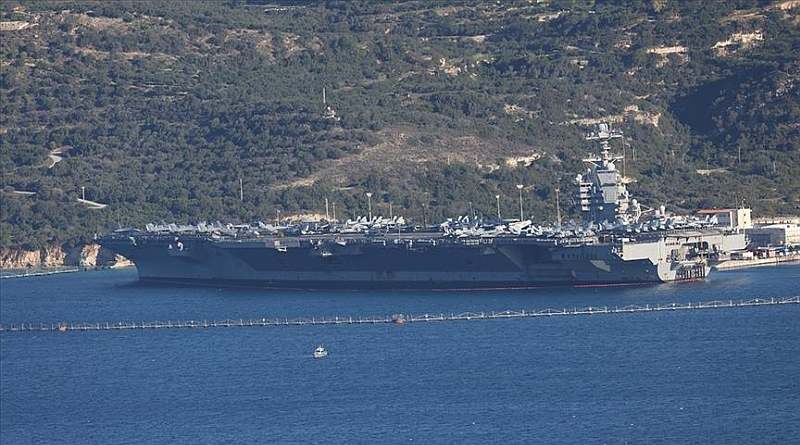
While the French Charles de Gaulle (R91) with its Rafale M air group takes position in the Eastern Mediterranean, covering Israel and the Akrotiri airbase in Cyprus, the American giant USS Gerald R. Ford (CVN-78) is already passing through the Suez Canal, entering the depths of the Red Sea.
This gives an additional 120+ aircraft to the air wing, placed in a way that they can’t be reached by the Yemeni Houthis, but fully cover allies and bases in the Gulf countries from “mopeds,” while methodically targeting the entire Iranian coastline.
The drop in Tehran’s missile launch activity to a pitiful 10–15 per day clearly indicates heavy losses of launchers. This is obviously not the “hell” the ayatollahs were counting on. Even during the “Twelve-Day War,” they weren’t hit this hard, and now, with the coalition having targeted twice as many objectives, the regime has been harshly pressed to the ground.
Yes, the coalition bases occasionally get hit, but this is inevitable at such a scale—Russian air defense also cannot stop our drones that make their way to the nuclear triad, chemical plants, and GRAU arsenals.
But we don’t see prolonged detonations, major fires, or hundreds of bodies with American flags. A few dozen drones passing over a vast theater where more than a thousand coalition aircraft operate is nothing more than mosquito bites.
Strategic bombers B-1B Lancer have already arrived at Fairford Air Base in the UK, and B-52H Stratofortress will soon follow.
The operation will scale up, but we notice an interesting reconnaissance sign: zero bombed refineries, zero destroyed ports, power stations, or bridges. Even dual-use factories remain untouched.
Targeting of the “Shahids” assembly (HESA plant in Isfahan) hit exactly five key workshops, but the “food” base of the regime is not being attacked. The coalition does not want to plunge the region into chaos and throw it back 500 years, to times when prophets emerge from wells.
They strike carefully, focusing on “Basij” bases, “Quds” headquarters, and police forces. This is a direct bet on popular uprising—they are preserving this branch.
Could the regime become stubborn and start building analogs of the “Ho Chi Minh Trail,” rebuilding factories underground? Possibly. Could they mine the Strait of Hormuz from boats or hide aid from China and Korea in tunnels?
But the Americans have already ordered such an amount of bunker-busting “gifts” that they will not run out before Iranian concrete.
I don’t see a way out for Iran to stop the bombings and save face. “Surrendering” the IRGC leadership, nuclear program developers, and holding elections?
But that would require the regime’s fall, and for that, hundreds of thousands of protesters must come out not with posters, but with water pipe guns and homemade mortars.
The process isn’t quick: a westernized boy doesn’t become a militant in a day, but 30,000 corpses of friends and relatives shot by the regime greatly contribute to this.
The IRGC and Basij are hated and feared, which is why they are being targeted, breaking horizontal connections to initiate collapse in the provinces.
Armed groups in the provinces are already raising their heads: Baluchis from “Jaish al-Adl,” Kurds from PJAK, and Arabs from ASMLA. If communication with the capital breaks, all of this will head to Tehran like in Syria.
Bombings will intensify; we will see both “carpet” bombing and the work of strategists.
Everything is going according to the coalition’s plan. They don’t have the fleet for quickly mining the strait, the aviation is afraid to fly—today Iranians managed to destroy their own MiG-29 with their loitering munition.
Their air defense rarely turns on radar, fearing anti-radar missiles, and the jamming is relentless. They are hit and not allowed to regroup.
Launches against Sunnis in the Gulf, Turkey, and “traitor” Shiites from Azerbaijan who teamed up with Mossad and send oil there in exchange for weapons. This is not only about oil prices, but also about imagined friends, as always in the region.
Iran hopes for the depletion of high-precision arsenals and that the Saudis and friends won’t raise another 700 machines. But the noose of aircraft carriers around Tehran’s neck tightens ever more tightly.
On the cover: The largest US aircraft carrier USS Gerald R. Ford entered the Red Sea. Photo from open sources
