
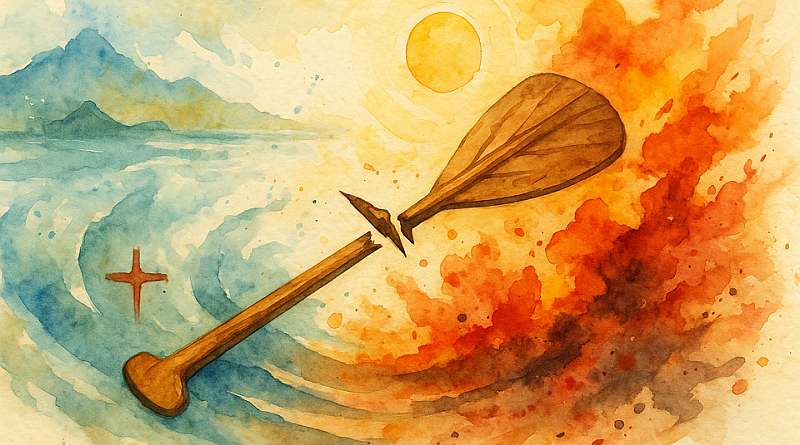
The morning sun rose over the island of Hawaii, its first rays reflecting in the waves, and the ocean, which had stormed just the day before, had completely calmed down today and, it seemed, was also rejoicing in the sun—like people, animals, and birds. It was the beginning of dawn—one of those idyllic dawns that had made Hawaii a symbol of tranquility and a tourist magnet for Americans.
However, the event I mentioned took place in the late 18th century—there were no tourists, and the dawn was not idyllic, to put it mildly. Hawaiian chief Kamehameha, the future first monarch of the united islands, lands in the village of Puna to quell the rebellion of his own relatives. The residents of the fishing village flee in terror from the chief’s warriors. One of them, who covers the escape of a neighbor with a child in his arms, sees the chief with a paddle in hand, dressed in a feather cloak and helmet—and this burly man is heading straight for them, but suddenly his foot gets stuck in a crack in the rock, Kamehameha loses the paddle and falls right next to the fisherman, frozen with fear. The fisherman grabs the paddle and strikes the chief on the head with all his might. The paddle breaks over the unconscious Kamehameha’s head. The fishermen flee.
Twelve years later, the people of King of Hawaii Kamehameha I find the fisherman. He prepares to die for attempting to kill the monarch, but unexpectedly the king asks for his forgiveness and says that he was only defending his life and property.
Thus is born the famous “Law of the Splintered Paddle,” which remains part of the legislation of the American state of Hawaii to this day. This law clearly states that civilians should not be persecuted during armed conflicts. “Let the old men, women, and children lie safely on the road without fear of being harmed,” the king decreed.
A civilized person is distinguished from a savage by respect for human life and understanding its value. In 1797, the King of Hawaii rose above the customs prevailing not only on his islands at that time and realized that it is the duty of the authorities to protect those who cannot save themselves from an armed person.
In our time, the Kremlin savage has broken the norms of law and humanity and the law of the splintered paddle itself by trying to take it out on women, children, and the elderly for the inability of his army to occupy Ukraine. Kamehameha’s warriors only had spears and paddles, but the king did not want them to harm a child. The Russian military has missiles, planes, and drones, and with such weapons, a significantly larger number of people can be harmed. The law of the splintered paddle does not apply in the Russian-Ukrainian war. It could be said that this law was ignored in previous wars fought by presumably civilized countries, but every time it meant another fall into the abyss and the collapse of civilization. It could have seemed that after World War II, with its destroyed cities and millions killed, conclusions had been drawn, but it turned out that Russian society was incapable of any conclusions but capable of producing monsters such as Putin and other Russian leaders.
When we talk about the Russian-Ukrainian war, we primarily emphasize the violation of international law, the world order that emerged after the world wars, and the refusal to resolve political conflicts through diplomacy. But, in reality, this is a much deeper change: Russia, Putin, is, as we see, encroaching on the very foundations of our civilization; they are returning the world to savagery, which always ends when a person realizes what suffering is and how important it is not to be its cause. Paradoxically, these people sincerely call themselves Christians and bow before sooty icons.
The law of the splintered paddle demonstrated that a leader can be ahead of his time, but there were reasons for this as well: Kamehameha knew that the Hawaiians were outraged by reprisals against the civilian population, and disrespect for ordinary people could cost his dynasty power.
Putin’s war reminded us that at any moment one can return to a distant and tragic past, but the Russian president knows that his society mostly won’t even notice the horrors he and his army are committing in Ukraine. It is accustomed to reprisals. And so, the law of the splintered paddle is not needed by him.
