

Information on current losses of the Russian Federation due to sanctions as of 13.02.2026.
1. Volgograd’s Lukoil refinery stopped processing after yesterday’s Ukrainian drone attack.
– The Volgograd oil refinery of Lukoil company suspended oil processing after a fire caused by the drone attack.
– The key primary oil processing unit CDU-1, which provides about 40% of the plant’s capacity, was damaged. The shutdown of such a unit can significantly impact the plant’s production volumes.
– In January, amid discussions of possible peace negotiations, the intensity of strikes on Russian energy infrastructure decreased, but in recent days the attacks have intensified again.
– Another disabling of a large refinery increases pressure on Russia’s fuel sector, which is already facing export problems and budget losses.
2. Russian business recorded record losses — 7.5 trillion rubles.
– Amid sanctions and a worsening economic situation, Russian companies are massively moving into loss-making. From January to November 2025, 18,200 organizations declared total losses of 7.5 trillion rubles — the highest figure for the entire observation period.
– For comparison – in 2024 losses amounted to 7 trillion rubles; in 2023 — 4 trillion rubles.
– The share of loss-making companies in 2025 increased to 28.8% — the highest since the pandemic in 2020.
– The largest losses are recorded in manufacturing (including oil refining and metallurgy), wholesale trade, and mining (especially coal, oil, and gas).
– Developers, transport engineering enterprises, and the light industry are also experiencing difficulties.
– The situation is linked to slowing GDP growth: if in 2024 the Russian economy grew by 4.3%, then in 2025 it was only 1%. Additional pressure is created by sanctions, the strengthening of the ruble (which hits exporters), and high inflation, which reduces domestic demand.
– Record losses indicate systemic problems in the Russian economy, accumulating against the backdrop of prolonged sanctions and structural imbalances.
3. In the State Duma of the Russian Federation, a “terrible production decline” is predicted for 2026.
– In Russia in 2026, there may be a sharp decline in production, a reduction in investments, and a withdrawal of funds from banks. This was stated by the deputy head of the State Duma of the Russian Federation’s committee on economic policy. According to him, the high interest rate policy “ruined the economy.”
– In the fall, depositors may begin to withdraw money from deposits en masse. He also noted that about 2 trillion rubles have already been withdrawn from banks since December, primarily by small businesses under the pressure of high taxes.
– The deputy also accused the authorities of concealing the real level of inflation and claimed a “shortage of 5 trillion rubles” in the budget.
– Even representatives of the ruling system publicly acknowledge the growing financial risks and deepening problems in the Russian economy.
4. Tens of thousands of Western cars reach Russia through China bypassing sanctions.
– Despite sanctions from the EU, USA, Japan, and South Korea, the Russian market continues to receive tens of thousands of cars from Western and Japanese brands through “grey” import schemes.
– In 2025, almost 130,000 cars of brands from countries that have imposed sanctions on Moscow were registered in Russia. Almost half of them were manufactured in China. Since the beginning of the full-scale war in 2022, over 700,000 such cars have been sold in Russia.
– The main supply channel has become China. Intermediaries allow Russian dealers to order cars bypassing official restrictions.
– A common scheme involves new cars being formally registered in China as sold, then re-registered as used and exported to Russia. Such “requalification” allows avoiding the automaker’s direct permission to supply to Russia.
– Automotive companies claim they do not officially supply cars to Russia and are trying to block unauthorized exports. For instance, BMW reported strengthening control over its operations in China, and Toyota emphasized that it has not exported new cars to Russia since 2022.
– Despite formal restrictions, the Russian market continues to receive Western brands through intermediary schemes, demonstrating the complexity of completely blocking trade channels under sanctions.
5. Sanctions, ship arrests, and low prices pressure the Russian oil industry.
– Dozens of tankers with Russian oil are drifting without buyers. The West is increasing pressure—from sanctions against specific ships to their arrests in open waters. Buyers demand record discounts.
– The Urals oil grade trades at about $45 per barrel—$27 cheaper than Brent (Argus Media). To balance Russia’s budget in 2026, around $59 per barrel is required.
– In January, Russia’s oil and gas revenues were the lowest since July 2020.
– As of February 10, about 143 million barrels of Russian oil were “afloat” waiting for buyers (Vortexa)—nearly half of the monthly production. If the volume of unsold oil does not decrease, Russia may have to cut production due to storage shortages.
– Nearly 80% of Russian oil in 2025 was transported by a “shadow” fleet. However, a series of ship seizures by the US and Europe increases risks and costs for such operations.
– The IMF lowered Russia’s economic growth forecast to 0.6% in 2025 and 0.8% in 2026—the weakest performance since the pandemic in 2014.
– Traders are finding it increasingly difficult to find buyers amid a global supply surplus. To compete with Iranian oil, Russian suppliers are forced to increase discounts.
6. The Kremlin is ready to abandon “de-dollarization” for a deal with Trump.
– The Kremlin, which for years claimed the “decline of the dollar” and promoted de-dollarization, is now considering a return to transactions in US currency.
– An internal memorandum for Russian officials mentions readiness to resume dollar operations as part of a potential deal with Donald Trump’s administration.
– The document outlines seven areas of cooperation following the potential end of the war against Ukraine.
– Among them are returning to the dollar system, joint investments in oil and gas, contracts for American airplanes, and allowing US companies access to Russian resources and consumer market. Moscow offers economic concessions in exchange for lifting sanctions, including restrictions on dollar transactions for energy resources.
– This would mean a sharp policy reversal for the Kremlin, which previously called de-dollarization “irreversible” and built financial schemes bypassing the western system.
– Western officials familiar with the document’s contents doubt that Putin could implement such a step without conflict with China, with whom Russia has deepened cooperation as an alternative to the West.
– After years of loud claims about the “collapse of the dollar” and a shift towards Asia, the Kremlin effectively acknowledges dependence on the western financial system and seeks ways to return to it.
7. A Saudi company wants to buy Lukoil’s foreign assets.
– Saudi Midad Energy has signed a letter of intent to acquire all foreign assets of the Russian oil company “Lukoil”.
– The agreement was reached at the end of January amid “intense competition.” Midad agreed to pay for the assets in cash and deposit funds into a special escrow account pending approval from the U.S. Treasury Department and the Office of Foreign Assets Control (OFAC). Sanctions against “Lukoil” and six of its subsidiaries were imposed on October 22, 2025. Following this, the company announced its intention to sell international assets.
– There were earlier reports of a possible deal with Carlyle, but the document was signed with Midad. However, there is no guarantee of Washington approving the deal.
– In case of refusal by the U.S., the sale may fall through, highlighting the dependence of Russian energy companies on sanctions decisions and external regulators.
8. “Shadow fleet” tankers are increasingly being scrapped.
– More and more tankers involved in transporting sanctioned oil are heading for dismantling. In less than a month, three ships under U.S. sanctions arrived at India’s western coast for disassembly — an unusually active start of the year for the ship breaking industry.
– The supertanker Woodchip (built in 1993), which was added to the U.S. sanctions list back in 2021 under a different name, reached the coast of Gujarat state late last week. It is the oldest sanctioned supertanker to arrive at the Indian ship recycling center in Alang. Tankers Global Star and Bodhi also arrived for dismantling.
– This indicates the gradual “aging” and reduction of the so-called shadow fleet, which transports sanctioned or restriction-sensitive oil. Due to excess supply and increased operational risks, obsolete vessels are beginning to be withdrawn from the market.
– According to Braemar, 963 shadow fleet tankers that carried sensitive cargo over the past year have an average age of 21 years — significantly older than the typical service life before dismantling. Previously, owners of Indian scrap enterprises were hesitant to purchase sanctioned vessels due to the risk of secondary U.S. sanctions.
– Now, it seems part of the “shadow fleet” is beginning to complete its operational cycle, which may complicate the logistics of transporting sanctioned oil.
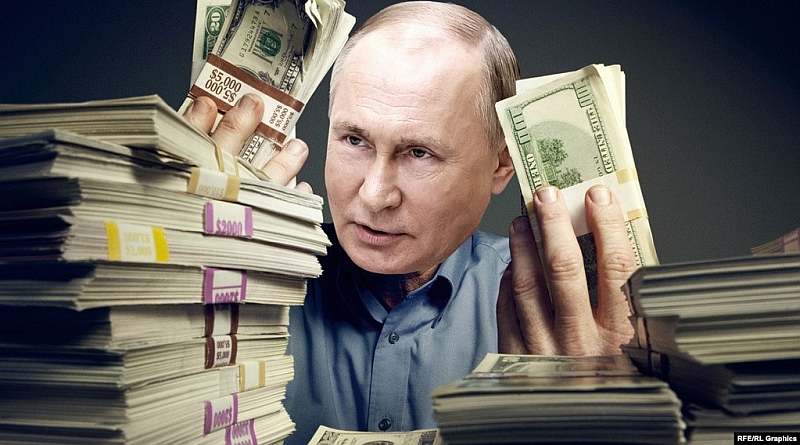
Collage: Radio Liberty
Copyright © 2021 RFE/RL, Inc. Reprinted with permission from Radio Free Europe / Radio Liberty
