
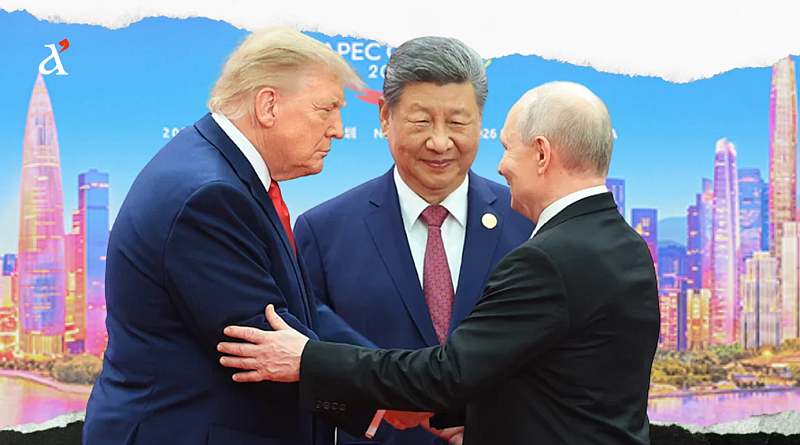
While Donald Trump, Xi Jinping, and Vladimir Putin posed for historic photos in China, Russia launched one of the most intense daytime attacks on Kyiv in recent weeks. The summit, which some called “Yalta 2.0,” did not bring breakthroughs regarding the war in Ukraine but left many questions: about the future of sanctions against Russia, Europe’s role in negotiations, and what the Kremlin truly gained from this meeting.
As negotiations continued in China and Vladimir Putin spoke of readiness for peace, Kyiv was under attack by Russian drones.
BBC correspondent Sarah Rainsford points out: after the talks ended, the attacks intensified. Explosions were heard in the capital, air defenses were active, and fires broke out in Podil in the city center.
Currently, there is news of one fatality and four injured in Kyiv.
“These are the most intense daytime attacks in a long time, and their timing is unlikely to be a coincidence,” writes Rainsford.
In China, Putin sounded increasingly uncompromising about peace negotiations, claiming that it is Ukraine that continues the war by striking civilian infrastructure, including the bridge across the Kerch Strait.
At the same time, he did not mention nearly five years of continuous Russian attacks on power stations, bridges, and residential buildings in Ukraine.
Will Europe be at the negotiating table?
One of the main questions after Vladimir Putin’s visit to China remains the relations between Russia and Europe, as well as the EU’s role in possible peace negotiations.
Last week, Jared Kushner, after meeting with Putin in Moscow, stated that Russia agreed to engage Europe in the next round of negotiations on ending the war in Ukraine.
However, Putin’s words today indicate otherwise, writes BBC journalist Elizaveta Fokht.
According to Putin, the Kremlin only invited representatives of European countries to Moscow to hear their position and decide whom Russia would like to see at the negotiation table.
“One involuntarily wonders where this discrepancy comes from. Was Kushner’s statement an attempt to pressure Moscow, or did it reflect a real misunderstanding of the Russian leader’s position? – Fokht ponders. – And if the reason is indeed the latter, how much can we count on the success of these negotiations on much more complex issues related to Ukraine’s security and future?”
At least part of these questions will likely be discussed on November 19 in Berlin during important diplomatic talks. There, Ukrainian President Volodymyr Zelensky is set to meet with European leaders and special representatives of the US President Jared Kushner and Steve Witkoff.
“A Gift to Vladimir Putin”
British Conservative MP Jeremy Hunt, who has held various ministerial positions in previous conservative governments, called today’s meeting “a summit that should never have happened.”
He stated on the World at One program on Radio 4:
“It’s a gift to Vladimir Putin, who is responsible for the largest war on the European continent since World War II.”
According to Hunt, this meeting “gives him legitimacy, which will strengthen his position and likely lead to the war lasting longer.”
Even more troubling, in his opinion, is that it confirms: “America is no longer the leader of the free world.”
“In our lifetime, no other U.S. president has done anything like this,” Hunt said, adding that Donald Trump is ready to set aside all other duties to get a loud headline in the press.
Calling the U.S. president a master of making deals, Hunt noted that Trump is “desperately” seeking to lower gas prices in the U.S. According to him, this is one of the key issues after his party’s crushing defeat in the midterm elections.
However, what exactly Trump is ready to offer in return is “less clear,” says Hunt. In his opinion, the American president is likely “hinting at some easing of sanctions against Russia” as a major energy producer.
Such easing, according to Hunt, would give Russia “more money to finance the war in Ukraine.”
These concerns partially coincide with assessments heard in Russia itself.
Kirill Babaev, director of the Institute of China and Contemporary Asia at the Russian Academy of Sciences, which is state-funded and advises Moscow on relations with China, stated that a “stable connection” between Donald Trump, Xi Jinping, and Vladimir Putin is important for communication and conflict resolution.
In an interview on the World Business Express program, he also said that improving relations between the U.S. and Russia could significantly impact the future of sanctions.
“If trust between them is restored, sanctions could be lifted, and the two countries could return to full-scale cooperation in the energy sector, agriculture, industrial production, and technology,” Babaev stated.
What does the joint statement by Putin, Xi, and Trump mean?
The White House released a statement following the summit, listing four key agreements:
- China, the U.S., and Russia committed to reforming the UN to make it more effective in responding to global challenges.
- All three countries plan to increase production and supply of petroleum products.
- They agreed that the International Criminal Court and similar structures “should not abuse their powers.”
- The U.S., China, and Russia will hold a dialogue on reducing nuclear risks and preventing the proliferation of nuclear weapons.
Many observers expected Trump to announce the extension of the trade truce between the U.S. and China, which is set to expire in January. However, no statement on this matter has yet been made.
The joint communiqué released by the three states, notes the BBC North America correspondent Anthony Zurcher, mostly contains rather vague support for efforts to ensure “strategic stability and international security.”
This, along with the very image of the three influential world leaders sitting at one table in a friendly atmosphere discussing global issues, may instill some optimism that no catastrophic conflicts are expected in the near future.
However, the promises to continue the “dialogue” and reminders that nuclear war “should never be started” contain little specificity and almost do not go beyond diplomatic rhetoric.
The point about increasing the “production and supply of petroleum products” seems primarily addressed to Putin, considering Russia’s role as one of the key suppliers of fossil fuels to the global market.
It was also hard to miss the criticism towards the International Criminal Court, which recently has increasingly become a target of dissatisfaction from the United States.
If there is anything the leaders of the three leading world powers agree on, it’s the belief that multilateral international organizations attempting to enforce international law should not have real levers to forcibly execute their decisions, suggests Anthony Zurcher.
Were there any results at all?
As noted by Zurcher, Trump went to the trilateral meeting in China with few agenda items and without clearly formulated demands.
“It seems he returned with insignificant results,” Zurcher writes.
After his departure from China, we are still awaiting his assessment of how the meeting with Putin and Xi went.
Ultimately, the visual image of the meeting, or, as political observers like to say, its “optics,” may become the only lasting impression of the summit, which some called a historical “Yalta 2.0” for the major powers.
In the end, the pomp and ceremony may have been what Trump sought most, writes Anthony Zurcher.
In an interview with Fox News on Wednesday, the American president mentioned his honorary seat at the table during the APEC dinner on Tuesday, as well as the ceremonial reception upon arrival in China.
“All these honors, beauty, celebrations, thousands of people,” he said, calling it evidence that the trip was already successful.
This might seem like a rather low bar for evaluating success, but it appears that such a result might fully satisfy the American side.
Doubts about the success of the summit are voiced not only by observers and European allies of the United States but also within the American political establishment.
While Trump’s favorable attitude towards Putin and Xi is not new, during the meetings in Shenzhen, he demonstrated particular warmth towards both leaders. This likely raises concerns among many American lawmakers who already expressed apprehensions or criticism before his trip.
Republican Senator Rick Scott, a member of the Senate Armed Services Committee, stated on Wednesday:
“Do I trust Xi or Putin? No, they are both liars.”
At the same time, he added: “I’m glad the president is trying. Hope dies last. But do I really believe anything good will come of this? No.”
Senate Democratic Leader Chuck Schumer declared from the Congress floor on the eve:
“Xi Jinping and Vladimir Putin are playing Donald Trump like a cheap fiddle.”
The same day, nine Democrats from the Senate Foreign Relations Committee signed a letter urging not to allow a situation where “American security is traded for photo ops or personal vanity.”
Collage: Apostrophe, Xinhua
