
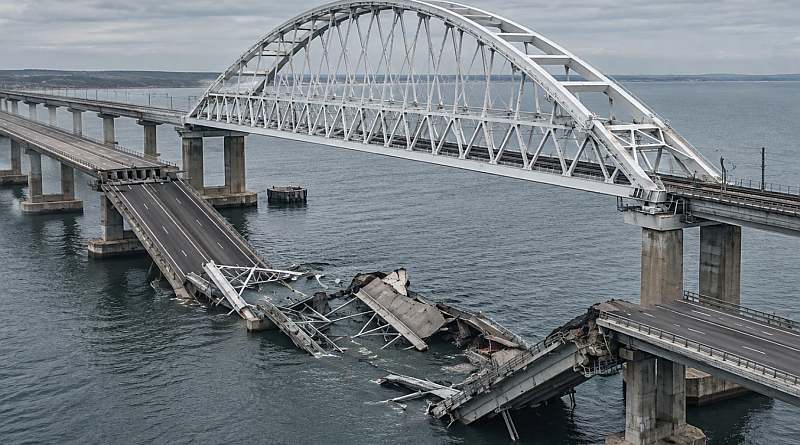
The blockade of the shipping passage under the Kerch Bridge disrupted the transport of Russian goods and oil products, dealing a significantly more serious blow to the Russian Federation than the damage to the bridge itself.
This was reported by journalist Vitaliy Portnikov on Espreso.
Commenting on Vladimir Putin’s belligerent statements after the summit and Russian attacks on Kyiv, Portnikov noted that the Kremlin’s reaction should be viewed more broadly than merely as revenge for the bridge structure damage. According to him, Russia can potentially restore road and even rail connections, but it is much more challenging to eliminate the consequences of the arch’s destruction, the debris of which fell into the sea channel.
“Putin wants revenge not for the bridge. If we had intelligently blown up the bridge but preserved navigation, I think no one in the Kremlin would have even been concerned,” explained the journalist.
He pointed out that due to the closure of the Kerch Strait, Russia lost the ability to use the usual maritime route for transporting goods. Now, some flows have to be redirected to the railway in the Novorossiysk area, which cannot simultaneously meet the needs of the front and the rear at previous volumes.
Moreover, the consequences may be felt by Russian oil refineries in Volgograd, Saratov, Samara, and Nizhny Novgorod. Previously, products from there were transported by tanker via river routes through the Volgodonsk Canal and the Kerch Strait. The disruption of this connection creates additional challenges for shipping oil products and complicates logistical links with the Caspian Sea.
“The main essence was not on the bridge, but under it. Who could have thought?” emphasized Portnikov.
In his opinion, it is the blockade of the maritime passage and its associated economic and logistical consequences that are a much more serious blow to Russia than the damage to the crossing itself.
