
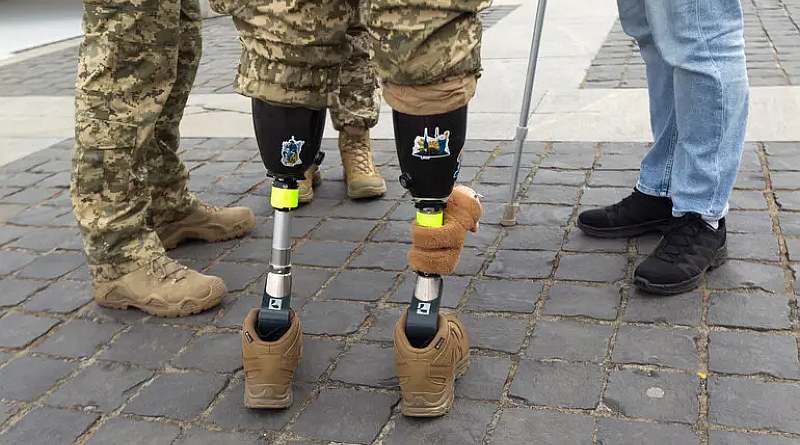
I realize I was eagerly awaiting Vitalii Kim’s interview, still the new minister for veterans’ affairs. I was waiting because I will always be upset with him for the memorable phrase: “Most of them [soldiers] have PTSD, high expectations, and a heightened sense of justice. […] This will hinder political work.” Because of this, and also due to Mr. Kim’s lack of military experience, I am sincerely biased about his appointment to the current position. And I, a veteran, am still waiting for decisive, effective steps to dispel my prejudice; and sincere conversations from which I will understand: the person has rethought their views. The interview came out. Looking into social media, I realized I had not seen such synchronized disdain from the veteran community toward anyone in a long time. “Even Syrsky has deliberate defenders among sharp critics,” I thought. “I must hurry to watch that interview.”
At first, I really didn’t understand why everyone was so upset. Well, the conversation was awkward, and the accents seemed strangely placed, but it was supposedly about working for the benefit and wellbeing of an average veteran named Vasya. But the further it went, the more I felt: for Mr. Kim, veterans are something foreign, unpleasant, and threatening. He doesn’t say it outright — of course, it would be unseemly for a minister of veterans to openly disdain his charges — but I read this with sad ease. First of all — problems, problems, problems. We, veterans, are continuous problems. Our “adaptation difficulties,” our unawareness of our own affairs, our “falling out of the economy” and “desire for eternal treatment,” our benefits and payments, our “demands on civilian society” (only psychological problems aren’t problems, they’re marketing). I didn’t see what I sorely wanted to: an acknowledgment of our experience as valuable. Not “the state must return you to where it took you from and the way it took you” — but something like: veteran, your new skills are valuable in the new Ukraine. You have changed, and the country has changed. If you want, teach civilians, share your experience, let’s move forward together through the new reality. It’s sad, but I didn’t even see a shadow of such a thought.
Mr. Kim rightly says that a veteran should be an example of socially beneficial behavior. But the criteria he uses for evaluation are somehow pre-war: “look, I [an average veteran] am educated, I am a leader.” Education is important, leadership qualities too, no one argues. But, in my opinion, it’s more appropriate in our times to mention the ability to filter information, react quickly, prepare for different scenarios; practical skills of self- and mutual assistance in case of physical or mental acute states; the ability to establish comfortable living conditions in any environment — and the rest of the skills that I and not only I learned on our military path. Truth is, I also became much more irritable and foul-mouthed. In the army, no one cared about this, but in civilian society, it is something that, metaphorically, takes social points away from me…
I also noticed that in moments of vulnerability, I often meet the expectations of people around me. And, I think, I’m not the only one; that’s why I’m a bit scared by Mr. Vitalii’s confidence that veterans will lead the criminal world after the war, and that veteran-criminal chaos will engulf the last civilian bastions. “Man,” I wanted to shout at the screen. “You’re contradicting yourself! You say stereotypes must be overcome, veterans shouldn’t be feared — yet you’ve just branded us, without any grounds! Why? I understand when my comrades binge-watch series and start thinking the same. But you, nonetheless, are a minister! Isn’t your job: to smooth over the edges and make every effort to prevent the polarization of society?” Well, I must apologize: the lack of military experience in a minister is a minor problem (although, admittedly, the moment where Mr. Vitalii compared the changes in his relationship with his wife to changes in veterans’ marriages irritated me — I wanted to shout: “What do you even know about this?”), because everything is known by comparison. The point is, the minister of veterans’ affairs openly makes veterans “others” — a foreign element in Ukrainian society. And he is so cautious about the return of veterans that one cannot escape the impression that this return is inconvenient and undesirable for the minister. And among this impression, the reasonable thoughts in the interview seem unreal, as if copied from a desk neighbor.
I have a feeling that Vitalii Kim is and will be an extremely convenient minister of veterans — caring about the protection of civilians, reducing the budget burden, suppressing problematic issues. Convenient to everyone except the veterans themselves… and veteran women. About whom, of course, not a word was said, really, not once did “veterans and VETERAN WOMEN” come up. Well, our male comrades were relentlessly othered in that interview, but us, the sisters, don’t exist at all.
Photo: Ukrinform
