
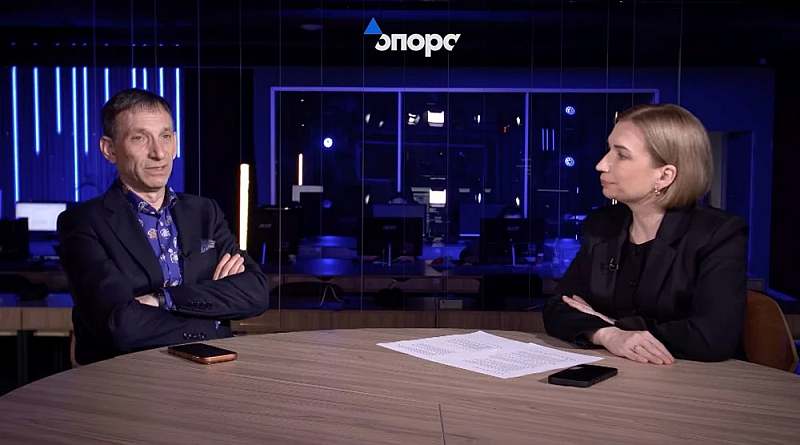
People remaining in Ukraine need to focus on adapting to the conditions of warfare and creating infrastructure for survival, as the war will last not just years, but rather decades. Ukrainians who have moved to the European Union should prepare to defend the countries they live in from Russian aggression or move even further. Those who wish to immediately live in a country without corruption should pack their bags and set off in search of a democratic haven, as cleansing Ukraine of this phenomenon might be a chance for our children, if not grandchildren. So says political commentator and publicist Vitaly Portnikov.
As much as we dream of a quick end to the war, we should be realistic: for Russia, this is a war for living space, and they have no conditions to stop. On the other hand, Vitaly Portnikov does not dramatize the unfavorable political processes for Ukraine in Europe, as he believes that European countries will support us under any government.
In a conversation with the head of the OPORA Civic Network, Olga Aivazovska, on the program “The Power of Choice”, Vitaly Portnikov explained why we are doomed to live under anesthesia during the war and suggested how society can influence the government without elections.
“Ukraine is just a large Oleshky”
Mr. Vitaly, Ukraine has become part of the domestic political agenda and elections in the USA. Is this good or bad for us, especially in the context of peaceful negotiations with Russia?
The majority of voters in practically all political camps in the United States support Ukraine and do not support Russia. You know this from your own experience: when you are in the USA and talk to Americans, most people, hearing that you are from Ukraine, express support and apologize for their president’s attitude toward Putin.
These tendencies are observed in all electoral groups. Practically all, including supporters of MAGA. But this is an issue that does not affect voting.
The majority of voters are guided by other priorities. Therefore, the idea that we are at the center of the American agenda is mistaken. At the center are fuel prices at American gas stations, worsening living standards, and problems with migrants. Attitudes toward these issues differ among different strata of citizens. The war in the Middle East is certainly in focus because it has created prerequisites for worsening life.
The American president tried to introduce the Russian-Ukrainian war into the agenda to say, “No, it’s not my fault. It’s Ukraine’s fault for shelling Russian refineries, which is why we have such high diesel prices.” But the audience did not accept this. We didn’t see any reaction from Americans to Trump’s statement. His remarks did not change attitudes toward Ukraine and Russia, nor did they change the understanding of the reasons for what is happening with diesel fuel. So, I think the war in Ukraine has no particular impact on American voters.
However, at least because of diesel and Oleshky, Ukraine ended up at the center of the American election campaign. For the internal American audience, the story with Oleshky looks like a propaganda event. Meanwhile, even Trump’s Republican channel Newsmax covered it quite adequately. Ukrainians received a key message: 17 buses went towards free Ukrainian territory and only 4 to Russia. This means the narrative that all these people are pro-Russian waiters didn’t work. So, who is this propaganda for? Does this mean that the information operation with Oleshky failed for the Russians?
It’s important to understand how many people left Oleshky after the flooding. And we don’t know where these people were going. Some were heading towards Russia, others towards free Ukrainian territory, and the rest stayed in more prosperous places in the occupied territories. The city itself is practically gone. Now, definitively.
Putin needed to give Trump a piece of truce before the midterms that did not interfere with the Russian army’s plans, and he provided this piece. Trump has no complaints against Putin. He showed that agreements are possible and even, one might say, advertised Melania Trump. That’s all that was needed. We have no doubts about Melania Trump’s role as a humanitarian ambassador.
Russian propaganda says what its users want to hear. We also hear what we want to hear, see these buses, and real facts. Americans talk about Melania Trump’s humanitarian mission and how people were rescued from Oleshky.
If Ukraine fires on Russian refineries and Russia on Ukrainian civilian infrastructure, who could be in a weaker position by next spring?
These are not interdependent processes. We may not fire on Russian refineries, but that won’t stop Russia from shelling our infrastructure.
What distinguishes this year from previous years of war is that we can also strike Russian refining infrastructure and the military-industrial complex. Previously, as you remember, Russia hit Ukrainian infrastructure, not considering that something might also hit their territory. Even if there were no attacks on Russian refineries and other infrastructure now, Russia would still destroy our infrastructure.
These processes are not interdependent, but who will feel more pain?
Russia systematically destroys our infrastructure to make Ukrainian territory uninhabitable. It will do this regardless of whether we target its infrastructure. The question is different: will we be able to strike Russia in the coming years of war—not in the spring of 2027, but in the spring of 2028, 2029, or 2031—with a blow that will make it stop striking Ukraine?
And there’s no need to explain that Russia will destroy infrastructure and push the Ukrainian population beyond the borders of the so-called “primordial Russian lands,” so that Russian troops and settlers from Russia can take their place. Look at Oleshky, located in the occupied territory. People have left from there. That marks the end of Ukrainian Oleshky’s history. If the left bank of the Kherson region remains under Russian control, Russian citizens will be resettled there. These will be different Oleshky—with Russian citizens.
This has happened in the history of Ukrainian lands for centuries. Ukraine is just a large Oleshky. Oleshky’s inhabitants moved to the free territory of Ukraine, and Ukrainians are being encouraged to move further, to Western countries, to make room for Russians. That is the whole policy. Putin’s adviser said that Russia has always saved Ukraine by resettling its population on Ukrainian territories.
“Any Polish government is doomed to support Ukraine”
We can protect our infrastructure, but how can we win, withstand, and survive without causing significant harm to the enemy?
It depends on how strong our blows will be.
For us, the main question is not victory in war. Our questions are simple: will this state remain on the political map of the world, and will this people remain on the demographic map? There is no positive answer to either of these questions today.
There are chances that Ukraine and the Ukrainian people will disappear from the political and demographic maps of the world, and the borders of Russia and the Russian demographic space will reach Uzhhorod.
To win the war means creating conditions for Ukraine and the Ukrainian people to continue to exist. There is no other victory. Everything else is deceitful.
There are two peoples who fought with the Roman Empire, trying to defend themselves and survive: the Dacians and the Jews. Where are the Dacians? In the archaeological museum. They were completely exterminated. Some assimilated and became part of the peoples living in modern Romania, but there are no Dacians as a nation. There is only archaeological evidence of their existence. The Jews, as you can see from our conversation, are here. This is our national victory over the Roman Empire. I can wish the Ukrainian people the same victory over the Russian one.
Many peoples that resisted the Russian Empire either disappeared long ago or remain in small numbers in their traditional settlement areas. As an example, I can mention the Mordvins. The Mordovian state fought with the Golden Horde many years after the Slavic princes began traveling for labels in Sarai. As a result, those who traveled for labels are now trying to destroy us, while those who fought have become, I would say, a relict autonomy within the Russian Federation, where even learning their own languages is not mandatory. This is the fate we must not suffer.
Global experience shows that parties are ready to engage in real negotiations when another day of conflict brings more harm to both. Or if one side collapses and the other wins. Is Ukraine more threatened? It is smaller territorially, in terms of armed forces, in terms of technology renewal scale.
Saying that Russia has tremendous capabilities is a huge exaggeration.
The majority of Russia’s population lives in its European part, which, in terms of territorial parameters, can be compared to Ukraine’s territory. What we see on the map of the Russian Federation and are used to perceiving as the Soviet Union is an uninhabited territory. The inhabited areas were precisely those that separated: Ukraine, Belarus, Moldova, the countries of the Caucasus, and Central Asia. The uninhabited remained.
Russia’s mobilization capabilities, considering various political and social circumstances, are limited because Russia chose the mercenary army model.
It is also necessary to consider the capabilities of the Russian economy. A mercenary army will not turn into a mobilized army in a month or a year. And, as you can see, so far in Russia, no one is even considering such possibilities.
It is more challenging for us to fight the Russian army because they have mercenaries, while we have mobilized citizens. These are incomparable things. When feudal lords went to war against a country they wanted to capture, the residents of that country came out to defend it. Feudal lords, on the other hand, had armies of mercenaries, recruited from outsiders because their own were too valuable. But Russia is a country where their own are not too valuable. Pay money, and off you go, Vanko, to die.
At the same time, Russia’s human resources are limited. As soon as the war comes home to the Russians themselves, the number of anti-war advocates who say, “We just need peace. We don’t like Ukraine; they are Nazis, but we need peace,” starts to grow. For the average Russian, war is a war on foreign territory.
How should Ukraine work with Europe to ensure it remains a reliable support in light of key political events in Poland, Germany, and France?
I believe Europe is not going anywhere. Events in Poland do not worry me, as the conflict around the Constitutional Tribunal has been ongoing for eleven years. This phase was bound to occur sooner or later, as Poland enters another election period.
Any Polish government is destined to help Ukraine. We may not like the political views of the Polish right, the conservatives, but we also need to cooperate with them. By the way, I want to remind you that the Polish governments that helped Ukraine after 2014 were right-wing. Andrzej Duda is, I would say, an intelligent version of Karol Nawrocki, but he was one of Ukraine’s biggest supporters on the international stage, which cost him attention from Donald Trump.
In Germany, “Alternative” remains a popular party, but even if we imagine the next election to the Bundestag, the possibility of it forming a one-party government there, considering its popularity in the western lands of Germany, is zero. There is still zero chance that it will be part of any government. There could be a large coalition of Christian Democrats, Social Democrats, and Greens.
Marine Le Pen might either undergo the evolution that another leader of the European far-right, Giorgia Meloni, went through or face the French street. I’m not overly afraid that Marine Le Pen will be able to drastically change the foreign policy course of the French Republic. So far, I do not see a national union with a great chance of having a parliamentary majority.
These are all undoubtedly challenges, but the interests are completely different. Again, the French, Germans, or Italians don’t have much of a choice as Russia doesn’t want to perceive them as equal partners. This governance of Putin is different from the governance of, say, Leonid Brezhnev. Brezhnev was ready to talk with Chancellor Willy Brandt, Chancellor Helmut Schmidt, and French President Valéry Giscard d’Estaing as equal partners. Hence Brandt’s “Eastern Policy,” for which he, by the way, received the Nobel Peace Prize.
Hence all these events when they actually tried to be partners with the Soviet Union, when they didn’t want to boycott the 1980 Olympics. We always say that the Soviet Union was in isolation. Isolation from whom? From the United States and West Germany? All other European states perfectly attended the Moscow Olympics. Even Great Britain.
This is the formula I’ve been trying to use since the time of the 2014 Maidan: don’t worry, don’t bother yourself, Putin will do everything for us. The most likely thing that could happen is that by 2027, the war will escalate to Europe.
The question is not what will happen to us, but what will happen to the Europeans. The question is not whether they will help us, but whether they will be able to protect themselves from Russian missiles and drones when they fly at their poor heads. This is what I expect, and by the way, this is what they talk about in the Kremlin.
I read a text by Russian political scientist Fyodor Lukyanov, who says: either negotiations on the terms of Ukraine’s capitulation or escalation. And do you think escalation could be through Ukraine? What other escalation could there be? It will be through Europe. As Putin’s aide Ushakov says, the Russians understand that without the Europeans, they cannot end this war the way they want. Therefore, the Europeans need to be intimidated and forced into submission.
“You won’t see a non-corrupt country”
Should Ukraine operate only with a short-term perspective in its defense strategy given the challenges in Europe?
If we consider that the survival calendar is short-term, it will lead to defeat. We are only in the first four and a half years of a great war. There are no objective prospects to consider that the coming years will bring the end of this war. We are in the first phase of survival. We must always count on Ukraine being able to survive in this war in the 2020s and 2030s and reduce this conflict to, so to speak, a Cypriot level in the 2040s and 2050s. I do not expect the end of the great war in the coming years and, in principle, do not expect the end of the Russian-Ukrainian conflict.
Learning to live in war, in conflict, is the task and fate of every Ukrainian who intends to be on this territory. And the task of Ukrainians who will be on the territory of Europe is to prepare to defend the countries that accepted them, or to prepare for deportation from there.
The success of the next political season — and Ukraine needs to open all clusters for European integration — depends on receiving funds that can be used to protect the state. How can Ukraine achieve this and maintain its statehood?
This depends not only on clusters but also on the unity of the European Union countries. The European integration of Ukraine currently plays no role. If we do not preserve ourselves as a state, then what difference does it make where we join?
I am not saying that the process shouldn’t take place. Therefore, I hope that the parliament will act responsibly. I hope that we will find understanding with the Hungarian government. However, all of this is just a plus, a bonus, and the essence lies elsewhere. We talk about the survival plateau every winter, every spring.
Here, I would say, it’s not necessary to look for opportunities. The opportunities are simple: either Israeli-ization — turning into a fortress, or Lebanese-ization — turning into chaos, but we can manage even in Lebanese-ization. After all, Lebanon survives.
Again, how many people will we save? The history of mankind shows that many people adapt to living in such conditions. And those who do not adapt, emigrate.
Many people were leaving Ukraine even before the war in search of a more normal, comfortable life. There was a phrase in our broadcast, which is constantly recalled to me: “suitcase — train station — Warsaw.” I can repeat a hundred thousand times: “If you want to live in a country that today is already non-corrupt, you will have to leave with a suitcase to Warsaw and beyond.” But, as you see, Warsaw now also has problems with corruption.
And if you want your country to be free of corruption, you will have to accept that your children and grandchildren will still fight against corruption and live in a vertically and horizontally corrupt country. Corruption needs to be fought, but you won’t overcome such corruption as in Ukraine in ten or twenty years. Our European integration is a guarantee that this distance will decrease, but not for you. You will not see a non-corrupt country. And this is also a reality to accept.
How do social norms change? Will the ability to resist difficult realities during the war become part of a new political civic identity that will define domestic policy and democracy in post-war Ukraine?
It depends on how the war ends and when it ends. And on which territories it ends, and how much population will be here.
During this war, the population is still in a state of certain anesthesia, so it accepts the abnormal as normal. Like people who, figuratively speaking, come from Kramatorsk to Kyiv and are surprised at how Kyivans react to trivial strikes and shelling. People who now come from Kyiv to Ivano-Frankivsk or Lviv are surprised that here during an alert for a lone drone, people go to shelters and just worry. It’s just one drone, why worry? And people who leave Lviv or Ivano-Frankivsk for Krakow and Warsaw are surprised that Poles are simply scared by reports of a drone or missile appearing near Poland’s borders. Nothing is even flying towards your territory — why are you worried?
The normal reaction is how the Poles react. Everything else is an abnormal reaction. A normal person fears missiles and drones.
Remember the famous story when a woman was cleaning near the Stepan Bandera monument in Lviv when a drone struck nearby? Everyone said: “See, what a brave woman, she didn’t even pay attention to the drone!”. It’s as if the drone was some prankster running around her. The drone could have killed this woman if it flew slightly left or right.
We begin to perceive an abnormal reaction to the threat of death as normal brave behavior. But it’s not. When the war ends, people will return to normal behavior because if they behave normally now, they won’t survive.
Can the Ukrainian state be united in the context of different war experiences?
I don’t think it’s necessary to stitch the entire country together, as it’s still about survival in challenging conditions. For each person, it’s different. Everyone has their own experience and reaction level. Some might find living in Ivano-Frankivsk more terrifying than in Kramatorsk in terms of reactions to danger. Someone may not live under drone attacks but lose a loved one at the front, and that’s no less of a tragedy than seeing a drone near their home. Which is worse? Sitting in a shelter when there’s an explosion nearby or losing a child? How can that be measured?
People unite through hardships, but the question is how they will feel afterward. I assume some people won’t want to live in Ukraine after these trials. They might live through the whole war here, but decide afterward that it’s enough. Furthermore, there may be a difficult period even after the war. Conversely, people who didn’t live here during wartime may come, and then we will truly have diverse experiences.
“The ability to survive in war needs to be developed”
There are many scenarios and timelines for the conclusion of the Russian-Ukrainian conflict. Is it possible to construct an internal Ukrainian governance culture in advance for a dignified exit from the war, given there are no political or electoral processes?
No one knows how society will behave after the war, whom they will seek out, or what outcome they will want. It depends on many circumstances. People may vote for those who are symbols of resistance or for those symbolizing future peace. By the way, that was the case in 2019. They voted for the symbol of future peace.
How do we know how the electorate will vote after the war ends? What will be the level of suffering at that point? We cannot know this. Therefore, I don’t know how anything can be directed in this situation now. Right now, we need to survive, not direct.
Initially, we had the idea that we must maintain a normal life during the war. I always supported this idea and said it was necessary to do so. But a normal life isn’t just ignoring the war. Normal life means preparing for possible new trials, such as building shelters rather than rearranging paving stones.
Once again, we have a people’s government, and it thinks like the people. It constantly thinks that everything will end soon. But it won’t end for the people or the government. We need to develop the ability to survive in war. And that’s the main point.
Now, when normal life in the rear is falling apart, we also begin to classify it by degrees—where it is more shattered and where less. In Kyiv, it’s now more shattered than it was before the intense strikes on the capital. But this could have been the case at any moment. Do you remember the ballistic bombardments of Kyiv at night when we learned to differentiate between Russian and North Korean missiles by sound?
In Lviv, near the place where I live, a missile hit right before my eyes. It’s unforgettable. I was lucky twice: because, as a journalist, I could see this, and I survived. In the building, five minutes on foot from here, where the missile hit, a whole family died. This wasn’t even this winter.
We live like this all the time and draw no conclusions. Even from our own experiences.
It’s necessary to direct not what the government will look like later, but to make sure it is effective now. That it understands today’s challenges and remembers that these challenges will only grow as the war continues.
How can society influence the government, apart from public opinion, which is often ignored?
Due to public demand. The request should not be for a quick end to the war, but for shelter from missiles. The request should not be for information about how terrible the methods of work of the TCC are, but on how we can effectively organize mobilization for the coming years. Because it will be needed as long as the war continues.
Don’t you think there’s a certain logic in the fact that referendums are prohibited on taxes and mobilization? These prohibitions existed before the great war. It’s the foundation of the Constitution. That is, there are topics on which public opinion is predictably negative.
Correct, but if the authorities made certain processes effective, conducted real explanatory work with citizens, many issues could be avoided. In our case, the authorities avoid the pressing topics of taxes and mobilization. By the way, the president can make decisions. Remember how in 2022 all the heads of territorial recruitment centers were replaced? Is that an instrumental approach?
No, it was populism. One of them was caught with a large bribe, which was proven.
Of course. And it was decided that everyone would be held accountable because it looks good. But we need not what’s pretty. We need what is effective.
We need to stop treating people as voters and start treating them as potential victims of future trials. As people who need to be saved from death, not as people who will vote for you—because dead people don’t vote.
What can make the government accountable to society now?
Any government considers public sentiments. If the public sentiments are as they are, it responds to them. If public sentiments change, the government—any government, especially one as populist as ours—will adapt to them. Therefore, it’s necessary to work with society. To try to keep it in reality and understand how to go through trials and not lose.
