

Information on Russia’s current losses due to sanctions as of 11.20.2026.
1. Ukrainian defense forces have again attacked the “Dorogobuzh” chemical plant in the Smolensk region.
– On the night of November 20, Ukrainian strike drones attacked PJSC “Dorogobuzh” in Russia’s Smolensk region. An explosion on the plant’s territory was confirmed by an OSINT analysis by ASTRA using eyewitness video footage.
– “Dorogobuzh” is part of the “Acron” group and is one of the largest producers of nitrogen chemistry in Russia. The plant produces ammonia, nitric acid, ammonium nitrate, and mineral fertilizers. According to the company, the plant accounts for about 11% of the total Russian production of ammonium nitrate.
– This product has dual-use and can be used in the manufacture of industrial explosives, particularly for the needs of the Russian military-industrial complex.
– This is the second attack on the plant in 2026. The previous strike occurred on the night of February 25, resulting in a massive fire at the plant, killing seven people, and injuring 11 others. Russian authorities reported damage to the production infrastructure and the halting of the plant, after which restoration work began.
2. The Russian stock market collapsed following Putin’s visit to China and his participation in the APEC summit.
– Investors awaited concrete agreements on ending the war against Ukraine and positive signals about the possible easing of geopolitical tensions.
– By the end of trading on Thursday, the Moscow Exchange index fell by 2.19% to 2415.7 points, dropping to the lowest level in a month during the session. During Putin’s two-day stay in Shenzhen, the market capitalization of Russian companies decreased by about 200 billion rubles, or 3.7%.
– The shares of metallurgical and oil and gas companies fell the most: “Gazprom” by 3.3%, “Rosneft” by 2.4%, “Novatek” by 3.6%, “Severstal” by 3.8%, and NLMK by 3.9%.
– One of the biggest disappointments for investors was the lack of concrete agreements on Ukraine following Putin’s meetings with Donald Trump and Xi Jinping.
– The Kremlin’s expectations for a diplomatic breakthrough were not met, and the Russian president’s statements about new threats to Ukraine and demands regarding Donbas did not give the market reason to expect a quick lifting of sanctions or improvement in economic prospects.
3. Capital outflow from Russia for January–September 2026 has already exceeded the total for the entire previous year.
– According to the balance of payments data, the negative balance of primary and secondary incomes for nine months exceeded $26 billion compared to $26 billion for the entire year of 2025. The Central Bank of Russia forecasts that by the end of 2026, this figure will be about $31 billion.
– Meanwhile, the Russian economy is increasingly losing income to non-residents. The deficit in the balance of primary and secondary incomes for nine months increased to $25 billion from $21.6 billion a year earlier. This means that payments abroad — including investment incomes and money transfers to foreign households — continue to exceed inflows.
– An additional indication of massive capital outflows is that the increase in foreign assets of Russian residents significantly exceeds the inflow of external liabilities: $50.2 billion against $26.9 billion. A significant portion of the asset growth is explained by the Central Bank as an increase in non-residents’ debts on unsettled international transactions.
– This points to problems with international payments and accumulation of funds outside the Russian financial system. Despite the increase in trade surplus to $103.5 billion, Russia is not retaining a significant share of foreign currency earnings within the country.
– Capital continues to accumulate in foreign assets, and payments abroad are growing. For an economy suffering from sanctions, limited access to international markets, and increasing budgetary expenses on the war, this means additional pressure on domestic investment resources.
4. Russian diesel export in November may fall by half due to Ukrainian attacks on refineries.
– Russia risks reducing November diesel fuel exports by approximately half — to 1 million tons instead of the planned 2 million tons. The reason was Ukrainian attacks on oil refineries, which disrupted production and forced a review of export plans.
– After nearly daily attacks for 20 days, daily oil processing at Russian refineries decreased by about 45% — from over 700,000 tons at the end of October to around 400,000 tons. Operations at 15 out of the 35 largest oil refineries have been disrupted or halted.
– The enterprises hit since the end of October have a combined primary processing capacity of about 500,000 tons per day — this is 54% of the country’s total capacity.
– Problems are already affecting the domestic market. In some regions, there is a noted diesel shortage, and certain gas station networks have introduced sales restrictions. In St. Petersburg, within a week, the share of gas stations with available diesel fuel decreased from about 70% to less than 40%.
– Meanwhile, exchange prices for winter diesel fuel set a record as early as the beginning of October. Against this backdrop, the Russian authorities may tighten export restrictions up to a complete ban. The total ban on diesel fuel export by producers has already been extended until January 31, 2027, but quotas apply to certain companies.
– In November, the government planned to allow the export of up to 2 million tons. Now these plans are under threat: Moscow has to choose between fulfilling export commitments and ensuring its own market with fuel.
– The attacks by Ukrainian Defense Forces simultaneously reduce Russia’s ability to earn from fuel sales abroad and increase the risk of domestic shortages.
5. The Russian “AvtoVAZ” is increasingly dependent on state subsidies: without preferential loans, Lada sales decrease even when the entire Russian car market is growing.
– The company warned that in November, sales of the brand will not reach 30,000 vehicles due to the suspension of the preferential car loan program. The manufacturer now expects its renewal from December 1.
– October figures show the loss of competitiveness of the Russian brand. Over the month, the Russian car market grew by 10% compared to September, while Lada sales fell by 8% — to 29,700 cars. Annually, the demand for Granta dropped by 23.6%, and for Vesta by 33.5%. Thus, Russians continue to buy cars but increasingly choose products from other manufacturers.
– The situation demonstrates the problems of the Russian automotive industry, which is simultaneously protected from foreign competition by high import barriers, receives production subsidies, and relies on government sales promotion programs. Despite these measures, Lada is losing customers even in a growing market.
– In December, the board of directors of “AvtoVAZ” is to approve the production plan for 2027, which will be even more modest than this year’s target of 400,000 vehicles. The Russian government is forced to pay not only for production support but also for demand for products that cannot compete for consumers.
6. China has imposed export restrictions on drone components supplied to Russia and used in the production of “Shahed” type strike drones.
– The new rules took effect on November 18 — the day of Putin’s visit to China for a meeting with Xi Jinping and Donald Trump. Under export control are jet engines with thrust over 400 N, other UAV engines with power over 16 kW, radio modules for controlling more than ten drones, speed controllers, and brushless electric motors.
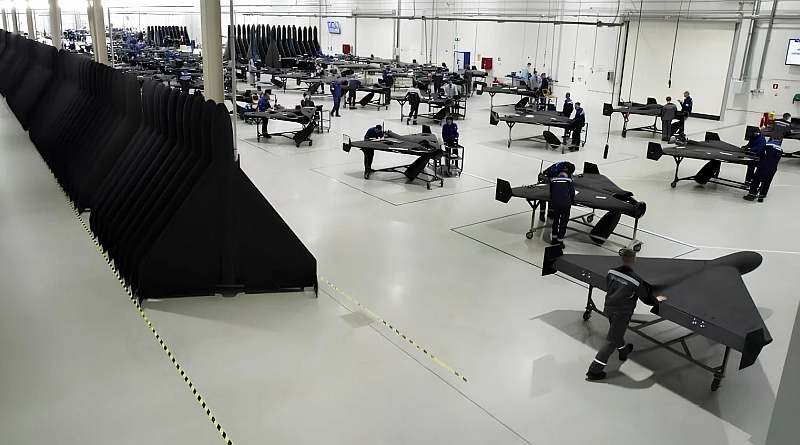
– Now, to export these products, a permit from the Ministry of Commerce of the PRC is required, and their free shipment abroad is prohibited. These components are used in particular in “Shahed” type drones, which Russia assembles at a facility in Alabuga, Tatarstan.
– The restrictions may complicate the supply of components for Russian strike drone production if the Chinese authorities ensure proper control over their compliance.
– The Authorized Representative of the President of Ukraine for Sanctions Policy thanked Beijing for the new measures. According to him, the Ukrainian side provided China with information on Chinese components used in Russian weaponry and the manufacturers of these products. Kyiv is counting on strict enforcement of the new rules.
7. Swedish law enforcement discovered that the digital bank Revolut was used for money laundering related to Russia.
– Individuals involved in such schemes transferred criminal proceeds through the platform, converted them into cryptocurrency, and sent them abroad. Meanwhile, regulators in several European countries are demanding that the bank strengthen financial controls.
– The Swedish Financial Crime Unit analyzed transactions totaling 2.9 billion Swedish kronor (about 259 million euros), with participants suspected of laundering Russian funds.
– Following the investigation, Revolut was identified as one of the most common channels for transferring money out of Sweden. Transfers were most frequently sent to Lithuania and Ireland.
– Revolut’s owner, Russian-born entrepreneur Nikolay Storonsky, is not implicated in the charges mentioned. The issue involves the platform’s use by clients for financial transactions that authorities associate with money laundering. The bank itself claims zero tolerance for financial crimes and cooperates with regulators.
– Revolut’s problems are not limited to Sweden. In Italy, a court has already imposed a year-long judicial oversight of the bank’s European division due to serious shortcomings in the anti-money laundering system. According to the court, 24 individuals, suspected or convicted of various crimes, managed to conceal illegal financial flows amounting to 41.9 million euros through the bank accounts in 2021–2026.
8. Sweden will deny Schengen visas to Russian athletes for participation in international competitions held in the country.
– This was reported by the Swedish Migration Agency, explaining the decision by implementing EU rules that allow for visa denial to individuals whose presence may threaten international relations.
– The agency emphasized that such practice has been implemented before, and participation in sports competitions is not a reason for obtaining a visa. Meanwhile, Russian athletes could theoretically try to enter Sweden with Schengen visas issued by other EU countries. In such a case, Swedish border guards may separately consider refusal of entry.
– The restrictions will apply, in particular, to the World Ski Championships, which will be held in Falun, Sweden, at the end of February 2027. Previously, Finland, Norway, and the Czech Republic announced similar measures regarding the non-admittance of Russian athletes.
