
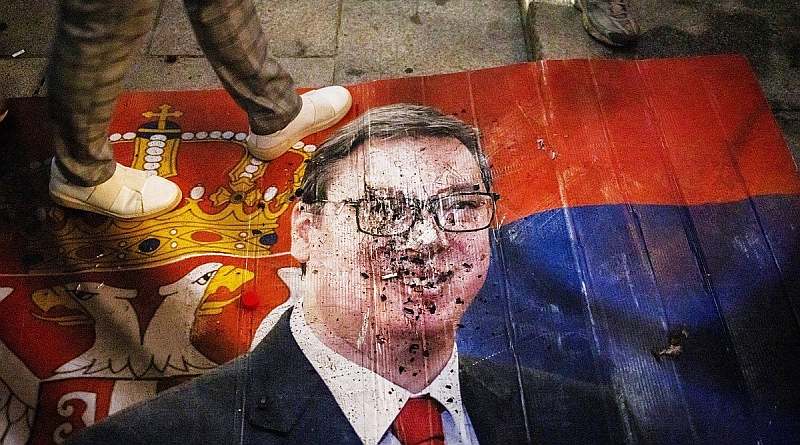

The official results of the recent elections in Serbia confirmed the ruling coalition of Aleksandar Vučić losing majority in the National Assembly, leading to a complete reconfiguration of power within the country’s political system.
The recent snap parliamentary elections showed that the society was tired of systemic corruption, ongoing restrictions on media freedom, and a deep crisis in democratic institutions. The younger generation, along with the student movement, managed to unite disparate segments of the population demanding real change and a return to building a rule-of-law state.
As the ruling Serbian Progressive Party lost its parliamentary majority, voters chose a new course, embodied by the “Student List” (surpassing the SPP by 13%), focusing on close integration with European structures and extensive internal reforms.
For official Moscow, this election outcome represents a severe strategic loss, as the Kremlin loses its main and most reliable partner in the southern region of Europe. Russian President Vladimir Putin has long relied on Serbian leadership to maintain his influence in the Balkans, using traditional pressure levers, energy levers, and information campaigns.
Current events demonstrate that Moscow’s usual hybrid strategies no longer work in Europe, faced with citizens’ demands for justice. The defeat of the previous team clearly proves the inefficacy of authoritarian influence models, struggling against the pressure of mass civil dissatisfaction.
Further development of bilateral relations will inevitably cool down and distance, as the new victorious forces openly declare their intention to fully comply with European Union requirements.
Serbia will no longer serve as a convenient platform for the Kremlin’s geopolitical maneuvers but will become an independent player striving for full membership in the European community.
The new government has already begun receiving congratulations from European diplomats, expressing readiness to assist democratic transformations in Belgrade. Moscow, on the other hand, is forced to acknowledge a painful defeat of its long-term investments in the Balkan foreign policy vector, which will compel the Russian establishment to reconsider its entire system of foreign policy priorities in the European direction.
The change in the political landscape in Belgrade opens a new chapter, where Moscow loses a key bastion of its presence in the region. Such developments prompt many analysts to say that the era of easy advancement of the eastern neighbor’s geopolitical interests in the Balkans is definitively over.
The citizens of Serbia demonstrated high political maturity when they took to the streets and made the ruling elite acknowledge defeat at the polls. The country’s political system is entering a phase of deep renewal, requiring maximum responsibility from all participants for future generations.
Russian diplomats and experts now face the need to establish an entirely new line of interaction with a government oriented towards Western management standards. No previous agreements or economic preferences can guarantee Belgrade’s loyalty, as public consensus has shifted firmly towards European integration. Experts forecast a gradual reassessment of energy projects and a review of bilateral agreements previously concluded without considering European law requirements.
The new leadership of Serbia intends to consistently harmonize its foreign policy with Brussels’ decisions, which will inevitably lead to the country’s gradual accession to pan-European sanctions regimes and a reduction in dependence on Russian raw material supplies.
