
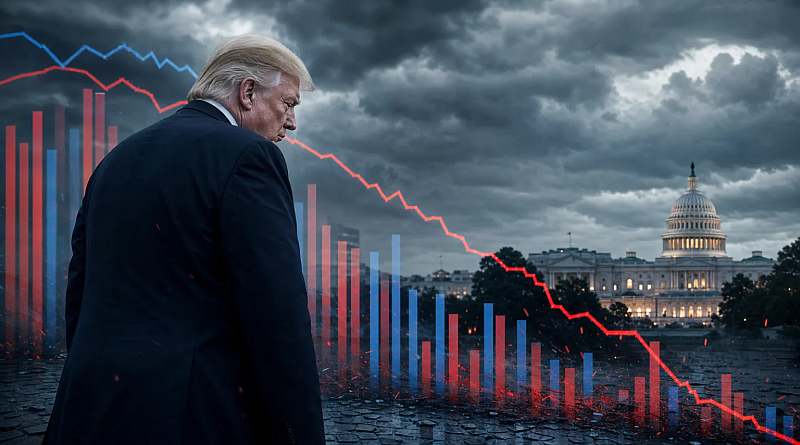
Valeriy Chaly / Dzerkalo Tyzhnya
For the eighth year, Ukrainian citizens, unable (for well-known objective reasons) to exercise their voting rights, periodically delve into the electoral processes in the USA, both informatively and even emotionally.
This is understandable. Firstly, it’s always competitive and unpredictable. It’s no coincidence that the US midterm election results attract the most interest and significant money on the most popular platform for political betting — Polymarket. Secondly, Ukraine and Europe significantly (in some areas — critically) depend on the decisions of official Washington, especially when the executive branch led by the US president almost ignores appeals from congressmen and senators, particularly regarding increased pressure on Russian aggressors, and instead pressures Ukraine. Thirdly, there is hope for the potential return of checks and balances in Congress, at the state level, or in the courts, and such a potential development receives a lot of attention.
Usually, midterm elections do not cause a stir. However, some are exceptional, occurring at the crossroads of epochs, during periods of war escalation, or the anticipation of a new technological revolution and intense competition for resources worldwide.
Such elections are now taking place in the USA, as early voting in the midterms, when Americans vote for the entire House of Representatives (435 seats) and a third of the US Senate, as well as reelecting 37 governors and making decisions about thousands of government positions across the United States, has already begun. The main election day is November third.
For the US itself, these elections and their outcome are essentially the first act of the historical drama Quo vadis, America? (“Where are you going, America?”). The second act will soon follow in the US presidential election in November 2028. The conclusion may surprise or even shock us, but its epilogue — with the moral and future fate of the main characters — is being written today.
The prologue of this drama was Donald Trump’s victory in the 2024 presidential election, which, combined with control over both chambers of Congress (the so-called trifecta), allowed the formation of a “unified government.”
The blatant attempt by the US president to seize as much power and control over the executive structures did not surprise anyone. However, his abuse of issuing executive orders (many of which go against established norms and practices) or numerous instances of violating current laws (which experienced and battle-hardened White House lawyers try to justify) have already triggered waves of dissatisfaction, not only on Capitol Hill.
Perhaps this is why many commentators and analysts, predicting the Republicans’ loss of the House of Representatives amidst the still uncertain situation with the Senate, present the current trends in the expected distribution of votes almost as a sensation. However, a brief retrospective analysis suggests rather the opposite.
Trifectas are usually unstable. Voters often “punish” the ruling party during midterm elections, disrupting unified control. Republicans along with Donald Trump did not avoid a situation where they lost one chamber in Congress. This happened in the 2018 midterm elections, when they lost the House of Representatives to the Democrats by a count of 223 to 117. Conversely, Republicans strengthened their position in the Senate, gaining two additional seats (totaling 53), leaving Democrats and independents with 47 seats.
The situation in this year’s elections follows a similar scenario: victory in the presidential race, high voter expectations due to loud populist promises, harsh realities, a drop in ratings for the sitting president, who is fully associated with parliamentary representation, and as a result, a shift of one chamber of Congress to the opponents. As of today, most election forecasting platforms unanimously give preference to Democrats in the House of Representatives (from 220 to 238 seats with 218 needed).
The Senate race is described as 50-50. To gain a majority in the Senate, Democrats need to secure 51 out of 100 seats (since the decisive vote is held by the Vice President of the United States, representing the Republicans). Given the current Senate seat count of 53 to 47, and 35 senators being re-elected in these midterms (13 from Democrats and 22 from Republicans), Democrats need a net gain of four seats, meaning they must defend their 13 positions and add four more. Observers are focused on seven states, including: Iowa, Alaska, Kansas, Maine, Michigan, Ohio, and Texas. Whether Democrats manage to achieve their maximum program will only be shown by the vote count. There are chances, but Republicans are also taking a number of serious anti-crisis measures.
So what is the specificity of these elections, and what has caused such attention from political observers? The answer is simple: two words — Donald Trump. The 47th President of the United States has directed all the experience gained and lessons learned from his previous term towards ensuring a maximally controversial approach to control all branches of power and achieve his personal goals. And in many ways, he has succeeded.
Firstly, he and his family became wealthier. And it wasn’t so embarrassing to talk to friends, holding a golf club with more confidence. Secondly, by fully subjugating the party, taking personal control over the legislative and (partially) judicial branches, and surrounding himself with completely loyal associates, Donald Trump created an illusion of unity in power and a picture of monumental achievements never seen before in America. Thirdly, the American president proposed a certain balance and proportional access to state funds for various lobbying groups, where everyone seemed to get what they wanted: new “financial sharks” received concessions from the Fed to shift the dollar for cryptocurrencies; owners of the largest databases and powerful next-generation chip manufacturing equipment from Silicon Valley saw restrictions lifted on the development of artificial intelligence technology; ambitious defense companies gained access to an unprecedented military budget of $1.5 trillion (!).
If only their votes were counted, the current US president certainly would not have had to distance himself from the disappointing expected results of the midterm elections in his speech from the podium of the UN General Assembly in New York.
The threat came from a predictable place: the leader-centered style of governance by the current US president, alongside increasing competition in praises for Donald Trump, and the diminishing influence of balancing factors led to such overconfidence in the ruling group. This inevitably resulted in a series of serious mistakes that the voters felt, even those who recently had collectively carried their ballots to finally “make” America “great again.”
Ordinary voters increasingly noted the difference between reality and slogans. Although economic indicators (especially in the stock market) and the number of Americans among Forbes’ billionaires demonstrated “great and unprecedented growth,” “rednecks” on ranches in Texas or fishermen in Alaska were more interested in other issues — labor shortages, rising mortgage payments, inflation, and rapid price changes in supermarkets, constant unfavorable fluctuations in the conditions and cost of medical insurance.
If they believed in the “eight wars stopped” or the “inevitable success” of the US in the Middle East or the restoration of America’s greatness worldwide (as they couldn’t help but hear that the Gulf of Mexico finally became American and soon the Atlantic Ocean would as well), the sharp increase in fuel prices, especially diesel hitting unprecedented $6.66 per gallon in Texas, and even more in other states, couldn’t help but stir increasing negative emotions.
Besides the surge in oil product prices, the failures in foreign policy became evident, including in the war with Iran and the inability to effectively mediate to stop the Russian-Ukrainian war and its escalation on the European continent.
The strict anti-immigration policy of the current administration, which was supposed to bring, according to its proponents, additional dividends, especially in voter support, also created problems for the Republicans. Instead, the mechanisms for implementing this policy, the approach of law enforcement agencies, particularly the generously funded ICE (allocated an additional three-year funding of $75 billion), did not become, to put it mildly, popular.
All these mistakes and the decline in the rating of the sole Republican leader — Donald Trump — have opened great opportunities for the Democrats that they could hardly have hoped for a year ago. Predictions of a crushing defeat for the Republicans could come true if the Democrats had consolidated strong candidates in all districts. However, they too were not fully prepared for such a chance.
A notable example is the situation in the elections to the U.S. House of Representatives in Michigan’s 7th Congressional District (the former district of Elissa Slotkin — a professional intelligence officer with an impressive track record who moved to the Senate and issued a programmatic statement, essentially on behalf of part of the U.S. intelligence community, with scathing criticism of Donald Trump).
In this district, the Democratic primaries had two main candidates trusted by many, including Slotkin herself — Bridget Brink (U.S. Ambassador to Ukraine from 2022 to 2025) and Matt Maasdam, both having substantial national security experience and positioning themselves as centrists. However, unexpectedly, a third, leftist candidate — William Lawrence, co-founder of the environmental movement Sunrise Movement, won the internal party primaries. Although he didn’t win the majority of votes, it was enough for him to advance to the election where he faces the incumbent Republican congressman, U.S. Army veteran Tom Barrett. Now, despite prior forecasts that the district would undoubtedly go to the Democrats, well-known analytical centers (such as the Cook Political Report or Inside Elections) assess the chances of both candidates as completely equal. By the way, another outcome is already clear — with Bridget Brink, we effectively lost another potential member of the Ukraine caucus in the House of Representatives.
The Democrats were unable to consolidate sufficient financial resources to ensure the most effective campaign. Here, the victory is clearly on the Republicans’ side. The Republican National Committee and related groups had over $600 million in cash by the end of summer, while the Democrats had only $400 million. Add another $400 million under MAGA’s control, and you conclude that such a disparity, even if not fully benefiting the Republicans, might manifest itself during the final election results. Polls are one thing, but such factors have always influenced outcomes.
Regarding sociological forecasts, things are not straightforward either. Commentators point to polling errors and the fact that many who voted for Donald Trump might avoid responding due to a sharp drop in trust in the de facto Republican leader (from 52 to 34%).
All these factors indicate the prematurity of definitive predictions even two weeks before the final vote count. These days, the Republicans have engaged all levers — from reallocating resources to districts where the situation can still be salvaged, to using “heavy artillery” in the form of statements by the U.S. President. The harsh assessments and direct campaigning by Donald Trump against the Democrat Senate candidate in Michigan — Abdul El-Sayed, who has every chance to become the first Muslim senator in U.S. history — are noteworthy.
So, despite the current picture, everything can still be adjusted. But the main scenarios and their consequences can already be highlighted today.
Traditional Scenario (probability — 60%). Democrats gain the House of Representatives, while the Republicans maintain control of the Senate. This could lead to a gradual decrease in the White House’s influence and Donald Trump personally, with the ability to block Democratic initiatives — both through the Senate (especially by the MAGA group) and through the US President’s veto power. There is a significant likelihood of a government shutdown by the end of the year and the beginning of impeachment proceedings against Donald Trump, which is unlikely to result in a final verdict (an accusatory court decision).
Status Quo Scenario (probability — 15%). Republicans make a surge in the last weeks of the campaign and retain control not only of the Senate but also of the House of Representatives. This could lead to US President Donald Trump feeling he has absolute support and a mandate to further strengthen his policy of consolidating power and finding mechanisms to retain authority for himself, his family, or his closest circle in the future, and to prepare for such a scenario in the 2028 presidential elections.
Confrontational Scenario (probability — 25%). Democrats take control not only of the House of Representatives but also of the Senate and block further initiatives by the US president and his candidates for government positions, effectively beginning political, legislative, and judicial pressure on his previous decisions and positions, up to the possible early removal of the US president through impeachment. In this case, it is highly likely that the current administration and some Republicans will delay recognizing the election results until declaring them illegitimate, followed by protests and attempts at suppressing them by force, with all the unforeseen consequences of escalation.
In any case, whether liked or not, even a politically weakened US President Donald Trump will retain (to a greater or lesser extent) influence on the internal and (especially) external policies of the United States until the elections in November 2028, unless he is removed from office earlier as a result of impeachment. So, the conclusion of the drama “Where Are You Heading, America?” and its epilogue will be seen in the next presidential elections in the USA, the format of which and results will largely be shaped in the coming weeks.
Collage: Xpert.Digital
