
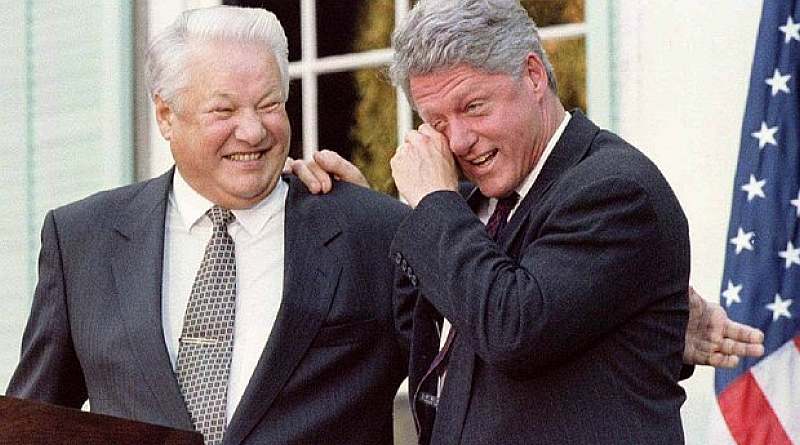
November 19, 1999, Istanbul. U.S. President Bill Clinton meets with Russian President Boris Yeltsin for the last time. Both politicians have an excellent personal relationship that has lasted for years—they can be said to be friends. In his memoirs, Clinton will describe Yeltsin as a man “with democracy in his heart.” He doesn’t yet know that he will not see him again as the Russian president, as Yeltsin will leave office early, just weeks later, on December 31, 1999. But even at this meeting, Yeltsin confidently speaks to Clinton about Putin as his successor. “He’s tough,” Yeltsin tells Clinton. “He has inner resolve. He’s internally tough, and I will do everything possible to make sure he wins—legally, of course. And he will win. He will continue Yeltsin’s line in democracy and economics…”
Anyone reading these words from the first Russian president now might be unsurprised at how indiscriminate Yeltsin was and how poor his judgment of people was—otherwise, he would never have chosen a successor who would destroy his legacy. Yet in his characterization of Putin as a person, Yeltsin turns out to be surprisingly accurate—he values his successor precisely for his toughness, not for anything else. And can we be sure that someone who, in the Soviet system, reached the status of candidate member of the Politburo and Secretary of the CPSU Central Committee, and later won the power struggle against the General Secretary himself, understood nothing when he saw Putin as his policy’s continuator?
The last meeting between Yeltsin and Clinton is interrupted when the American president tries to talk to his Russian colleague about the horrors happening in Chechnya. Yeltsin simply stands up and announces that they had been talking longer than planned. Yeltsin gives his assessment of Putin as he is leaving the room where the talks were held, in response to Clinton’s question about the winner of the upcoming presidential elections in Russia.
But it is during these talks that Yeltsin quite seriously proposes to Clinton “to give Europe to Russia.” The presidents are discussing the deployment of elements of the American missile defense system on the continent, and Yeltsin is convinced that this will strengthen American influence, which should not be in Europe at all. “You can take all the other countries and protect their security. I’ll take Europe and ensure its security. I’m serious: hand over Europe to Russia!”
Clinton reacts to these words ironically—after all, he is Clinton. Besides, this is not the first time he hears these appeals from Yeltsin. In March 1997, during a summit in Helsinki, Yeltsin suggests Clinton sign an agreement clearly stating that NATO will not admit former Soviet republics, especially Ukraine. “We see how you and the Ukrainians are developing your relations. This does not help us resolve Russian-Ukrainian problems,” he tells the American president.
Clinton jokingly deflects again (after all, he is Clinton), but agrees to nothing. When Yeltsin proposes to make a secret deal that would preclude the possibility of the former Soviet republics joining NATO, he carefully explains to the Russian president what political catastrophe this could lead to. But Yeltsin does not relent…
Documents from the U.S. National Archives, made public several years ago (and it is those I am citing), provide an answer to the question of whether Putin continued Yeltsin’s policy—if we view this policy without epithets about democracy and reforms, as a course aimed at maintaining Russian hegemony. And we will be convinced that yes, he continued almost word for word. Indeed, there are demands from the Russian Foreign Ministry, sent in 2021 to the U.S. State Department and foreign ministries of NATO member countries. They specifically demanded that the United States and other Alliance members guarantee Russia that former Soviet republics— especially Ukraine—cannot be admitted to NATO. This fully repeats not just the algorithm of the Yeltsin-Clinton conversation, but its exact content. As well as the Russian Foreign Ministry’s demand to remove modern weapons from the territories of countries that joined NATO after 1997. What is this if not a return to the idea of Russia as a guarantor of European security—because the Americans are leaving?
So, several conclusions should be drawn. First: we must abandon the illusion that what is happening now is a whim of Putin. No, it is the implementation of Russian policy as such. Yeltsin, as a large-scale politician of the old Soviet school, might have stopped in the situation where Putin finds himself, not so much before the sheer impossibility of starting a war (he didn’t stop in Chechnya) but before the need to exit a conflict if it unfolds unfavorably. But Putin, as Yeltsin accurately noted, is tough, meaning inflexible and persistent. And he’s ready to throw everything into the furnace of his desires. But, strangely enough, it is not Putin himself who is the problem, just as Yeltsin wasn’t—the Russian presidents simply reflect the imperialistic course of their country, which hasn’t changed for centuries.
The problem lies with who they face. Clinton clearly understood that his task was to limit the imperialistic intentions of his interlocutor and bring him back to a reality where other countries also enjoy sovereignty and have the right to their own choice. And here Yeltsin could do nothing. But Putin finally awaited a partner who regards the sovereignty of smaller states exactly as he does—who might call Canada an American state, demand to sell Greenland, and brag about controlling Venezuela. And yes, perhaps Trump doesn’t like that Putin continues to wage war in Ukraine, but he might completely understand the non-military limitation of Ukraine’s sovereignty.
Yes, our problem and the problem of the whole world is not only that Putin continues the policy of Yeltsin and his other predecessors using barbaric methods.
Our main problem is that Trump does not continue the policy of his predecessors.
