
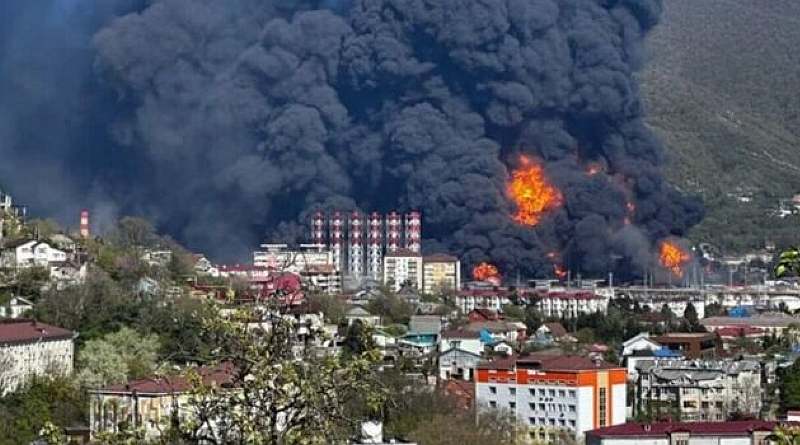
Oleksandr Kovalenko / Obozrevatel
In 2026, Ukraine significantly increased the number of strikes on Russian territory, disabling oil refineries, depots, defense industry enterprises, military facilities, and more. However, there are absolutely unique targets on the aggressor country’s territory, whose damage, destruction, and annihilation can halt entire industries and logistics routes, and also paralyze cities and regions.
More about this can be found in a new piece from the joint project of OBOZ.UA and the group “Information Resistance.”
Since 2022, I have periodically published information about unique samples of Russian military equipment destroyed in the combat zone. Eventually, feeling the deficit of armored vehicles due to heavy losses, Russian forces were forced to deploy models that sometimes existed in single specimens and which the Russian defense industry can never reproduce.
The most striking examples are the destruction in Ukraine of almost all BMO-T flamethrower combat vehicles, the unique “doomsday” combat vehicle based on the T-80 “Ladoga” tank, the museum BTR-90, and others.

Regarding the aviation component, during the full-scale war, the Russian Aerospace Forces lost unique flight laboratories A-60 and A-100, A-50U AWACS aircraft (leaving only three flyable units), among others.
The most painful for the Russian Aerospace Forces was the SBU operation “Web” (June 1, 2025), during which the majority of strategic bomber missile carriers Tu-95MS, which Russia cannot manufacture, were destroyed.
But this concerns combat equipment, while in Russia there are numerous engineering structures or technical means that exist in a single instance – on whose functionality entire industries or the survival of entire regions depend.
We will talk about some of them today.
The Consequences Are Catastrophic
Yenisei is the most voluminous river in Russia with a very powerful current, making it extremely difficult for ships going against the current to overcome. The risks increase especially for navigation in the Kazachinsky Rapid area.
To overcome it, a toueur (from Fr. toueur) is used. This is a special river towboat that uses a chain steamboat, allowing it to move on the river’s surface along a chain or cable laid at the bottom. This ensures a stable passage without the risk of being caught by the current and smashed against the bank in a turbulent flow.

In Russia, there is only one tow ship – the diesel-electric “Yenisei”, built back in 1964 at the Krasnoyarsk Ship Repair Yard. This very touer operates around the clock at the Kazachinsky Rapid, approximately 235 km downstream from Krasnoyarsk, ensuring the passage of vessels against the river’s current.
The diesel-electric ship’s operability is carefully monitored, and it undergoes regular major repairs (with the most recent significant engine and winch upgrades conducted in 2022–2025). But if for some reason it breaks down, sinks, or, for example, burns out, navigation on the Yenisei will stop. In essence, part of the river, starting from the Kazachinsky Rapid, will be in a kind of blockade.
It might seem like it’s just an old electric ship, yet in reality, navigation entirely depends on it, with all the consequences that entails, on Russia’s most voluminous river.
Since we have already mentioned the Yenisei, it is worth noting another unique engineering structure – the Krasnoyarsk HPP ship lift.
It was built in 1982 and today it is the only one in Russia and unique in design as a longitudinally inclined rail ship lift.
The principle and feature of its operation are that instead of conventional locks, it uses a giant rail platform 9 meters wide to accommodate a ship and transport it over the dam crest, overcoming a height difference of 100 meters.
The stoppage (for uncertain and varied reasons) of this ship lift’s operation will also block the passage of vessels along the river.
An equally interesting issue is energy.
In Russia, it is critically important not just for a single city or region, but, without exaggeration, for the entire country, to have the Central Dispatch Center of the Unified Power System Operator (Moscow).
The reason is that the Unified Power System of Russia is a synchronously operating energy system that covers not only Moscow and the region but essentially synchronizes the current frequency and the flow of energy from the European part of the Russian Federation to Siberia and the Urals.
In case of an emergency (such as the fall of certain unidentified debris), rolling blackouts will begin over a large part of the Russian Federation, leading to a cascading shutdown of power plants, halting of city life support systems (waterworks, heating), communications, and railways across several time zones.
It is surprising that for such a large country as Russia, to ensure electric supply to a substantial part of it—especially the critically important European part—there is a focus on one facility, on which the stability of thousands of cities and the well-being of tens of millions of people depend.

One could continue at length, listing critically important equipment existing in a single instance or an engineering structure, or an important hub, on which an entire region, federal district, or a significant part of the aggressor country depends… There are very many such unique targets in Russia, making it extremely vulnerable, because in the event of the loss of such objects, the Russian industry will not be able to manufacture, build, or reproduce most of them.
Conclusions
Ukraine has rendered more than 50% of Russian oil refining inoperable. We have destroyed a significant portion of the largest storage and logistics hubs of Russian marketplaces. The Ukrainian Defense Forces have done an enormous amount of work to weaken Russia economically, technically, technologically, etc.
But there are unique targets whose destruction would significantly increase the already inflicted damage, paralyzing entire regions. There are many such targets, and their neutralization is entirely appropriate from a moral and legal standpoint—as a reciprocal response to the terror that Russia has been waging for the fifth year against Ukraine.
The targets are known. They cannot all be hidden or protected. Is it time to give the “green light” for their destruction?
In the image: A large-scale fire at the refinery in Tuapse. Photo: Telegram/exilenova+
