
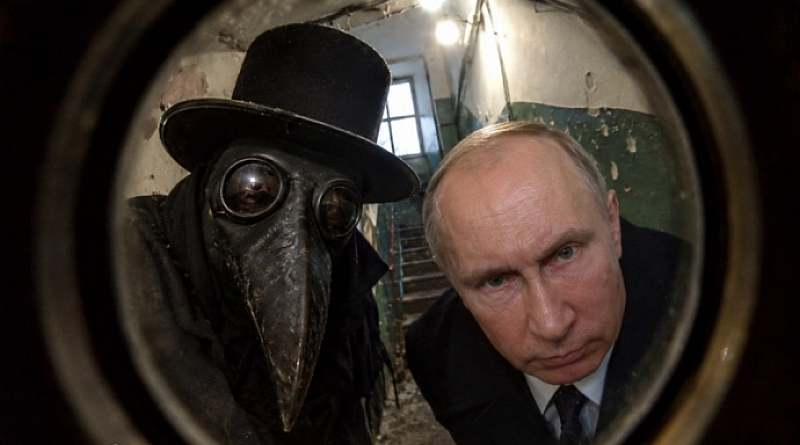

When the first rumors about the incident at the Siberian research laboratory emerged, they sounded like the beginning of a dark spy thriller because a young lab assistant allegedly accidentally broke a test tube with a deadly pathogen and died suddenly.
Although the global community might be mistaken in its conspiracy theories, global panic is easily forgiven as excessive Russian state secrecy securely conceals the real scale of the looming threat.
No one disputes the facts that Daria Shipilova died at a regional hospital on October 2nd, while about 200 people who had contact with her were placed under strict medical observation, which unequivocally indicates a high probability of an infection outbreak.
However, representatives of the Russian Ministry of Health were quick to state that they found no traces of microorganisms that could be linked to the deceased’s professional activities, citing pneumonia of unknown etiology as the cause of death, although the World Health Organization has yet to confirm this information.
Besides the dry statement of the employee’s death, the authorities provided frighteningly few details, even though they are urgently taking stringent regional control measures to prevent the spread of the unidentified contagion.
Since memories of the coronavirus pandemic are still fresh in people’s minds worldwide, it is quite natural that the international community is desperately trying to uncover the truth. Inevitable questions arise about whether the incident is related to a secret Russian biological weapons development program, which, according to Western intelligence, continues to operate despite agreements.
Experts are well aware that the plague pathogen can be dispersed as an aerosol to maximize transmission to humans, and the bacteria can also be genetically modified to become fully resistant to modern antibiotics. Philippa Lentzos, a biosecurity expert from London’s King’s College, states that the complete lack of transparency regarding the Siberian incident is profoundly concerning on a global level.
Despite the Soviet Union officially ratifying the Biological Weapons Convention in 1975, the state continued extensive clandestine pathogen development until Boris Yeltsin acknowledged its existence in the 1990s.
Recently, Russia has again been meticulously shielding its military research centers from inspectors, while satellite images of a closed facility near Moscow indicate significant expansion that began immediately after a large-scale military invasion of a neighboring country.
A recent State Department report explicitly states that the Russian Federation actively supports an offensive biological weapons development program, although federal officials steadfastly insist that only defensive research is conducted at these facilities. While there is no incontrovertible evidence directly linking the Irkutsk institute to weapon development, the global community remembers well that the government said exactly the same thing about toxic substance research right before the notorious attempt to poison Sergei Skripal in the United Kingdom.
It is quite possible that there is not a shred of truth in the circulating rumors, but with such critically low levels of information transparency, it becomes utterly impossible to take at face value the word of those officials who have been deceiving the rest of the world for years.
Illustration: Semen/Durdom
