

Party Statement
«European Solidarity» is a democratic party, where debates, different views, and sharp disputes have always existed and will remain. This is normal for a political force that respects freedom of speech and thought.
However, for us, there is a fundamental difference between a discussion about political tactics and disagreements on the basic values and strategic course of the country.
For «European Solidarity», such principles include a strong Ukrainian army, the Ukrainian language, an independent Ukrainian church, Ukraine’s membership in the European Union and NATO. We are convinced: this is the foundation of Ukrainian statehood, which helped Ukraine survive the years of war with Russia and should determine its future.
These principles are not subject to political expediency and cannot be negotiated — neither within Ukraine nor, even more so, in negotiations with Russia.
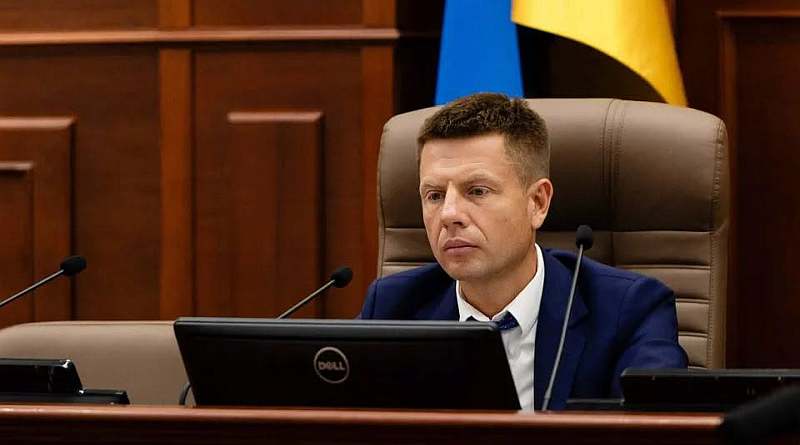
The public positions of Oleksiy Honcharenko on ending the war and the future security architecture of Ukraine diverged from the position of «European Solidarity» and its ideological foundations.
That is why the faction «European Solidarity» — we have decided that we can no longer continue a joint political path due to ideological differences.
This decision does not negate years of joint work. But party unity cannot be a formality that conceals fundamentally different answers to questions about the future of the state.
At the same time, the responsibility for Ukraine’s negotiating position and diplomatic strategy today lies with the government, which has a majority and full powers. And the broad public discussion provoked by Oleksiy Honcharenko’s proposals has demonstrated the obvious: the government must finally begin an honest conversation with society about how it sees a realistic path to a ceasefire and a just peace. “Resilience plans” and “power declarations” no longer suffice as answers to these questions.
Ukraine needs a large and complex conversation about how to end the war, achieve a just peace, obtain effective security guarantees, and prevent new Russian aggression. And society has the right to know not only what we all strive for, but also what is the realistic strategy to achieve this goal.
We are ready for this discussion. But our starting position is unchanged: peace cannot be paid for by renouncing what Ukraine stood for in this war.
Compromises may be part of the path to ending the war. But the independence of Ukraine, its European future, issues of national identity, and the right to independently determine its own security system are not subjects of compromise.
For us, the unity of the team, which is based on shared values and principles, is important. The «ES» team is not only a faction but tens of thousands of party members, the most authoritative of whom are our colleagues in the Armed Forces of Ukraine, and whose opinion and position on defending the country are crucial for us.

Everyone waited a long time for a decision from European Solidarity.
However, without internal discussion, without democratic debate in the party, which is not the CPSU, no decisions are made.
And when they are made, they are not hysterical, but balanced.

On fresh emotions… about flies and cutlets, the main and the secondary.
You see, the problem is not that Honcharenko broadcasts a Russian narrative. And it’s not even that until Monday evening, this deputy was considered a representative of a party with a completely opposite stance on war, negotiations, and the limits of what is acceptable.
The problem and the tragedy are that the deeply Russian theses voiced by Honcharenko, Hetmancev, Terekhov, and several other deputies (it seems, Buzhansky too, which doesn’t surprise me) are liked by millions of “ordinary people.” Despite the war, shelling, and losses.
The entire Threads and half of TikTok are whining with latent and overt “malorosy” who are ready to accept Russian almost as a second state language, give away territories for a promise not to shoot, agree to legitimize the religious-diversionary branch of Lubyanka under the insignia of the “Russian church.” This is the demand. The request.
You see, political animals very subtly, instinctively sense the moods of the electorate. Political animals – predators who go hunting for the emotions, illusions, myths, desires of the electorate. Political animals are Langoliers, devourers of the hopes of the naive (foolish, primitive) voter. Their goal is to gnaw out the next elections. And they are already going to this goal over others’ heads. Like hyenas that smell herds of potential victims in the air.
Honcharenko, Hetmantsev, and several others are precisely such political predators. Very technical. And cynical. Honcharenko, for example, began publicly building his own political project when he found resources for “Honcharenko centers.” Local activists from the “European Solidarity” party often quietly moved there—what’s wrong with a popular national deputy expanding a network of educational centers? Aha… His own? Educational? For how long? Or was the main word here “network”? And at the right moment, will the educational centers become party centers?
Is this some kind of cannibalism?
It seems Portnikov said that in the first post-war (or during-war) elections, the main battle will be for the votes of such “capitulationist-peace-loving” electorates? Zelensky wanted to reserve them for himself, but Honcharenko will try to challenge him. The first catered to Little Russians from the stage. The second has experience appealing to Soviets since the Party of Regions’ times. Two peas in a pod.
It’s a pity that in this story of “a stranger among his own” (and Honcharenko had long been a stranger or at most a situational fellow traveler), the ES party got smeared. In countries with a long history of ideological parties, such situations lead to serious work on mistakes. In what direction? Ideas, values, principles are more important than names. If a name loses the commonality of an idea, it must go, no matter how popular or useful the name might be in certain fields.
It would be desirable for Honcharenko’s case not just to lead to online squabbles but to realize that responsible politics requires ideological politicians and parties. People are weak and prone to betray ideas. Ideas and values cannot betray; they can only unite those who share them.
Something like that…
