
November 13, 1708. Troops led by the imperial favorite Alexander Menshikov capture the Cossack capital of Baturyn. They demonstratively, with particular cruelty, burn it and kill all the civilians, of course, not bothering to inquire who supported the tsar in the war and who supported the hetman.
Such killing of civilians is a usual tactic for the Muscovite state. Of course, the very history of this state as a separate entity (then still with centers in Suzdal and Vladimir-on-Klyazma) began with the ravaging of Kyiv by troops assembled by Prince Andrei Bogolyubsky, son of Yuri Dolgorukiy. Contemporary chroniclers described with amazement the looting of the city, raping of women, killing of civilians, and burning of churches. At the same time, Bogolyubsky himself—like Putin now—even did not claim power in Kyiv and left the capital of Rus under the rule of his brother Gleb. This wild pogrom convinced that Kyiv finally turned into a foreign city for the rulers of Zalesye, which could only be plundered and destroyed. “With Andrei Bogolyubsky, the Great Russian first came onto the historical stage.”
On February 8, 1918, Bolsheviks led by Mikhail Muravyov enter Kyiv. The Reds unleash real terror in the city, executing thousands—and not only soldiers of Ukrainian armies. They loot, rape, and burn.
Therefore, in the new attacks on Kyiv, in Putin’s attempts to turn the Ukrainian capital into a frontline city, there is nothing new or even surprising. Forcing Ukraine to abandon resistance by destroying its capital is a classic Russian concept of “victory.” In 1708, the capital of the Cossack proto-state was the small Baturyn—and it was practically wiped off the face of the earth: the city we visit today is a new settlement on the ruins of the pogrom. And in 1918 and now the Ukrainian capital was and is Kyiv—so they try to destroy it, and demonstratively so.
Why the capital, exactly? Russia is a capital-centric state. This is not a matter of Moscow per se, but the matter of the ruler’s location. We say that everything revolves around Moscow—but before the move of the Bolshevik capital to Moscow, everything revolved around St. Petersburg or Petrograd. The Bolsheviks seized power in the capital, and no resistance from Moscow had any real significance—thus began the “triumphant march of Soviet power.” In 1991, Moscow supported Yeltsin, not the coup plotters from the Kremlin—and the actual support of the provincial masters for the putschists didn’t help them.
Russia perceives other states as built around its own capitals. Destroying Kyiv from this point of view means destroying Ukraine. Intimidating Kyiv means intimidating Ukraine. Therefore, Putin planned his lightning war precisely as the capture of Kyiv, being sure that after the change of power in the capital, all of Ukraine would pledge allegiance to the collaborators—just as all of Russia has always pledged allegiance to whoever seized power in Moscow or Peter, even if it was an obvious impostor.
Of course, it is terrifying to live in Baturyn, towards which Menshikov’s crazed army is heading. It’s terrifying to live in Kyiv, targeted by Russian drones and missiles. But Ukraine is larger than Kyiv. Ukraine is not a city, nor even a territory to be “cleared” of dissenters. It is the idea of a people and their freedom.
And this is something the Russians—from Andrei Bogolyubsky to Vladimir Putin—simply cannot understand.
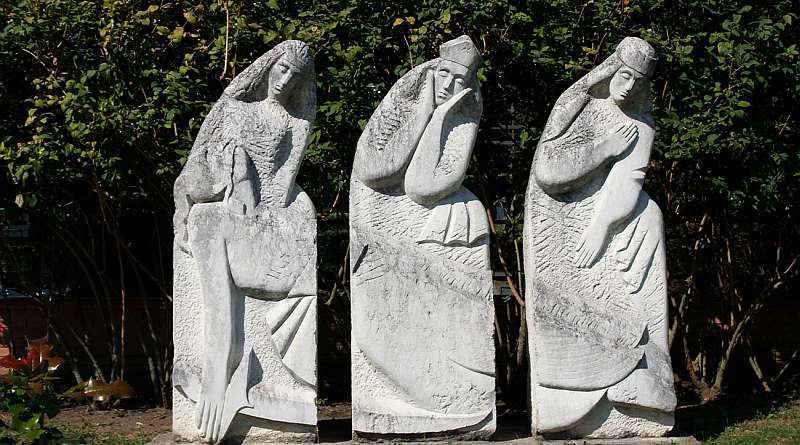
On the cover: Sculpture by Lyudmila Misko “Lament for the Hero of Baturyn”
