
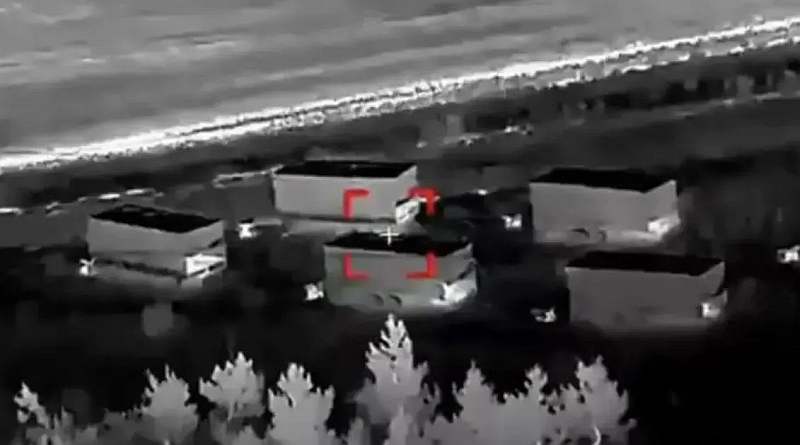
The history of electronic warfare is a story of the eternal chase between shield and sword, where each new defense system gives rise to ways to bypass it. Russia has built the most sophisticated shield. Ukraine proves every week that an absolute shield does not exist.

When going to war with Ukraine, Russia had five electronic warfare brigades (15, 16, 17, 18, 19) as part of its armed forces. This level of formation is only found in the Chinese army. India is forming two brigades on the Chinese and Pakistani fronts, but the process is not complete. No other army in the world has electronic warfare brigades, and the regiment is the pinnacle of organizational evolution (Great Britain). Belarus has several regiments (for example, 10th and 48th).
Ukraine had only one regiment, the 249th, in the Armed Forces, but the Ministry of Defense disbanded it in 2013, thanks to the leadership at the time.
Officers of electronic warfare consider their military profession one of the oldest since they found a picture in a history textbook depicting ancient people hunting a mammoth, where one hunter throws sand in the eyes of the mammoth, thereby jamming the enemy’s optical-electronic observation system. So, the profession is indeed old.
Before drones, electronic warfare was more akin to radio hooliganism. The first mentions date back to the Russo-Japanese War of 1904, when radio operators from one empire interfered with their counterparts on ships from another, preventing them from freely using the airwaves. This format of confrontation lasted a long time, and only Germany during the First World War created jamming stations. Nothing significant happened until 1942, when a well-known uncle in characteristic round glasses approached the leader of the nations with a memo on creating a service to destroy German radio stations operating on the battlefield. That was when it all began. Subsequently formed separate radio battalions acted very effectively in Operation “Bagration,” disorganizing the enemy’s troop management and significantly contributing to victory, even though the electromagnetic spectrum is invisible to the naked eye. Fighters of the invisible front in the truest sense.
Later, electronic warfare units developed like weeds by the roadside, because they can’t be paraded around at ceremonies or rolled out behind tanks during exercises. Nevertheless, in all leading armies, there were minds that did not let this branch of troops simply wither away.

Let’s return to our adversary. In addition to the already mentioned five electronic warfare brigades, the enemy has a separate electronic warfare regiment in Severomorsk, three separate electronic warfare centers, ten battalions, a comprehensive technical control center, and an inter-service training center for preparation and combat application of electronic warfare troops in Tambov.
The capital of electronic warfare of the Armed Forces of the Russian Federation is, so to speak, Voronezh, where interesting training and research institutions are compactly located, such as the faculty of electronic warfare (and information security) within the Air Force Academy named after Professor N.E. Zhukovsky and Y.A. Gagarin, which is the main institution of the Ministry of Defense of the Russian Federation for training electronic warfare officer-specialists for all types and branches of the military. The faculty is based in the former military institute of radio electronics, which existed in Voronezh from 1980 to 2006 and trained over three thousand electronic warfare officers. Madjar should know the address. In the same place, in Voronezh, there is the research testing institute of electronic warfare as part of the same Air Force Academy. This is the main interdepartmental scientific organization for research, development, and testing in the field of electronic warfare, which roots from the 21st research testing center of the Ministry of Defense of the USSR.
And if you have a scientific and educational base, it makes sense to have an industrial base nearby. In Voronezh, there operates the scientific production enterprise “Protec” (Bazova St., 6, if you’re interested). Protec produces electronic warfare complexes, including automated jamming stations R-330Zh “Zhitel,” which disrupt satellite communication, GSM, GPS, etc. There are also several enterprises that are part of the “Sozvezdie” consortium, which develop and produce modern electronic warfare means (for example, the “Vika” complexes for UAV navigation suppression and “Yarilo-M2” against FPV drones). The “Sozvezdie” consortium was once mentioned as the developer of the unified automated control system for the Russian army, but something didn’t quite work out. We have “Delta,” and they don’t have “Sozvezdie”.

The two wars against the Chechen Republic served as a good catalyst for the development of technology and weaponry in the EW units. The inventory of these systems was virtually completely renewed. Each military tier received its tools for combat operations in the airwaves.
Strategic tasks of the EW are carried out by the GT-01 “Murmansk-BN” complexes (suppression of the HF band at ranges up to 5000 km), “Krasukha-2” (counteracting aviation radars, primarily AWACS), “Krasukha-4” (counteracting onboard radars of aircraft, UAVs, cruise missiles), “Divnomorye” (a multifunctional long-range complex), 1l267 “Moskva-1” (a radio-electronic reconnaissance and control complex with a range of up to 400 km).
In the operational link (the same five brigades), there are the “Palantin” complexes, RB-109A “Bylina” (an automated control system for EW means), RB-636AM2 “Svet-KU”, a stationary antenna post for radio-technical reconnaissance “Svet-VSG”, radio-electronic suppression complexes R-325-P5 and “Samarkand-U”, and powerful noise jamming stations 1l248-2 SPN-2 and 1rl248-4 SPN-4.

In the tactical echelon, that is directly on the battlefield, the enemy’s EW battalions and companies use the radio-electronic suppression complex RB-301B “Borisoglebsk-2”, EW complexes RB-531B “Infauna”, “Leer-2”, RB-341v “Leer-3” (consisting of three “Orlan-10” UAVs with appropriate equipment on board), jamming stations R-330zh “Zhitel”, R-330BMV, R-378BM “Altaets-BM”, RB-312A, cellular communication jamming stations “Lesochek”, aviation VHF communication jamming stations R-934B “Sinytsa”, the radio suppression navigation system “Pole-21”, stations for jamming ammunition radio fuzes 1l29 “Rtut-B” (SPR-2) and 1l262E “Rtut-BM” (SPR-2M) (a highly effective system that counteracts radio fuzes of artillery shells with nearly 100% efficiency), helicopter active jamming stations “Ryachag-AV”, the technical monitoring system “Spektr” (to monitor the electromagnetic spectrum and detect unauthorized transmitters), the radio, radio-technical, and special control complex MCTK-1A “Dzudoist” (guess who the designers paid homage to?) and the military object protection system from eavesdropping “Zaslon”.

As someone who suffered from the RB-341V “Leer-3”, and this nuisance is capable of working with mobile networks, I’ll share a story: during the ATO, I called my wife from Luhansk region and told her I received an SMS from her: “I’m done, I can’t take it anymore. I’m leaving.” She checked her mobile and found no trace of sending this SMS. The REB service at our command post worked efficiently; we knew that in the enemy’s combat order, the Russian “Leer-3” was operating, and regular subversive SMS distributions were occurring. I laughed. My wife then asked why I was so sure she wouldn’t leave. “You never write SMS in Russian. That’s why,” I replied. We laughed together. The moral is — use Ukrainian and secure communication channels, do not turn on mobile phones closer than 30 km to the front line.
They actively and quite effectively counteract our drones with R-330Zh “Zhitel” (drone jamming station), RB-341V “Leer-3” (cellular communication and drone control channel interference), “Pole-21” (navigation signal jamming), “Krasukha-4” and “Krasukha-2” (counteraction to onboard drone radar), RB-301B “Borisoglebsk-2” and RB-531B “Infauna” (widely used at the tactical level specifically against drones, including FPV), R-330BMV, “Lesochek”, R-378BM “Altaets-BM” (suppression of drone control and communication channels), many tactical level REB stations (especially “Zhitel”, “Borisoglebsk-2”, “Leer-3”) have found their primary use as means of combating drones during hostilities. Strategic complexes (“Murmansk-BN”, “Krasukha”) indirectly affect drones by jamming reconnaissance, communication, and targeting systems.

In 2016, over Donetsk, where the Russians deployed the “Krasukha-4”, an American UAV Global Hawk was flying. It soared beautifully and for a long time. And that “Krasukha”, specially designed against it, could do nothing. It was one of the most beautiful hysteria moments of the Russians on air, which our radio intelligence listened to.
Amid all this zoo in 2026, something called “Volna Kupol Garant” started catching attention. It turned out to be an electronic warfare system specifically developed to jam Starlink. See how it hurt the aggressor when Mr. Musk disconnected their terminals and the advantages it provides to the Ukrainian Defense Forces in managing troops and weaponry? It’s also the reason to impose maximum prison terms on idiots helping the Russians register Starlink terminals on the whitelist.
“Volna Kupol Garant” costs about $1.5 million per set, looks like a parking lot of civilian trailers with antennas, and strongly resembles a civilian object. The complex simultaneously jams signals on eight channels transmitted by ground terminals to Starlink satellites in the 14–14.5 GHz range. The system is produced in occupied Simferopol at the “Russian Dome” enterprise. The complex covers an area of up to 20 km² (specialists are not unanimous in assessments, there are opinions that only 1–2 km²) with a resistance dome, within which reception of signals from satellites is impossible. This complex is not included in the list of enemy electronic warfare equipment. There are no mentions of its technical capabilities in open sources, only it is clear that it exists and periodically we clean it up.

Last week, the Center for Countering Disinformation reported that “Volna Kupol Garant” is a set of 8 to 12 trailers with Ku-band transmitters and antennas with a gain of 40 dB. It can have 8–12 transmitters and a powerful 14 kW generator. The estimated net microwave emission energy is 1.25 kW per channel and 10 to 15 kW depending on the number of transmitters.
However, the principle of the unity and struggle of opposites remains: as soon as this microwave is turned on, our electronic intelligence units immediately detect a giant release of heat and microwave energy, meaning the complex immediately reveals itself — and strike UAVs know exactly how to bypass this area on their way to designated targets. It also becomes clear where the trailers and generator are located, so they can be destroyed later.
Despite all the system’s shortcomings, our pilots who operate on targets in Crimea complain that flying has become much more difficult.
On the other hand, pilots from the 422nd Luftwaffe BPS Regiment visited Gelendzhik last week. Yes, the one with Putin’s dacha. Naturally, the dacha is covered by the “Volna Kupol Garant” complex, deployed on the territory of the 32nd Novorossiysk Border Detachment of the FSB, military unit 2156. The inspection carried out by the regiment showed that “Garant” is not a guarantee. The complex was hit, the hit was verified. Somehow it turned out that the complex, capable of countering Starlink satellites at altitudes of about 500 km, could do nothing against Ukrainian UAVs at altitudes of several thousand meters.

In total, this is the third destroyed complex of this type. On June 14 and 25, two other “Volna Kupol Garant” complexes were destroyed, including one in Kerch, which was covering the crossing. There are mentions of such complexes being destroyed in the Kharkiv direction in 2024 and later near Melitopol, but real evidence is scant.
An analysis of the electronic warfare situation in this war shows that nothing changes in Russia: during the Cold War, one side built a network of air bases around the USSR and developed aviation, in response, the USSR developed air defense. Now, the former builders of air bases have moved to the development of control systems, including basing individual elements in near space, while the former builders of air defense have again built an opposition system and brought their electronic warfare forces and means to a fundamentally new level, inaccessible to most armies in the world.
But then the 422nd Regiment came and disrupted the balance!
On the cover: the “Volna Kupol Garant” electronic warfare system through the lens of a Ukrainian drone’s camera. Photo: Serhiy Bezkrestnov’s Telegram channel
