
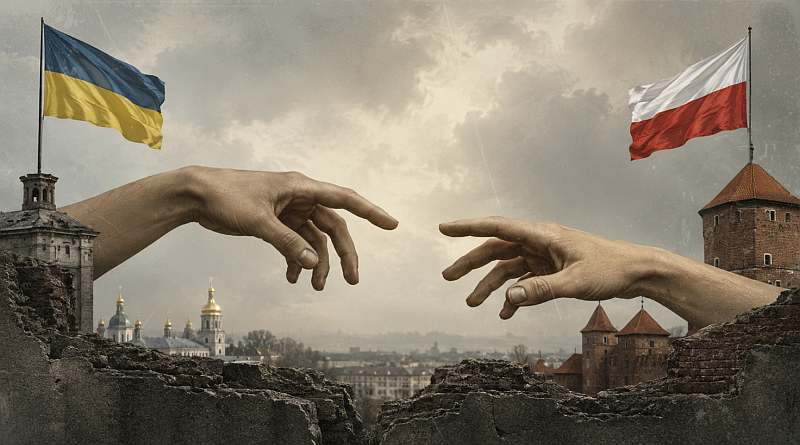
In this text, I will outline five principles which, in my view, can and should help resolve the differences in the approaches of Ukrainians and Poles to assessing our shared history. And one proposal aimed at ensuring our nations remain the closest friends and allies in the future — especially in defending common values against the threats already facing Europe today.
But we need to start not with history. We need to start with understanding the moment we find ourselves in.
The crisis in the relations between Ukraine and Poland arose, seemingly, at the most inconvenient and disadvantageous time for both countries.
Russia’s war against Ukraine has turned protracted, and no one knows today when it will end. Russia systematically attempts to dismantle Ukraine’s economy, logistics, energy, industry, and export capabilities. In such conditions, the Polish direction remains one of the key corridors for Ukraine’s connection to Europe and the world.
A significant portion of aid to Ukraine, including military assistance, passes through Poland. Millions of Ukrainians have found themselves outside their country due to the war. The Ukrainian army is experiencing serious problems with mobilization resources. European financial support helps the Ukrainian society and state withstand, but in conditions where Russia destroys enterprises, warehouses, and energy infrastructure, economic difficulties and migration risks will only grow.
Russia does this intentionally. Its goal is to force Ukraine into capitulation by creating conditions where Ukrainian society itself demands the government to cease fighting at any cost.
But Ukraine’s capitulation would pose a direct threat to Poland.
Firstly, the number of Ukrainian refugees would not decrease but sharply increase both in Poland and other European countries.
Secondly, an occupied or politically subordinated Ukraine would dramatically strengthen Russia. Russian troops, Russian secret services, and Russian military infrastructure would be directly at Poland’s borders on a completely different scale.
And there is no reason to believe that Russia would stop there.
Moscow is already engaging in a hybrid war against Poland and other European Union countries, trying to weaken European unity, stop support for Ukraine, and make individual European states weaker, divided, and more vulnerable to Russian influence.
That is why the Ukrainian-Polish conflict is not just a bilateral dispute. It is a matter of European security.
Russia needs a quarrel between Ukrainians and Poles
At the beginning of the full-scale invasion, Russia failed to foresee several things.
It did not expect the Ukrainian government to remain in Kyiv.
Did not expect that Ukrainian society would massively stand up to defend its state.
Did not expect the ability of the Ukrainian army to resist.
But perhaps Moscow’s biggest miscalculation was in assessing the reaction of the West and, in particular, Poland.
The Russians did not expect the Polish state to support Ukraine so openly. Even more so, they did not anticipate the reaction of Polish society, where millions of Poles helped Ukrainians, welcomed them into their homes, collected humanitarian aid, and supported our military and refugees.
This assistance was extremely important for Ukraine to withstand.
And, ultimately, it was important for Poland itself, as Ukraine today is defending not only itself.
That is why it is crucially important for Russia to destroy Ukrainian-Polish relations now.
If Moscow manages to convince Poles that the greatest threat to them is Ukraine, and Ukrainians that Poland is becoming an enemy, Russia will achieve what it could not with tanks in 2022: strategically isolating Ukraine from one of its most important neighbors.
We see a sharp increase in the number of hybrid operations on social networks. Polish politicians, special services, researchers, and journalists talk about Russian influence. We see political forces whose representatives are not ashamed to contact Russian diplomacy and seek political cooperation with Moscow.
Ukrainians and Poles know well from history how such cooperation with Russia ends.
We will not return to the USSR
At the same time, we must honestly see the other side of the problem.
Among some Ukrainians, there is an opinion that Poland is increasingly starting to behave towards Ukraine like a former empire: trying to dictate who Ukrainians should consider heroes, how they should evaluate their own history, what their streets can be named, and who they have the right to honor.
For a nation that is today waging an existential war against Russia precisely for the right to be itself, any such demands provoke a natural resistance.
No self-respecting state will agree to transfer the right to define its own historical memory to another state.
That is why more Ukrainians are beginning to recall old historical grievances and talk about alleged Polish revanchism.
I consider this perspective to be erroneous.
Despite the presence of radical sentiments, Polish society remains part of democratic Europe. Millions of Poles supported and continue to support Ukraine. Ukrainians remember this support and are grateful for it.
But that is precisely why Russia is interested in convincing Ukrainians of the opposite.
It is no coincidence that Moscow has been spreading the idea for years that the western lands of Ukraine might be “returned” to Poland, Hungary, or Romania. The Russian concept is simple: Ukraine, as an independent political nation, does not exist and its territory should be divided by Russia and neighboring states.
Polish leadership has repeatedly and clearly stated that Poland has no territorial claims on Ukraine, and such assertions are Russian provocations.
But propaganda works particularly effectively when it aligns with real painful events.
Ukrainian society is shocked by incidents of violence and aggression against Ukrainian labor migrants, refugees, women, and children solely because of their origin, because of the Ukrainian language on the street, or even because of an eastern accent in Polish.
The Polish government, police, and local authorities counteract such manifestations. The positions of Polish cities, particularly Sopot, are important, where local authorities have publicly opposed xenophobia.
Ukrainians see and appreciate this.
But the wave of reports about anti-Ukrainian incidents is simultaneously flooding the Ukrainian information space.
Even more worrying is that part of the Polish society, especially the youth, increasingly sees a threat in Ukraine, not Russia. From the perspective of Polish security, this is absurd.
Representatives of the radical right call Poland “Ukropoland,” Ukrainians “Banderites,” and Ukraine a state supposedly dominated by Nazi ideology. This practically replicates key Kremlin narratives used by Moscow to justify the attack on Ukraine.
For Ukrainians, especially shocking is the penetration into the Polish political mainstream of the formula: “You won’t enter Europe with Bandera.” Because no one can fully explain what this should mean in practice.
Subsequently, in these discussions, the Ukrainian Insurgent Army was added to Bandera, along with the names of Ukrainian streets, and the issue of reburial of certain figures of the liberation movement.
If this logic is followed to the end, Ukraine would practically have to abandon a significant part of its national liberation movement from the first half of the 20th century.
This is impossible. Because if Ukraine is to honor only those figures from the past whom both Poland and Russia equally positively evaluate, our choice will be small. We would have to return to the historical paradigm of the USSR.
And there, Putin and his henchmen have long awaited us.
Does this correspond to Poland’s national interests? Obviously not.
Indivisible Security
Ukraine and Poland do not have any fundamental conflict of interests that could not be overcome.
Poland is a member of NATO and the European Union. Ukraine is fighting to become part of these organizations. For Ukraine, this choice is existential: either we become part of the democratic West, or Russia will try to destroy our statehood.
The path to NATO is complex. Ukraine will not be admitted to the Alliance tomorrow. But strategically, this path must be irreversible. No temporary military alliances with individual European countries can fully replace NATO.
And the United States, despite all the changes in American policy, remains a defining force of transatlantic security.
NATO must evolve. Figuratively speaking, we need NATO 3.0 — an Alliance capable of responding to new realities and the new Russian threat.
And Ukraine has something to offer such an Alliance.
The Ukrainian Defense Forces today are among the most experienced in the world in conducting modern land and drone warfare.
The Ukrainian army learns every day.
The Ukrainian military-industrial complex is growing.
Ukraine has learned to strike Russian military infrastructure over long distances.
The Ukrainian society demonstrates exceptional resilience.
These are serious assets.
And that is why it is in Poland’s strategic interest to support Ukraine’s future NATO membership. Because Europe’s security cannot be divided.
We are still not using the enormous potential of cooperation between Ukrainian and Polish defense-industrial complexes. Ukrainians are interested in Warsaw being present in all formats where issues of assistance to Ukraine and the future European security system are decided.
We are interested in Poland’s voice being strong. However, Poland itself does not always leverage its influence according to its real potential.
One of the reasons is intense internal political confrontation. And it is very unfortunate that Ukrainian-Polish relations have become its hostage.
But the Ukrainian government also makes mistakes by sometimes underestimating Poland’s importance, substituting long-term diplomacy with internal PR, and not using all opportunities to strengthen the Polish-Ukrainian strategic partnership.
Challenges of Ukraine’s European Integration
The success of Ukraine’s European integration depends on Poland just as it does on all other European Union countries.
We have already seen with Hungary how much one country can slow down decisions for the entire Union.
If Poland decides to systematically block Ukraine’s membership, our path to the EU will become much more difficult.
It is painful for Ukrainians to realize that Warsaw is no longer the unconditional advocate for Ukraine it was called for previous decades. This seems especially paradoxical now, when Ukraine has made an unequivocal European choice and is paying for it with blood.
Public opinion polls in Poland show significant skepticism regarding Ukraine’s membership in the European Union. However, rational economic reasons for such fear are far from obvious.
Since the start of the full-scale war, Poland has gained significant economic benefits from trade with Ukraine. The vast majority of Ukrainians living in Poland work, pay taxes, and contribute to the creation of Polish GDP. Ukrainian workers and entrepreneurs have become a factor in Poland’s economic growth.
At the same time, there are real contradictions.
After the grain crisis of 2023, Poland imposed restrictions on the import of several Ukrainian agricultural products.
Ukraine understands the sensitivity of this topic for Polish farmers. We understand that agriculture, the redistribution of European agricultural funds, regional development leveling policy, and access for Ukrainian carriers to the EU market will be the subject of tough negotiations.
But this is why these negotiations need to start not after Ukraine joins the EU, but now. Together with Poland, we must start looking for models that will benefit both economies today.
We face disputes over transition periods, just as there were during previous waves of European Union expansion.
During the negotiations on the Association Agreement, the free trade zone, the visa-free regime, and the start of membership negotiations, Ukraine has already proved capable of compromise.
The desire to move towards each other is necessary.
Cooperation between local governments and civil society remains an underutilized resource. We, at the level of the Ukrainian parliamentary group for cooperation with Poland and the Polish cooperation group with Ukraine, must do everything to ensure that the number of such horizontal connections only increases.
Strong Ukrainian Potential Will Serve Poland’s Development
Ukraine’s membership in the European Union is beneficial to Poland not only economically but also from a security standpoint.
The world is increasingly structured around the global rivalry between the United States and the People’s Republic of China.
The main question for us is: what place will Europe take in this world?
If it wants to maintain its subjectivity, it needs a strong economy, innovation, technology, and its own defense capabilities.
Ukraine can become one of the key elements of this new European strength.
Ukrainian defense experience, industry, technology, human capital, and a vast post-war reconstruction market can work not against Poland, but together with Poland.
Europe must remain true to fundamental values: freedom, the rule of law, democracy, the dignity of every person and every nation.
That is why Europe needs more unity, not disintegration and a return to the old “concert of great powers,” in which Russia will once again claim the role of policeman in Central and Eastern Europe.
Russia has not changed its imperial goals or authoritarian nature. Its ideal model of “order” is the silence of the subjugated.
If Europe does not maintain its agency, Poland may lose it as well.
That is why Poland and Ukraine are equally interested in a strong, innovative, democratic Europe capable of defending itself.
Europe is Ukraine
Ukrainian society is genuinely surprised by the growing influence of pro-Russian and anti-European sentiments in Poland. For many Ukrainians, Poland has been a model of successful modernization for decades.
“Solidarity” became a symbol of the fight against communist dictatorship.
Polish economic reforms have shown that a Central European country can modernize quickly.
Poland’s accession to the European Union was a story of success.
For many years, Poland was not only an example but also an ally for Ukrainians.
We believed that together Ukraine and Poland could create one of the strongest centers of power in Europe, preserving their cultures, identities, and national interests.
Why voluntarily return to Moscow’s sphere of influence in such a situation? It borders on national suicide.
Polish populists, who are simultaneously against the European Union and Ukraine, fail to see the obvious: if Ukraine is defeated, Russian pressure on Poland and the entire eastern flank of NATO will only increase.
The slogan of the Ukrainian revolutions of 2004 and 2013–2014 was: “Ukraine is Europe.” Today, it needs to be complemented: “Europe is Ukraine.” Because Ukrainian resistance to Russian aggression and the defeat of the aggressor is one of the main guarantees of security for all of Europe.
We are united with Polish democrats by the understanding of the existential threat of imperial Russia and the need to defend Europe, democracy, freedom, and the rule of law.
From the Ukrainian side, there is hope for Polish support for our European integration.
However, the last decade, especially the current crisis, has shown how deeply history can divide us.
Some Polish politicians and experts propose to “leave history aside.” Unfortunately, this is no longer possible.
The Past Became the Present
I consider it a great strategic mistake to move away from the formula “we forgive and ask for forgiveness,” which defined Ukrainian-Polish reconciliation for many years after Ukraine regained independence. Abandoning this formula has made the past a part of present-day politics.
The Republic of Poland established July 11 as a national day of remembrance for Poles who were victims of violence committed by Ukrainian nationalist formations. Thus, historical memory has become part of current legislation and contemporary politics. Polish legislative and political debates increasingly touch on Ukrainian national symbolism, OUN, UPA, and figures of the Ukrainian liberation movement.
At the same time, Ukraine has its own legal and social tradition of honoring those who fought for Ukrainian independence. In 2015, Ukraine legally recognized members of the OUN and UPA as fighters for Ukraine’s independence in the 20th century.
For a significant portion of Ukrainians, honoring the figures of the liberation movement is an entirely natural element of national memory, existing since the end of the Soviet era.
Ukrainian decisions regarding street names, monuments, or reburials simultaneously provoke strong reactions in Poland.
In the Polish public sphere, debates continue over the number of Polish victims of the Ukrainian-Polish conflict. Various figures are cited — from tens of thousands to over a hundred thousand dead.
In Ukraine, search efforts have resumed, burial sites of Polish victims are being identified, and exhumations are conducted. These processes draw significant public attention in both countries.
Moreover, historical issues have already become a tool of internal political struggle and will undoubtedly remain so in upcoming election campaigns.
Thus, we can no longer bracket history aside. We must learn to live with it.
History cannot be bracketed: Five principles
I propose five principles that, in my opinion, Ukraine and Poland should adhere to.
First principle. The dead have the right to a name and a grave.
The right to search, exhume, and respectfully bury the victims of the Ukrainian-Polish conflict cannot be denied by either side. There should be no political reasons preventing a family from knowing where their loved one is buried.
Searches, exhumations, identifications, and reburials should comply with the laws of both states, scientific standards, and religious traditions.
Second principle. Every nation has the right to its own historical memory — but this right must be mutual.
Poland has the right to critically assess Ukrainian historical figures and formulate its own view of the past. However, this cannot mean the right to ignore crimes committed by Poles against Ukrainians and the memory of thousands of Ukrainian victims.
Similarly, Ukraine has the right to its own evaluation of its historical figures.
At the same time, we must be ready to honestly discuss the darker aspects of the activities of those we consider heroes. But we must do this not within the framework of Soviet and Russian propaganda myths created to discredit and dehumanize all who fought for Ukraine’s independence. We need our own, modern, scientific, and honest view of the past.
Third principle. We must remember not only conflicts but also alliances.
Today, disputes about the past have almost replaced the memory of those moments when Ukrainians and Poles fought together.
One of the most important examples is the year 1920, the Warsaw Agreement between the Ukrainian People’s Republic and Poland, the alliance of Simon Petliura and Józef Piłsudski, and the participation of Ukrainian military in the war against Bolshevik Russia.
We should not only remember when Ukrainians and Poles killed each other. We are obliged to remember when they fought together against a common enemy.
Fourth principle. Ukrainian historical memory must be part of the European historical memory.
Russia presented its invasion of Ukraine as an alleged fight against “Nazism” and “Banderism.” Ukrainians have brilliantly dismantled this propaganda construct.
Self-ironic terms like “bandero-moskali” or “Jewish-Banderite” have become ways to mock Russian propaganda and show that modern Ukrainians are a political nation that the Kremlin has failed to divide along ethnic, linguistic, or religious lines.
But our integration into the European historical space requires one more step.
We need to show not only the heroism of the Ukrainian struggle for freedom but also Ukraine’s place in the history of Europe.
To remind about the role of Stalin’s Soviet Union at the start of World War II.
About the joint partition of Poland by Nazi Germany and the Soviet Union.
About the historical roots of modern Russian calls to divide Ukraine once again among neighboring states.
Ukrainian history is part of European history.
The fifth principle. It is necessary to return to the formula “we forgive and ask for forgiveness.”
This formula became the foundation of major European reconciliations, primarily the Polish-German one.
But to restore it between Ukrainians and Poles, the very center of the historical discussion needs to be changed. Shift the focus from heroes to victims. From political disputes to human names. From competition of national truths to the dignity of the individual.
Memorial of Remembrance for Victims
Polish Prime Minister Donald Tusk announced the intention to create a wall of remembrance in Warsaw with the names of Polish victims of the Ukrainian-Polish confrontation. This involves tens of thousands of people, and accurately establishing their names requires significant further work by historians.
Ukraine has much to contribute to this initiative.
At the Ukrainian Catholic University, work has been ongoing for many years to establish the names of victims of the Ukrainian-Polish confrontation from 1939–1947. Historians collect information about the Ukrainian and Polish deceased, verify sources, and restore the fates of specific individuals.
In my opinion, it is time to propose to the Polish side the joint construction of a Memorial of Remembrance for the victims of the Ukrainian-Polish confrontation in Ukraine with a list of the deceased by name.
In Ukraine. Because it is on Ukrainian soil that the remains of a large portion of the Polish and Ukrainian victims of this confrontation rest, as well as representatives of other nationalities.
This should not be a memorial of Ukrainian truth against Polish truth. Nor Polish truth against Ukrainian. It should primarily be a Memorial of people. A place where the names of innocently killed Poles and Ukrainians stand side by side. Where there is no competition of numbers. No pre-election maneuvering. No attempts to use the deceased in contemporary political struggles.
Names should be established by historians. Facts should be verified by scholars. Exhumations should be conducted with respect for laws, religious traditions, and the dignity of the deceased.
And the task of politicians is to create conditions in which this work becomes possible.
I am convinced that such an initiative can gain the support of civil society, churches, historians, politicians, and authorities of both countries. It could become proof of our ability not to forget the tragic past but to overcome it.
We will not change history.
We will probably never agree on a uniform assessment of all its figures. And we should not demand this from each other.
But we can agree on something much more important.
Every victim has the right to a name. Every family to a memory. And our nations to a future.
A joint Memorial of Remembrance for victims could become the first major step towards new Ukrainian-Polish reconciliation.
Reconciliation that is needed today not only by Ukraine and Poland.
