
Oleksandr Kovalenko / Obozrevatel
In Gelendzhik, Ukrainian defenders destroyed a unique Russian electronic warfare complex “Volna Kupol Garant” worth $1.5 million, designed for jamming Starlink satellite communication. Notably, this most powerful EW complex, which is also supposed to be a nightmare for drones, has not for the first time come under attack, raising doubts about the effectiveness of this Wunderwaffe.
More details on this in the new material of the joint project OBOZ.UA and the group “Information Resistance”.
Target After Target
In June, pilots of the 422nd Separate Unmanned Aerial System Regiment LUFTWAFFE struck the EW complex “Volna Kupol Garant”, marking the first confirmed destruction of equipment of this type.
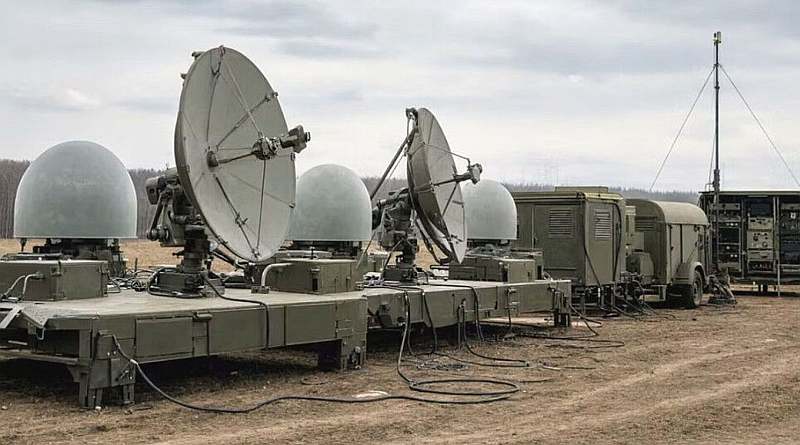
“Volna Kupol Garant” is produced in the temporarily occupied Simferopol and consists of a complex of satellite antennas mounted on trailers disguised as a civilian object. The system’s task is to jam Starlink satellites which receive signals from ground terminals in the 14-14.5 GHz range across eight channels.

It is not surprising that one of these complexes was located in Gelendzhik, near which lies Vladimir Putin’s palace, which impresses not only with its size and the public funds spent on it but also with the echeloned air defense system formed around it. The enhancement of this air defense with such a powerful EW means was supposed to increase the effectiveness of the fight against Ukrainian drones.
And so at the beginning of August, yet another “Volna Kupol Garant” complex is destroyed. The system, which on paper suppresses and jams everything flying in low Earth orbit, in reality, cannot protect even itself, let alone create some kind of “blind-deaf-mute” zone.

“Volna” does not guarantee the dome
Before understanding how it happened that the most powerful Russian electronic warfare (EW), designed to combat Starlink satellites in low Earth orbit (i.e., at altitudes from 500 to 570 km), is unable to protect itself from drones, it is worth clarifying its characteristics.
Let me immediately note that complete and reliable information about the specifications of “Volna Kupol Garant” is not published anywhere, but preliminarily, based on information available in open sources, we can conclude that this system includes:
– trailers with Ku-band transmitters and antennas with a gain of 40 dB, ranging from 8 to 12 in number. Optimal for performing tasks set for the complex;
– 12 transmitters;
– a powerful generator of 14 kW.
The complex also has a pure microwave radiation power of 1.25 kW per channel and, depending on the number of transmitters, from 10 kW to 15 kW.
As we can see, the figures are quite impressive, and indeed, it gives the impression that we are talking about an exceptionally powerful means of suppressing and jamming satellite communications. But this is only at first glance.

The first myth to debunk about the EW “Volna Kupol Garant” is its Starlink jamming range – “20 km²”.
In reality, 20 km (not square kilometers, I note, as is often indicated, because we are talking about distance, not area) is the maximum barrier, the limit beyond which a one-meter diameter antenna can track a satellite at a limited angle and generate a beam of interference in its direction. The actual area of the “blind-deaf-mute” zone is… from 1 to 2 km².
The nuance is that these 1-2 km² are projected onto a portion of land under the satellite as it flies while being influenced by interference. That is, the effect is not stationary but moving. However, it does exist. So does the system work?
Yes, the system works, albeit over a significantly smaller effective area, but here’s the point – it does not guarantee even in this zone the absolute suppression of the enemy.
The fact is that as soon as a strike drone loses connection with the Starlink satellite, it immediately switches to the nearest available one. In turn, the 8-12 transmitters and antennas of the “Volna Kupol Garant” cannot guarantee suppression of all satellites that simultaneously appear in the operational zone.
In other words, on one hand, suppression and jamming occur, but the point of it, essentially, is not that significant, as a modern drone automatically switches to an unjammed satellite.
But the most interesting thing is that as soon as the “Volna Kupol Garant” starts operating, this zone immediately demasks itself with a giant emission of heat and microwave energy. Essentially, this EW (Electronic Warfare) is like a New Year’s salute in the darkest night, which is impossible to miss.
Such powerful and overwhelming demasking properties of this complex allow it to either be bypassed in operational mode (considering its limiting capabilities to create a “deaf-blind” zone covering 1-2 km² at a maximum distance of up to 20 km), or directly aim for the zone of volcanic activity to destroy the “Volna Kupol Garant”.

In a sense, this EW complex not so much protects as it attracts attention with its giant heat and microwave generation.
Conclusions
In Russia, lacking the ability to catch up with and overtake Starlink in terms of the scale of the satellite group, decided to follow the traditional route: to create something that would suppress and destroy. Moreover, they initially attributed this Wunderwaffe with properties that, to put it mildly, do not correspond to real characteristics.
As a result, in an attempt to create a viable system, Russia succeeded partially. Let’s say, about 10% of the initially set task.
EW “Volna Kupol Garant” does not guarantee absolute safety, and the laws of physics and modern technologies allow either bypassing the operational zone of this complex or purposefully targeting it, as the system demasks itself.
All the aforementioned factors fully explain the reasons why this unique EW system is destroyed by Ukrainian drones without much trouble, which, theoretically, should not have been able to approach it within tens of kilometers. This does not negate its operability, which, in turn, does not benefit it much but rather harms it.
And this does not mean that, having achieved an initial, albeit chaotic effect, the Russians will not try to improve it and increase its efficiency. Therefore, to ensure that this complex of dubious quality and functionality does not become a serious challenge for our drones in the near future, it is necessary, without delay, to destroy the production facilities where the assembly of the “Volna Kupol Garant” takes place.
On the cover: Russian complex “Volna Kupol Garant”. Photo: MilNews
