
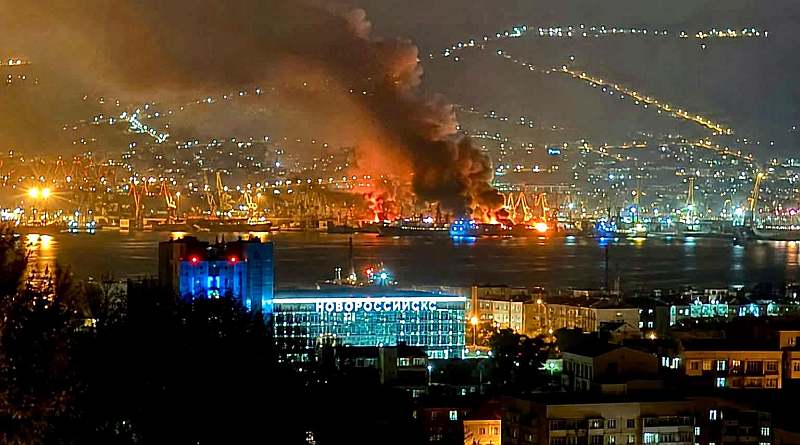

Yesterday was a very intense day, so you might have missed important details of yesterday’s attack on Novorossiysk. And I must highlight them. It was not just “fire from all barrels” on our drones, as seen in the video, an impression of the port and two ships. It was a huge combined special operation by our Defense Forces. Almost all services and key units were involved.
While the Airborne Assault Forces and storm regiments have been continuing the operation to restore control over settlements in the Hulyaipole direction since the beginning of the year (26 villages have already been reported liberated, but the operation is still ongoing), the infantry is holding positions, – all other forces participated in this crazy night attack on Novorossiysk.
Again, I repeat, this is our planned work, not an emotional or any other response. The roosters have been destroying port and other infrastructure in Odesa and southern Ukraine for several years, and such an operation on this scale could have been planned for no less than a month.
Just think about how much coordination it takes for the Main Intelligence Directorate to give Maguras and mid-strikes, the Security Service of Ukraine to provide Sibeybis and drones, the SBS to fly with all flying means, the Navy to supply Neptunes and Sargans – how many meetings need to be held? How many groups in different messengers? 😉 And the synchronization, when the surface UAVs arrived (some serving as air defense with R-37 missiles, some as a base for FPV, some even were kamikaze), almost all existing mid-strikes and jet drones were used. The latter – “Palyanytsia,” “Hell,” “Bars,” and a broad list of mids – MICH, Fire Point, “Ramzay,” “January,” “Trust,” “Kharyok,” “Bober,” “Lutyi,” “Dovbush.”
And all this with different speeds, routes, and timings arrived within two hours at their targets in the Novorossiysk area! This is a much more massive and larger operation than the Web and the flight to Moscow! Impressive coordination and use of all available means, I am truly amazed by such an operation.
Now let’s see what was hit, which targets, and why it’s so painful for the export of swamps. Because the main blow was directly at it.
The portal of the “Grushova” oil depot tunnel and the “Sheskharis” oil terminal were damaged. Simultaneous targeted hits struck the grain and fuel oil terminals of the Novorossiysk Grain Products Plant (NKHP) and the Novorossiysk Grain Terminal (Demetra Holding). According to Reuters, both key grain terminals of the port have completely ceased operations.
The defense forces fundamentally did not touch the facilities of the Caspian Pipeline Consortium (CPC). The CPC terminal is located away from Novorossiysk – in Yuzhnaya Ozereevka. Kazakh oil is pumped through it, and the main shareholders of the fields are Western giants Chevron and ExxonMobil. Russian propaganda regularly tries to substitute the concept and present the legitimate military target “Sheskharis” as the CPC terminal to accuse Ukraine of attacks on international interests. In reality, strikes are exclusively on purely Russian military-economic arteries.
To understand the scale of economic impact, it’s worth looking at the numbers.
Unwashed agricultural exports in 2025 amounted to $41.6 billion. Grain accounts for 27.3% of this amount, and fat-and-oil products account for 22.3%. That is, half of all of Russia’s agricultural revenue relies on these two positions. After navigation in the Azov-Don Canal and the Kerch Strait effectively halted from July 10 due to security risks, the Azov ports (Rostov-on-Don, Taganrog, Azov) dropped out of the loop. And it was through them that almost 25% of all Russian grain exports and over 50% of vegetable oil exports passed.
Russian traders frantically tried to reorient all volumes to the Black Sea. If in June the share of Novorossiysk and Taman in exports was 41%, by July it jumped to 63%. However, the Black Sea terminals were instantly overloaded: the KSK grain terminal transferred 9.2 million tons with a passport capacity of 10.5 million tons, and by the end of July, the Novorossiysk terminals stopped accepting grain from road transport due to complete congestion. Now, after the blow to the NKHP and grain facilities, this valve is completely knocked out.
Russians are physically unable to redirect agro-export to the Baltic. Logistics from the southern and central regions of the swamps to the Azov ports takes 1-2 days, to Novorossiysk – several days, and to the Baltic ports of Vysotsk or Ust-Luga – from 1 to 2 weeks. The railway is jammed, the delivery shoulder is gigantic, and transportation costs eat up all the profit. Even the initiative of the Ministry of Agriculture to subsidize 90% of the railway transportation costs to the Baltic cannot compensate for the lack of specialized capacities and throughput.
There is already panic in the domestic market of Laptistan. Grain in producers’ warehouses is sold for 10,500 rubles per ton without VAT, which is already below cost. Prices for 3rd class wheat have dropped by 17.8% (to 13,455 rubles), and for 4th class – by 20% (to 12,205 rubles). According to the Russian Grain Exporters Union’s estimates, with a complete blockade of the Black and Azov Seas, Laptistan will underdeliver 30-35 million tons of wheat to the world market from the planned export of 61 million tons. That is, Russia is losing more than half of its export potential. The situation with oil is further exacerbated by the Russian authorities, who raised the export duty by 2.4 times – to 7,748 rubles per ton from August 1.
The reaction of specialized media, analysts, and farmers’ associations (such as “ProZerno” or “People’s Farmer”) boils down to the fact that farmers are on the verge of bankruptcy and will not have funds to finance the next planting campaign. Z-bloggers and war correspondents, in despair, point out that the Ukrainian Defense Forces managed to uncover the air defense system of Novorossiysk and paralyze objects in the most protected port of the Russian Black Sea Fleet.
Now do you understand why it is so important for me to highlight these details of such a cool and very successful operation? 🙂
On the affected ships Admiral Makarov and Essen, the launchers of the Kalibr cruise missiles were damaged, but I remind you that there are universal navy launchers there that can be replaced quite quickly. And the surrounding damage – there are no details about it. And these ships were secondary targets – the main target was the Laptistan export.
And once again, I remind you that Russia’s agricultural export in 2025 amounted to as much as $41.6 billion, and it is very important for us to reduce such figures by all means. And as far as I can see, we are succeeding. The summer for the swamps definitely became hot, and for the farmers – even scorching 😎
