
Una Hajdari, Politico / Translation by iPress
The European publication Politico analyzes how Volodymyr Zelenskyy’s careless statement about non-recognition of Kosovo’s independence during his first official visit to Serbia caused a diplomatic stir in the Balkans. The publication traces how this move affected Pristina’s attitude toward Kyiv, exacerbated the dispute between Serbia and Kosovo around the Ibar River, and at the same time revealed Ukraine’s pragmatic motives related to the supply of Soviet-style ammunition. The material also shows how Serbian President Aleksandar Vučić uses the rapprochement with Zelenskyy as a tool for political maneuvering amid criticism from the European Union. Ultimately, Politico raises the broader question of whether the Kosovo precedent remains a unique case or could serve as a model for other territorial disputes worldwide.
The Ukrainian president experienced firsthand that there are no innocent statements about Kosovo, writes the European publication Politico.
Visit to Belgrade and Statement on Kosovo
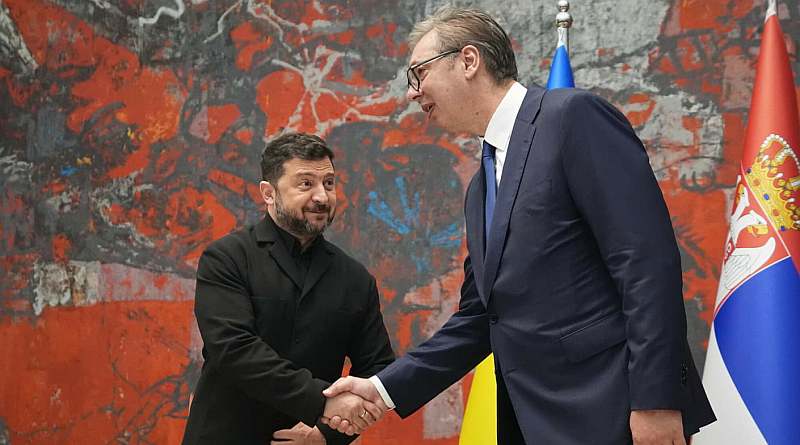
The publication notes that Volodymyr Zelenskyy’s trip to Serbia last weekend continued to echo in the Balkans long after the Ukrainian president’s return to Kyiv. On Saturday, he met with Serbian President Aleksandar Vučić—a politician who refuses to join EU sanctions against Russia and maintains close ties with the Kremlin. During this visit, Zelenskyy touched on the region’s most sensitive issue, stating that Ukraine would continue not to recognize the independence of Kosovo—a former Serbian province.
Kosovo responded immediately: a huge blue-and-yellow banner with the words “Free Ukraine,” which had been hanging on the main street of Pristina since 2022, was quickly removed. The city’s mayor, Përparim Rama, stated that his sympathies remain with “peoples suffering from war, violence, and persecution,” but “respect must be mutual.”
Escalation around the Ibar River
Following Zelenskyy’s visit, Vučić threatened to change the course of the Ibar River, which flows from Serbia to Kosovo, in response to the Kosovo side demolishing houses owned by Serbs on the reservoir’s bank. The implementation of this threat would dry up the reservoir, which provides a significant portion of Kosovo’s water supply and supplies water for cooling the country’s largest power plant.
Meanwhile, Serbian Foreign Minister Marko Đurić and Albanian Prime Minister Edi Rama exchanged barbs on the X network: the Albanian prime minister accused Belgrade of being “in a political bubble” and denying the fact that “Serbia lost Kosovo” a long time ago.
Historical Background
Politico reminds us that for most of the 20th century, Kosovo remained a predominantly Albanian-speaking southern province of Serbia. Under socialist Yugoslavia, its population had extensive political rights until a decade of Serbian repression against dissent led to the armed conflict of 1998-1999. A three-month NATO bombing campaign forced Serbian forces to leave, after which the province came under UN protection.
Kosovo declared independence in 2008 and is now recognized by over 100 countries, including the USA, the UK, and 22 out of 27 EU member states. Kosovo is also a potential candidate for EU membership, having submitted the relevant application in December 2022.
Kosovo as Putin’s Argument
The status of Kosovo, Politico emphasizes, has long been a favorite subject for Putin, who used the Kosovo precedent to justify the invasion of Georgia in 2008 and the annexation of Crimea in 2014. Kosovo’s Foreign Minister Glauk Konjufca stated that he regretted Zelensky’s position and dismissed “attempts by Russia to use Kosovo as a precedent.”
Why Zelensky Decided on This Step
Politico suggests that the reason the Ukrainian leader decided to intervene in the intractable Balkan issue likely lies in weapons. Serbia still produces significant amounts of Soviet-caliber ammunition, which Western partners of Kyiv, who adhere to NATO standards, cannot provide. Meanwhile, Ukraine still has Soviet heavy howitzers and tanks, which remain crucial for battles in Donbas and other directions. Despite its pro-Russian stance, Vučić is willing to supply such ammunition to Kyiv—quietly, without publicity.
Florian Bieber, head of the Center for Southeast European Studies at the University of Graz, explained: “Ukraine is in a position where it cannot concern itself with anything other than its own urgent needs, and that’s why Vučić is more important to it.”
The rapprochement between Vučić and Zelensky could also be an attempt to soften criticism from Brussels: EU leadership has condemned the “outbreak of violence” during prolonged anti-government protests in Serbia and the “decline of democratic standards” in the country.
Bieber added: “He hopes that in the coming months, criticism will be less severe due to closer ties with Zelensky, at least on a symbolic level. Vučić does this to have leverage over the EU ahead of possible elections in the country.”
Kosovo as a Precedent or Exception
Supporters of Kosovo’s independence have been insisting for years that its independence is a unique case, rather than a model to follow. However, the circumstances of its separation from Serbia still spark controversy, especially among EU members like Spain and Cyprus, which have their own separatist movements and still refuse to recognize Kosovo’s independence.
“Depending on which side of this dispute you support, you will have a different view of what Kosovo’s independence means for other conflicts and territorial disputes worldwide,” Bieber concluded.
