
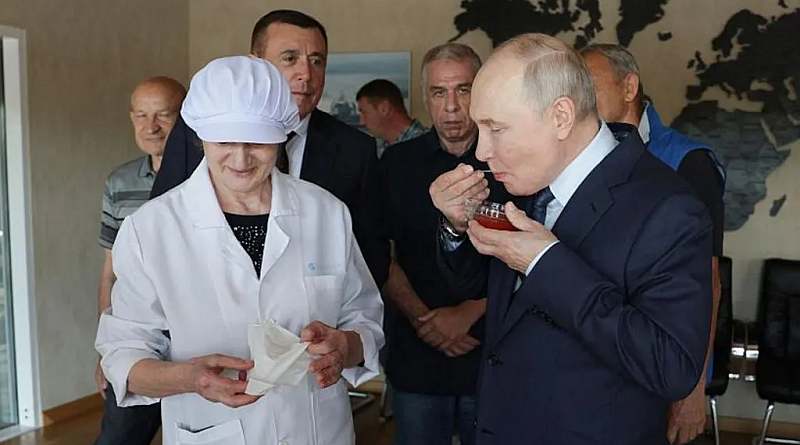

Putin visited the Southern Kuril Islands for the first time — the Northern Territories of Japan, which are under Russian occupation. He visited Iturup, marking his first visit to this island.
Putin is not the first Russian leader to visit the occupied Japanese territories. Before him, Dmitry Medvedev did so repeatedly — both as president and as prime minister of Russia. In 2010, Medvedev became the first leader of Russia or the Soviet Union to visit one of the disputed territories — Kunashir.
But no leader of the Soviet Union ever visited there. And this is telling.
Even during the Cold War, the Soviet Union was forced to adhere to certain rules of the international order that was established after World War II. After the fall of the Berlin Wall, this order increasingly relied on democratic principles, international law, state sovereignty, and the inviolability of borders.
Today, Russia is trying to change the very rules by which the modern democratic world functions.
This is why it is crucial for Ukraine not only to withstand the front lines in the war with Russia but also to have reliable allies in the global confrontation between democratic and authoritarian worlds.
Ukraine must unequivocally condemn Putin’s visit to Japan’s Northern Territories.
This would be completely logical and consistent, especially since on October 7, 2022, the Verkhovna Rada of Ukraine appealed to the international community regarding Japan’s Northern Territories, and the President of Ukraine issued decree No. 692/2022. It states directly that Ukraine respects the sovereignty and territorial integrity of Japan, including its Northern Territories, which remain under the occupation of the Russian Federation, and recognizes them as an integral part of Japan’s sovereign territory.
Putin’s visit to Iturup further demonstrates that the issue is much broader than Russian aggression against Ukraine. The Kremlin seeks to unite authoritarian regimes around the idea of revising the international order and a new redistribution of the world.
In this context, I believe Ukrainian policy regarding Kosovo is also flawed.
The independence of Kosovo has been recognized by most European Union member states, as well as the USA, the United Kingdom, and many other key allies. Therefore, demonstratively supporting the Serbian position on not recognizing Kosovo, as effectively happened during Volodymyr Zelensky’s recent visit to Belgrade, is politically shortsighted.
Especially considering that Serbia still tries to balance between the European Union and Russia, has not joined sanctions against the Russian Federation, and maintains close ties with Moscow. Meanwhile, Kosovo consistently looks to the West and builds its statehood in cooperation with the USA and European democracies.
Ukraine needs a clear values-based foreign policy.
We cannot demand principled stances from the democratic world regarding the Russian occupation of Ukrainian territories, recognize the Russian occupation of Japan’s Northern Territories, and at the same time remain hostages to the old Ukrainian “multi-vector” policy when it comes to our allies and fundamental political values.
The world is increasingly divided not just into states with different interests but into democracies and authoritarian regimes that seek to revise the international order.
Ukraine must clearly know which side it is on. And demonstrate this just as clearly.

It has been exactly 26 years since one of the most tragic pages in the history of the modern Russian navy. On this day in 2000, the nuclear submarine “Kursk” sank in the depths of the Barents Sea, taking the lives of 118 crew members. This date forever remained a symbol of the heartlessness of the state system when the disaster demonstrated the complete unpreparedness of the rescue services and the criminal hesitation of the leadership, which refused timely international aid from the United Kingdom and Norway, while no less than 23 sailors continued fighting for their lives in the flooded ninth compartment.
A quarter of a century later, the Kremlin prefers to demonstrate not mourning and respect for the fallen but the usual belligerent rhetoric and aggressive blackmail.
Vladimir Putin arrived at the Pacific Fleet exercises and boarded the missile cruiser “Varyag” to deliver a speech filled with geopolitical grievances and direct threats to the global community.

In his speech, Putin reflected on the military actions in Ukraine, the confrontation with the West, and security in the Asia-Pacific region, but did not mention the 118 submariners who perished in 2000. Such demonstrative disregard for the memory of the fallen warriors underscores the cynicism of the Russian authorities, who view human lives solely as expendable material for achieving their geopolitical ambitions.
The official reason for the naval show was the completion of large-scale maneuvers by the Pacific Fleet, involving over 13,000 military personnel, about 60 ships and submarines, as well as around 30 aircraft.
While on board the cruiser, Putin delivered sharp accusations against European countries, as Western states are striving to intercept illegal operations of the so-called “shadow fleet” used by Moscow to circumvent the international sanctions regime. The Russian leader called the lawful attempts by Europeans to restrict the movement of tankers piracy and robbery, announcing Moscow’s readiness to deliver reciprocal strikes on commercial vessels in any waters of the world.
Such statements effectively signify the Kremlin’s shift to open legalized piracy on a global scale, with Russian naval forces ready to seize commercial ships from other states.
Particularly alarming is the fact that Putin’s aggressive outbursts extend to the Asia-Pacific and Arctic regions, where the Kremlin tries to justify its growing naval presence with accusations against NATO. The Russian dictator claimed that the alliance is attempting to infiltrate the region and deploy new types of weapons there, posing a direct threat to the country’s security.
Regarding relations with Japan, which has officially identified Russia as one of the key threats in its strategic documents for the first time, Putin tried to portray Tokyo as the instigator of escalation. He declared that Moscow has no territorial claims against its neighbors and poses no threat, even though Russian troops continue to occupy the Southern Kuriles and conduct aggressive exercises there. A similar situation is observed in the Arctic, where declarative readiness for international cooperation on the Northern Sea Route is combined with militarization of the region and attempts to establish unilateral control over international transportation arteries.
The anniversary of the “Kursk” tragedy once again revealed the true nature of the current regime, where instead of learning from past tragedies, the authorities prefer to increase the level of international tension, rather than reflecting on the nation’s well-being.
* * *

Geopolitical tension in the East Asian region has reached another peak, as Putin made a demonstrative visit to the island of Iturup, known as “Etorofu” in Tokyo, which is considered an integral part of national sovereignty. For the first time in 26 years of staying in power, Russia’s top leadership personally visited the southern part of the Kuril chain!
Japan’s Prime Minister Sanae Takaichi made an official statement emphasizing that such actions violate the historical and legal rights of the country.
In response to the visit of the head of the Russian Federation, Tokyo promptly summoned Russian diplomatic representative Nikolai Nozdrev to hand him a note of strong protest. According to analysts from Japanese print media, this indicates a departure from Moscow’s attempts to engage in constructive dialogue, as the Kremlin leadership has deliberately chosen the path of escalation.
Speaking to journalists, Prime Minister Sanae Takaichi pointed out that the demonstrative visits of senior Russian officials to the Southern Kurils damage the sentiments of the Japanese and make it practically impossible to restore bilateral relations in the medium and long term.
The Japanese leadership constantly recalls the events of 1945 when Soviet troops occupied 4 southern islands of the archipelago, forcing 17,000 residents to leave their native lands. Tokyo consistently emphasizes that these territories belong to Japan both from a historical perspective and based on international law.
This rhetoric indicates a deep crisis of trust, which worsened after Tokyo imposed sanctions in 2022.
Japanese observers note that the timing of the visit was not coincidental, as diplomatic contact between the states has been blocked in recent months.
Experts note that Moscow seeks to demonstrate the uncompromising nature of its position against the backdrop of Tokyo’s rapprochement with NATO and the expansion of joint military exercises with the United States. Japanese analysts view the demonstration of Russia’s presence on the island as a pressure tool intended to punish Sanae Takaichi’s cabinet for supporting Ukraine and joining Western financial restrictions.
Many authoritative experts in Tokyo agree that the demonstrative trip to Iturup closes the window of opportunity for signing a peace treaty, which has been absent for 80 years since the end of World War II.
The Kremlin’s attempt to press sensitive points in Japanese society led to the opposite effect, strengthening the consensus on the need to counter external threats and further deepen the alliance with Western partners.
Tokyo is now forced to build a long-term foreign policy concept, considering that the northern neighbor has completely abandoned seeking compromises and has preferred to use the disputed territories as a tool of political blackmail. Sanae Takaichi’s strong protest shows that Japan does not intend to ignore such actions, and therefore, the diplomatic confrontation between the states enters a new phase.
In the image: Putin tasted black caviar during a visit to Iturup. Photo: Occupier’s media
