
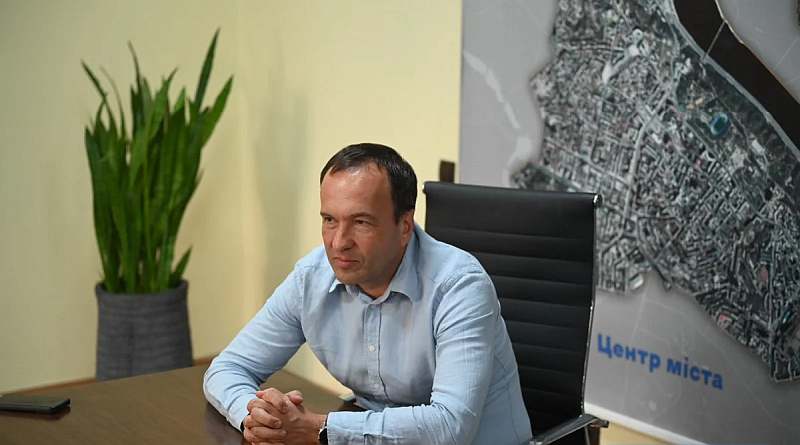
Petro Panteleiev is a person who needs no introduction within governing circles, yet is somewhat lesser-known to the residents of Kyiv. For 12 years, he has served as Deputy Head of the Kyiv City State Administration, but he has not developed his “brand” as a public politician. Panteleiev is acknowledged as a professional in the housing and communal services sector, and is spoken of with equal respect by subordinates, friends, and even those who can be considered political adversaries of Klitschko’s team. Nearly a year ago, Petro Panteleiev changed his office and nameplate: he assumed the duties of the First Deputy Head of the Kyiv City State Administration after a scandal and political pressure forced Klitschko to dismiss another indispensable team member, Mykola Povoroznyk.
After the redistribution of responsibilities, financial and economic blocks of the Kyiv City State Administration were added to the areas coordinated by Panteleiev (housing and communal services and territorial control). It’s important for us that this official from the mayor’s team is fully responsible for preparing Kyiv for winter: he manages the budget, program distribution, the work of the housing and utilities sector, and all relevant municipal enterprises that ensure the city’s viability (heat, water, gas).
Petro Panteleiev was responsible for preparing Kyiv for last winter, and he is currently overseeing the preparation and implementation of the city’s resilience plan.
Despite the respect colleagues have for the manager, one cannot say that Kyiv successfully overcame the challenges of the winter of 2026. But there is simply no other person taking on responsibility for this direction available to Kyivans right now. The city mayor has not gained a reputation as a manager deeply involved in the depths of city affairs, and last winter he kept a pulse on the current challenges rather nominally. The Chief of the Kyiv Military Administration, appointed by the president to oversee processes in the capital, significantly reduced his activity just before the start of last winter and did not show any presence during the trials. Almost six months ago, the president announced the involvement of his advisor Oleksandr Kubrakov in preparing Kyiv for winter. However, this initiative wasn’t realized: according to our information, Kubrakov refused to “go against Klitschko,” participate in any confrontation, and from open sources, it is evident that he has long ceased to play a notable role in the meetings regarding the resilience plan.
So, we can only rely on Petro Panteleev, his professionalism, and resilience to political storms. In February, when everything in Kyiv was collapsing due to frost and energy hits, catching Panteleev for an in-depth conversation was impossible due to his hectic schedule: this is not an overstatement — the first deputy literally lived on Khreshchatyk, 36 and worked non-stop at various sites. In the spring, during the phase of challenge analysis and resilience planning, we had the opportunity to hear the position of this official at a meeting of the discussion club LB.ua “New Country”. Now, we have invited Petro Panteleev for a large conversation about winter preparations amidst another wave of turmoil in central government, personnel changes in the cabinet, and statements from politicians at various levels that “regions will not be able to complete resilience plans.”
Mr. Petro, in recent weeks we have heard a lot about the inadequate pace of implementing resilience plans in regions, and Kyiv separately concerns the president. What exactly does the central government dislike about Kyiv’s preparation dynamics for winter?
I can only speak from my position and about the things I am responsible for. We are currently in the most active phase of preparing for winter. Everything is so intense — this involves both organizational and technical measures, as well as financing — that we are outside of political discussions on these topics. At least, we don’t feel any political interference.
The task is to prepare for the heating season as effectively and comprehensively as possible. Accordingly, the state leadership, of course, strictly demands this from local executors.
And primarily, this is probably a matter of our survival, so it’s a bit above politics.

There are statements everywhere that “the next winter will be the scariest.” Can you explain what this is about?
I cannot comment on others’ statements.
Do you have a feeling that the next winter will be worse than what we experienced this year?
I would say this: everything we are doing now will allow us to be much better prepared for winter than, for example, last year. Because we are doing a lot of work.
Is this a guarantee that we will have a mild winter?
No. It’s definitely not worth expecting an easy winter. Primarily given the intensity of the shelling we’re currently experiencing, the level of weapons the enemy is using, and the capabilities of our air defense.
We (the city authorities) are systematically building protection for critical infrastructure, working on accelerating the creation of alternative energy infrastructure, and doing other things, but we must also prepare for scenarios in extreme conditions. We are doing that as well.
We must be realistic. We are living in a harsh phase of the war, where civilians have become one of the priority targets for the enemy.
Recently, the government composition was updated, and the Minister of Infrastructure changed. You’ve known Mykola Kalashnyk from his work in Kyiv, in the city administration. How is your interaction with the new government, and have there been any comments or demands different from the previous ministry?
I can say that, first of all, we’ve felt that Kyiv is a priority.
In the first week, we had two meetings at the level of the Prime Minister. We thoroughly discussed all issues related to the city’s life support, preparation for winter, and the resilience plan. This shows real attention to the capital, which I see positively.
Both the Prime Minister and the relevant minister are familiar with our issues of building and protecting critical infrastructure. They worked in Kyiv and experienced the last winter in other positions related to this sphere. They understand the context and specifics of our work well.
It’s very positive that our requests for help have been taken on board and are being promptly acted upon. This includes resolving regulatory issues and financing matters.
There’s no delay related to changes in the government. We’ve started working without any politics, focusing solely on results.
You mentioned there have been some shifts from the government regarding funding and the processing of permits. What are you referring to?
This concerns specific projects that we can’t discuss in detail. They are speeding up processes that are usually quite lengthy. For example, an issue that typically takes months to consider is brought to the Cabinet three days after the first discussion meeting.
There are also preliminary decisions on funding measures for Kyiv’s resilience plan.
The Presidential Office played a significant supportive role in consolidating our work with state banks. The head of the Presidential Office personally held several meetings with the banks to consolidate our efforts in raising funds.
In the approved resilience plan, the measures Kyiv is undertaking with the state are valued at over 31 billion hryvnias. This budget was split 50/50 between the state budget and Kyiv’s budget. Is this position still maintained?
This position is maintained. However, I want to note that the legal proportion is not fixed anywhere. The agreement is supported by the new government, and preliminary decisions on funding specific directions for Kyiv have been made.
What are these directions?
Primarily, the creation of backup heating systems and engineering and technical protection of critical infrastructure facilities.
The obligation of Kyiv to finance 50% of the program is a considerable sum, about 16 billion hryvnias. Can Kyiv fulfill such obligations?
This is indeed a large sum. But here we simply have no choice.
Just before our conversation, I returned from Sberbank, where I’m finalizing the agreement on a city loan.

We need to explain here that the majority of Kyiv’s contribution to the resilience plan expenses will come from funds attracted from financial institutions.
Yes. The decision to attract credit funds was supported by Kyiv City Council, and we are implementing it. However, the process of attracting these funds is quite complex and requires certain procedures and efforts. In this regard, the government has started to assist us.
Last week, we already signed an agreement with the EBRD. We are currently in the process of preparing a credit agreement with another state bank.
How soon can funds from these agreements be received?
Approximately within two weeks.
Do you have an understanding of what amount from Kyiv’s budget for the resilience plan is realistically available?
Half of the plan, which is about 16 billion hryvnias.
Of this, 11 billion comes from funds whose sources or programs have already been approved. An additional 5–6 billion needs to be found by the end of the year.
Where will you look for them?
These will be loans and budget reallocations of the city of Kyiv.
In February, during one session, you told deputies that this year there would be different priorities in Kyiv’s budget. Did this happen, or have the priority financing directions changed during the year?
If you remember, the resilience plan was formed at the beginning of March, and its measures were formulated based on the problems that arose in winter.
In the 2026 budget, which was adopted last December, these priorities were outlined rather broadly. However, some programs from the current resilience plan were already budgeted at that time.
So yes, of course, reallocation of funds between programs is still planned. Due to the nature of the legislation, we could not make changes to the funding of public investment projects in the first half of the budget year.
Priority changes definitely occurred. Even decisions that have already been approved, such as credit agreements, are also budgetary decisions. The city takes on obligations, so this hot topic was discussed in the city council session. Other decisions were adopted in the session hall as part of the resilience plan: regarding equipment purchases, installation of boilers, cogeneration units, etc.

However, it is necessary to objectively look at the needs that are not less important than the resilience plan. For example, the construction and repair of shelters. Or the restoration of homes after shelling. Unfortunately, this is a very significant area of expenditure right now: the consequences of each ballistic attack result in losses of 300-500 million.
Also, let me remind you that last year one of the main priorities of the Kyiv budget was aid to the army. The city allocated 12 billion to it. These are funds directly transferred to various military units, including Kyiv’s air defense. But this year we no longer have such capability.
Did the budget revenues indeed decline after the harsh winter, as experts previously warned?
We regularly work with tax officials since the main revenue sources for the budget are your taxes and business taxes. It’s not possible to say that their data indicates a collapse in payments.
However, there is also no budget surplus as there usually was. This is related to various factors, and it can’t be said that winter alone had an impact. So, there is definitely no excess money.
Explain to us, Kyiv residents, what exactly the resilience plan consists of. What specifically needs to be done?
This includes the restoration of destroyed equipment at existing CHP facilities. Protection of facilities. Backup power: generation of electrical energy and creation of a backup heating supply scheme where possible.
What is there definitely money for?
There is funding for the main directions: restoring capacities, engineering and technical protection, backup power, and the development of cogeneration units.

Does the creation of a backup heating system have a “protected budget”?
After all the calculations, we see that the full implementation of the backup heating scheme plan will cost the equivalent of the entire resilience plan. So now I can say that for this direction we need more money than we have.
When you say that the cost has exceeded expectations, should I understand that it will not be done?
No, it is already being done. But if you ask about what there is actually money for, then it is lacking specifically in this direction. And when we mentioned here the decisions that were discussed at meetings, among them is the decision about financing from the state budget for creating the backup heating scheme.
Let’s say: work is currently ongoing on three-quarters of the objects in this direction.
What percentage are those three directions of the plan, which we call budgeted, funded? Restoration of CHP capacities, engineering protection, and backup power supply.
I think we can talk about the availability of 70% of the funds. And we must understand that the contractor is not paid 100% upfront – they must first accomplish something. Therefore, this figure of available funding at this stage is quite sufficient for the work to be carried out.
That sounds optimistic. Do you state the percentage of work completed on all three mentioned directions?
Yes, we do. But you must understand that there are a lot of objects at work, they are different. Some small ones are almost completed. There are huge objects with a deadline by the end of the year, and there, for example, currently 25% executed, but they are in progress.
There were claims that only 6% of the resilience plan has been completed in Kyiv. What does this mean?
I find it difficult to understand what the authors of such statements are talking about.
There is no mention of such figures. Currently, we are talking about an average level of execution of 50% and above.
When talking about the execution of resilience plans, it is often noted that a big problem is the lack of contractors.
Contractors – this is a problem not only for the resilience plan, it is a problem for all work in all communities, especially in Kyiv. Here we need to talk about the general problem in this context: most contracting organizations do not have the ability to book their people in the volume they need.
There are organizations that have the capability to reserve, as they have appropriate contracts with energy providers. However, there are contractors who carry out work but do not have the ability to reserve. This is a peculiarity of our mobilization legislation.
There is a problem with having a sufficient number of personnel. But this is a common issue, as it is clear that people are needed for the defense of the Homeland.
There are not enough people, so a balance needs to be maintained here.
Part of the resilience plan for Kyiv has been taken on by the State Recovery Agency. What exactly are they doing?
Yes, the Agency is creating backup heating for the area of one thermal power plant on the left bank of Kyiv. These are state funds, and they are executing their work plan.
In June, there was a situation where the city transferred 1.25 billion UAH to the Agency, which they could not use. What was that about?
This does not relate to the aforementioned work site of the Recovery Agency on the left bank. This is a separate issue: the city allocated 1.25 billion UAH to the State Agency for the contracting of equipment for other works. It was unable to do this, and we returned the funds to the city budget.
Why were they unable to use these funds?
It’s difficult for me to interpret this situation for them, but it was related to the passage of funds through the Ministry of Finance.
What equipment was this about, and will it be purchased?
Boiler houses, pumps — what we need to create heating systems. State funds will be allocated, and these works will be carried out.
Can you forecast the expected volume of electric and thermal generation you plan to achieve by the end of 2026? Considering winter damages, new sources, and networks?
I am very wary of giving hints to the enemy. We must fully restore the heating facilities, partially restore energy blocks, approximately 350 MW, and then 100 MW by the end of the year. Additionally, create 1000 MW of extra heat generation through reserve sources, local boiler houses, replacement, and strengthening of old boilers and pumps.
But I don’t want to give specific data because there have been instances where officials reported something — and within days, the mentioned facilities were targeted by the Russians.
Could you then theoretically explain what the plan for creating backup heating entails?
We need to start with the fact that Kyiv has a unique centralized supply system, which is very efficient economically as it simultaneously produces electricity and heat. It’s supported by powerful sources and is one of the largest centralized heating systems in Europe. Over 2 GW of energy is involved here.
Currently, the discussion is about creating distributed heat generation. This means smaller sources providing thermal energy into the network, offering some diversification of risks. But only to some extent, as all facilities can be targeted by the enemy.
Initially, we adopted a concept that involved creating small boiler houses based on courtyard central heating points. These are hundreds and hundreds of sources. From an ecological perspective, the city would suffocate if there was a boiler house in every yard. Therefore, this option was abandoned.
Arguments such as the complexity of laying such a number of networks to each point and other communications were also considered. Additionally, there are security concerns. For example, now the enemy already targets gas stations, and smaller objects are becoming targets. Since each boiler room is located right within courtyards, strikes on them pose a direct danger to the homes that are literally just a fence away.
Therefore, the initial idea of very small sources was abandoned, and the focus shifted to objects optimal in size, the potential for risk diversification, and ensuring their normal operation.
Are they linked to areas most vulnerable to heating supply, to gas sources, or something else?
Primarily to heating networks, since we understand that new networks (main heating pipelines) cannot be created now. New sources must be connected to the networks.
You mentioned a project that the Restoration Agency is implementing for part of the left bank. Has a solution been found for the Troieshchyna district, which is completely dependent on the heat from a large CHP?
There is a specific task for that area, and it is being executed.
Are new connections being created between the main routes for additional switching capabilities?
Unfortunately, a simple connection is not sufficient for the tasks ahead. Each project is a complex of various tasks, including the reconstruction of gas infrastructure, electrical, heating, and water supply systems.
So the main problem is not creating new connections, but the capacity of the sources?
It’s about the capacity of the sources and our gas supply system. The main consumers of gas in Kyiv were the population, using gas in certain volumes, for which low-pressure networks were laid. Now, the task is entirely different: reconstructing the gas supply system for distributed heating needs.
It sounds like these tasks will take years to complete, not months.
In some cases, it’s a matter of months. In others, significant network re-laying is required, which takes a long time. We are constantly solving these puzzles: what, where, and how can be laid.
There is some perception that cogeneration units (CGUs) will save us from all winter troubles with hits on critical infrastructure. Please explain what functions are actually intended for cogeneration and why we need it within the resilience plan?
The main function of cogeneration units is electricity production. They also produce heat. However, relying solely on CGUs to build an alternative city electricity supply system is not yet possible.
To clarify: we went through winter with a total city consumption load of 1900 MW, almost 2 gigawatts. This electricity was provided by nuclear power because, unfortunately, this winter Kyiv was left without its own generation produced from gas (Kyiv’s CHPs).
Each cogeneration unit has a capacity of 2–3–4.5 MW. To cover our winter electricity consumption, we would need to assemble a vast number of such CGUs — it’s an impressive scale… Plus, they also run on gas, requiring us to build an additional gas supply system for their consumption (with the complex initial data we’ve already discussed).
These are the drawbacks. The advantages include the maneuverability of CGU: they can be launched quickly and efficiently, for example, during peak hours. Cogeneration is also economically beneficial as it simultaneously provides two products: electricity and heat.
Is this the same working principle as a CHP, but on a micro-scale?
Yes, and that’s how we are designing their installation: we combine 3–4 CGUs into one block and install them in a second-level protection shelter. In urban projects, we have already implemented a mini-power plant project where we combined seven units into a system.
They are a good backup power source, primarily for heat supply facilities (because there is a network to supply thermal energy). Therefore, the main task for these installations is now to provide the additional energy volume needed for the survival of critical infrastructure facilities during risky periods.
I imagine it like this: there is a blackout at a CHP due to various threats, and you simply switch the power of the CHP to supply from this CGU.
Pretty much. But the thing is, CHP is a very large electricity consumer, and one small unit won’t make it work. However, we are gradually installing cogeneration units at some CHPs; a gas turbine is already in place.
How much backup power from the CGU will you launch this year?
The plan is to launch 200 MW by the end of the year.
How many megawatts of CGU capacity have been purchased and how many launched?
There is equipment for 200 MW. 60 have been launched. The rest are planned to be launched by the end of the year.
I must ask: why were the cogeneration units ordered by Kyiv back in 2024 not installed before the winter of 2026?
Some weren’t installed, some were still under construction to house them. These units were placed in second-level shelters, which was entirely new in terms of design and network connection. We faced the fact that this experience is the first in the world; it has never been done before.
We had to change design solutions on the go, recalculate, and reapprove because we coordinate all these shelters with the General Staff.
But we must also understand that direct impact from a ballistic missile is a separate ultra-complex challenge best protected by air defense.
Recently, there was a KCSA board focusing on resilience measures, and I was surprised to see that the social department and education were among the presenters.
Everyone is preparing for winter. The Department of Social and Veteran Policy must ensure uninterrupted power and heating for permanent care facilities. In education, the number of basic schools in districts that should have autonomous heating and power is being increased.
Last winter, there were approximately five such basic schools in each city district. Now we have decided to have ten schools, meaning a total of 100 basic points throughout the city. This is the task of district administrations.
Do basic schools mean they will serve everyone in the community, not just educational needs?
As soon as electricity or heating is cut off, they are open to everyone in the district.
What else are you focusing on?
Not only as part of the resilience plan, but for many years the city has been investing budget funds in building resilience. Every apartment building is a component of the city. For example, in Kyiv, 200 solar power plants are already operating in multi-story buildings. 200 protected micro-communities are already an achievement.

But in Kyiv, there are over ten thousand apartment buildings.
And city programs that allow the purchase of backup power, not only SES, already cover more than 1000 buildings. This year, a record amount of about 500 million hryvnias has been allocated for co-financing programs.
Such active communities make a significant contribution to the city’s overall life support by protecting the resilience of their buildings. These communities become our partners, and they continue to engage in new projects.
When I write about programs for HOAs, I am often reproached, saying, we have a Khrushchyovka, pensioners live here, participating in co-financing programs is practically impossible…
This is a myth already debunked by hundreds of buildings, the same Khrushchyovkas and the same old stock buildings, which had certain maintenance quality problems, and then this problem simply ceased to exist. On the contrary, savings on heating and the financial effect are even more apparent in such buildings.
For all the building communities that reached out to us, we found ways to meet them halfway and resolve certain issues.
And it seems to me that if ten thousand buildings reached out to us, we would drop everything and find funds and opportunities for them to implement their plans.
In summary, tell us, will we be better prepared for the next winter than we were for the last?
Of course, we will be better prepared. But this does not guarantee a better winter, considering all external factors and the possibility of air defense capabilities.
In the cover photo: First Deputy Head of the KMDA Petro Panteleyev. Photo: Zoryana Stelmakh/LB.ua
