
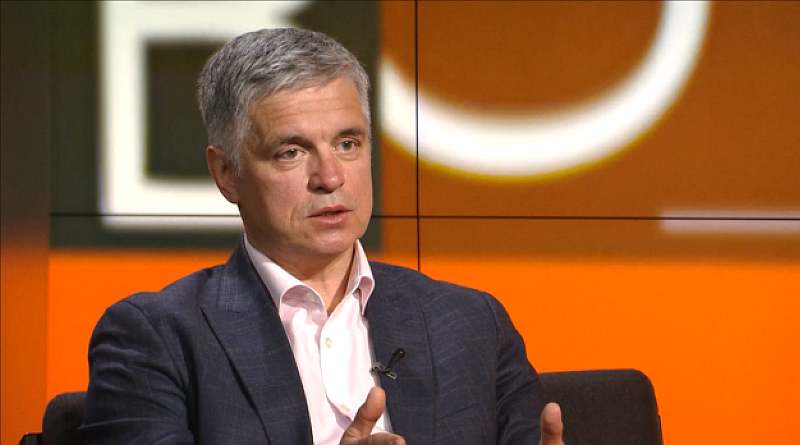
Oksana Maksymlyuk / Radio Liberty
After this week’s meeting between the presidents of Ukraine and the USA in Washington, relations between Kyiv and Washington have transitioned to a new stage, believes former Minister of Foreign Affairs of Ukraine and former ambassador to the United Kingdom Vadym Prystaiko. According to him, Ukraine managed to change the Trump administration’s approach to the Russo-Ukrainian war and demonstrate that any decisions about its future are impossible without Kyiv’s consent.
Prystaiko positively assesses the results of Volodymyr Zelensky’s visit to the USA but warns against excessive optimism. He emphasizes that support for Ukraine from Washington will continue to depend on the political decisions of the US President, as well as Kyiv’s ability to maintain subjectivity, strengthen its own military potential, and persuade partners of the necessity to pressure Russia.
The diplomat also commented on personnel changes in the government, the scandal in the Ministry of Foreign Affairs, the prospects of Ukrainian-Polish relations, support from Great Britain, and diplomatic signals regarding possible negotiations for ending the war.
On the results of the Zelensky-Trump meeting, sanctions against Russia, Ukraine’s relations with the USA, personnel decisions of the Ukrainian government, and the main challenges of the coming months – in an interview with Radio Liberty.
Meeting of Trump and Zelensky
– Let’s start with Volodymyr Zelensky’s visit to the United States. Initial assessments of this meeting have already appeared. In particular, US President Donald Trump called it “very good” on his social network Truth Social. Ukrainian President Volodymyr Zelensky also assessed the negotiations positively. Deputy Head of the President’s Office Pavlo Palisa also speaks of optimistic results. What are your impressions of this meeting? Do you share this optimism?
– Firstly, I truly share the optimism regarding the fact that, compared to previous ones, this meeting was entirely different in terms of interaction and mutual understanding.
At the same time, President Trump’s moods tend to change, so it’s challenging to expect him to consistently maintain such a positive attitude…
– Meanwhile, your optimism is shared by international media – including Politico, Financial Times, and The Wall Street Journal. They write about a certain warming of relations between Ukraine and the USA and a change in Donald Trump’s attitude towards Ukraine. They also speak of a new window of opportunity for greater American support. How, in your opinion, could this manifest in practice? Is it about possible concrete agreements, or should some steps be expected from the United States?
– I believe that we have already achieved a very serious result for our survival.
Through joint efforts, we managed to move away from what the Russian side called the “spirit of Anchorage” – that is, from the feeling that the Russians reached agreements with the Americans behind Ukraine’s back or that they indeed agreed… There was very little information about those negotiations, no documents were signed, which allowed the Russians to exploit this topic for a long time.
Senator Rubio’s statement that Ukrainians are not happy with what we agreed upon speaks not just of our growing agency, but of the fact that as a result of this discussion between the Russians and the Americans, some variant was proposed. This variant was probably proposed by the Americans to the Ukrainian authorities, which the Ukrainian authorities and the Ukrainian people did not accept. Now, with their “long-range sanctions,” determination on the frontlines, survival in the rear, and technological development, they have demonstrated that not only are we not satisfied, but we are ready to rewrite this page.
What we saw in Washington, I regard as an attempt to rewrite these agreements, which hypothetically could have been reached in Anchorage.
Graham’s Bill
– How do you evaluate the progress of Senator Lindsey Graham’s bill? Recently, after a long period, it finally began moving towards consideration. There is voting ahead in the Senate and the House of Representatives, but how do you assess the current dynamics? Could this process be delayed again?
– The very fact that such a powerful person as Lindsey Graham continues to support Ukraine even after his passing is very indicative.
There was often criticism that the Republican Party is no longer the party of Ronald Reagan or John McCain. No, in reality, there are our friends, there are powerful Republican politicians who support Ukraine not only out of sympathy for a state that became a victim of aggression but also because they thoroughly understand the United States’ place in the world order. They realize the need to preserve the international system that was formed after World War II.
The proposed bill provides for the restoration of sanctions and gives the President of the US the right to impose additional tariffs on states that continue to buy Russian oil and gas, thus effectively supporting the Russian Federation. This is what we needed to achieve and have finally achieved.
However, it is worth understanding: the bill only allows the US President to do this, but does not obligate them. Therefore, our further work with the American administration continues.
“Peace Through Strength”
– How do you explain the change in Donald Trump’s rhetoric and attitude? Is it a result of the upcoming Congressional elections in the USA, or has he developed an interest in Ukraine due to the scale and experience in drone production?
– I liked the wording from one of the leading, well-known media: in Ukraine, Donald Trump found an ally he lacks among European NATO countries.
It’s about allies accustomed to living under the broad protection of American security, under the US nuclear umbrella, accustomed to living at the expense of American taxpayers, American weapons, and the army.
As for Ukraine, not being a member of the alliance and lacking such support, it was forced to find its own way. Having endured this struggle, it offered something new: the willingness to kill, die, and suffer for its future. This is something respected in the United States, including by President Trump.
At the same time, I would not want to create the impression that everything is already decided. It is far from this. War is such a thing that can change very soon. But we have demonstrated a way through which the war can be ended.
And for Donald Trump, as you can see, peace is very important. Another question is how he envisions it. And it seems to me that our perspective resonates with the US administration and Trump himself. In other words, “peace through strength.”
– Does this mean we can now expect increased pressure on Russia? After all, there were previous concerns that Donald Trump would primarily pressure Ukraine.
– We indeed appeared as what is called in American language: the low-hanging fruit that is easiest to pick and use. Now our fruit has risen higher on the tree of opportunities. And they understand that Russia’s war against Ukraine doesn’t significantly impact elections. For American voters, what is more important is how their life changes or doesn’t change at home.
But, undoubtedly, another victory would help Trump. As for historically achieving such an agreement as another concluded war before the elections… I wouldn’t be so optimistic.
In any case, Ukraine now doesn’t look like another dependent vassal that the United States must worry about and spend money on.
Don’t forget that all the weapons transferred to us so far are bought by our European partners. They have taken on the biggest burden.
If we talk about why the US attitude has changed, one of the main reasons is that Europe made an unexpected move and took on the maximum burden. And Ukraine continues to fight, despite all difficulties, showing the path to victory.
The Visit of Witkoff and Kushner
– And one more question to conclude this block. It’s about the upcoming visit of Donald Trump’s special representatives – Steve Witkoff and Jared Kushner, which became known after the meeting of the two presidents. This will be their first official visit to Ukraine, although they have visited Moscow several times before, and Steve Witkoff has met with Russian leader Vladimir Putin more than once. What do you think this visit means for Ukraine?
– This is standard diplomatic work, where Ukraine will need to demonstrate to those close to the President of the United States what we are discussing and what they cannot see with their own eyes.
I understand how important it is, but I do not overestimate it. Ukraine has other sources of conveying information to President Trump. One of them is direct communication between presidents. Moreover, there are also partners who travel, who have influence on the President, including European leaders, the head of NATO, and other leaders. And, thank God, we have those friends who help us and try, let’s say, to guide President Trump in a direction that is beneficial not only for Ukraine but for all of us.
Ambassador of Ukraine to the USA
– Let’s move to the topic of a possible appointment of a new ambassador of Ukraine to the United States. After information surfaced that the current ambassador of Ukraine to the USA, Olga Stefanishyna, requested to end her diplomatic service, various speculations regarding her successor began to appear in the media. It has been reported that the President might appoint former Prime Minister Yulia Svyrydenko as ambassador. Additionally, on July 21, LIGA.net reported, citing sources in the Office of the President, that one of the main candidates for this position is Rustem Umerov. At the same time, his candidacy was also named last year in July. How do you assess the prospects of such an appointment? Who, in your opinion, could lead the Ukrainian embassy in Washington?
– I know your audience is very educated. However, I still want to remind that there are traditions described in documents and agreed upon by all countries in the world. It is about, as much as possible, refraining from publicly announcing the future ambassador, thus allowing the receiving country the possibility to refuse or agree.
This is called from Ukraine’s side a request for agrément, from the French agrément meaning that the country agrees to the appointment of a specific person.
If we followed this practice, it would be much simpler now. Currently, the discussion of whether Rustem Umerov’s candidacy was considered last year and whether it is being considered now would not arise. Because this name, this candidacy, would be discussed between professionals and politicians of both countries. How does this look in reality?
If we have a desire to replace the ambassador in the USA, and believe me, having worked there once, I understand how important it is. For me, there is no more important position for Ukraine than the ambassador of Ukraine to the USA, so the selection of a candidate must be as careful as possible.
In my opinion, there is no more important diplomatic position for Ukraine than the ambassador to the United States. Selecting this unique person is not just an “artificial product,” it’s a “unique product,” it must be done very clearly in Ukraine. And also communicated with the United States in such a way that they have the opportunity to consider and say whether it suits them or not. And do so without offending us as a state or imposing any of their solutions on us.
Therefore, public discussion of specific names puts us in a situation where we either expect that the USA has already agreed, or we will be disappointed when we somehow find out that this is not happening.
– Then please explain, what should be the selection criteria? Who is more needed in Ukraine today as an ambassador to Washington – a professional diplomat or a politician?
– That’s a good question. There are systems in the world that do not allow for non-professional diplomats. For example: the German, British, and other European systems. They realized long ago that diplomacy, especially at such a high level as an ambassador to the USA, is a kind of professional activity. And conditionally, you cannot appoint someone as a surgeon, no matter how likable they are, or a teacher, or a professor at a university. For some reason, it is believed that anyone can be an ambassador.
I want to say that there are positions that require a high political level. In such a case, Ukraine expects that the person who will be sent there must not only have influence, importance, status, a symbol for countries to understand that indeed the country sending them respects, by sending the best of the best. On the other hand, it is very important that this person can, in a case of crisis, pick up the phone – and on the other end, the head of the state, who sent them, would answer. This is a very important moment. And probably, the United States is precisely a unique country where, from time to time, questions arise that require the direct attention of the head of state, the Ukrainian state.
If all these criteria are met, not to mention professionalism, language knowledge, the ability to manage a large team, have excellent communication skills to communicate with the people and government of the country you are being sent to – this very complex package, such should the politician be.
The Prime Minister of Ukraine is a serious position that the United States would understand as sending conditionally the best of the best. On the other hand, the fact that a person has finished their career, if they have completed it normally and still have the ability to pick up the phone and talk to President Zelensky – good. If this does not happen, it will be a lost opportunity, and in a year or two, we will return to this moment, where we are now, changing our ambassador once again. There is definitely no need to change ambassadors every year, especially the ambassador to the USA, because it is a very complex task to establish relations in such a complex political organism as America.
Personnel changes in the government
– I also want to discuss the personnel changes that have occurred and are still ongoing in the government. Until August 18, Ukraine remains without an appointed Minister of Foreign Affairs, in the Ministry of Defense – an acting one. What does this mean for the state, and how critical is this situation for a country at war?
– I think it’s a formality, as they are still not appointed. According to the Constitution, the president must submit these two proposals to parliament. Unlike all other members of the Cabinet of Ministers, these two candidates are directly submitted by the head of state. This is defined by the Constitution.
I think that the relevant submissions will be made soon, and I have no doubt that the deputies will vote. Not only do we have these two positions vacant in the government, but also Ukrainian ambassadors from all over the world have gathered for an ambassadorial meeting, which takes place once a year, sometimes once every two, and to formally not have the head of the diplomatic department is not quite timely.
– Speaking about international negotiations, can an acting Minister of Foreign Affairs fully perform these functions? Is such a situation likely to affect, in particular, military assistance to Ukraine?
– In a normal situation, you are right. Legislation defines that the Minister of Foreign Affairs, the President, and the Prime Minister are the three people who have the right to negotiate and sign documents on behalf of the state. This is a very important position, and the formalization of the role is crucial.
We are currently living in a time that is not normal for an ordinary state. All negotiations are conducted directly by the head of state or the closest people. This is not only how Ukraine operates; it is characteristic of the United States and many other countries as well. In crisis moments, states primarily use communication channels they consider effective, loyal, close, and so on.
Therefore, it is undoubtedly better when all appointments are properly formalized, but I do not think the current situation critically affects Ukraine’s ability to conduct international negotiations.
– What about the situation regarding the appointment of the Minister of Defense? In Ukraine, we see public discussion, and some citizens disagree with the President’s personnel decisions. How might this be perceived by international partners? Does it create an impression of chaos or a lack of clear strategy ahead of a challenging autumn-winter period?
– It is difficult to speak for all partners, but, for example, the EU’s Commissioner for Defense and Space has already stated that there are questions in the European Union they would like answered, particularly why Ukraine frequently changes defense ministers. Especially since the minister, who seemed effective in the EU, was suddenly replaced.
Some Ukrainians also feel that it was a young person who offered very interesting approaches to warfare, intended to change the current situation on the front line. However, until now, the head of state seems not ready to propose the return of Mykhailo Fedorov.
And this current appointment does not contribute to effectiveness. Yet, again, the acting ministers are professional people. I think it is very unfortunate for them to read opinions that suggest otherwise—saying that since they were not officially appointed, they are not doing anything. That’s not how it is. People work, structures operate.
Scandal in the MFA
– I cannot avoid asking you about the scandal currently unfolding in the Ministry of Foreign Affairs. It is related to a potential corruption scheme. Recently, NABU and SAP announced the exposure of an organized criminal group allegedly led by the former state secretary of the Ministry of Foreign Affairs. According to law enforcement, the scheme’s participants embezzled donations from foreign citizens and donors intended to support Ukraine at the start of the full-scale invasion. The funds in question amount to 37 million hryvnias. The name of the official has not been disclosed by law enforcement, although it is known that Oleksandr Bankov held the position of state secretary of the MFA from 2020 to 2024. My colleagues from Radio Liberty contacted him. He refused to comment on the suspicion, neither confirming nor denying receiving it. Later, the MFA reported that this was uncovered partly due to an internal audit. You led the Ministry of Foreign Affairs until 2020 and know well how the institution operates. How do you assess this situation? Could potential violations have been detected earlier?
– You know, I was not only a minister, but also the head of the ministry’s apparatus – essentially the person now referred to as the state secretary. I realize just how many financial, economic, personnel, and other issues this person handles. How many conflicts and adversaries are involved, and so on.
I know Oleksandr Bankov personally. I worked with him for many, many years. I still cannot believe that these charges are proven. If they are proven, it will be one of my greatest disappointments in the world.
I believe that Oleksandr Bankov is a very competent, good, professional, and patriotic diplomat. I would be very upset to learn, if as a result of a full investigation, his guilt is proven.
– If we assume that the investigation confirms these facts, how might this affect the trust of international partners, donors, and benefactors towards Ukraine? Does this case pose serious reputational risks?
– It is a serious risk of reputational loss. It is not an enormous sum that would significantly influence our ability to obtain the help we’re referring to.
Any stolen or lost hryvnia is unpleasant. However, I think partners understand that no system is perfect.
I remember that during my tenure, there were cases when certain diplomats attempted to engage in minor smuggling. It was unpleasant for me as the head of the apparatus, for the department, and for the entire diplomatic service. At the same time, the diplomatic service was traditionally considered one of the less corruption-affected areas of state governance. There are many reasons for this: diplomats belonged to the professional elite, had relatively decent salaries, and worked in a specific environment.
That’s why each such case is particularly painful and distresses diplomats of all generations.
I hope that this investigation will be not only fair but also as transparent as possible. So that future generations of diplomats know that if you allow yourself to be dishonest, you will be punished ruthlessly. If this is not true, the system will defend you, and you will be protected.
Because, believe me, at the moment when the war began, we received help from everyone who wanted to contribute, whether it was cash in an envelope or a transfer to the embassy’s account. These millions of dollars, which our diplomats collected worldwide and brought to Ukraine, had to be meticulously documented according to the law, and so on. I always knew that sooner or later, when the war ends, there would be intense scrutiny, and no one would consider how critical the situation was, how decisions had to be made “on the fly.”
– Still, I want to clarify: in your opinion, what was wrong with the control mechanisms? Was there a lack of systemic internal audits? What safeguards could prevent similar situations in the future?
– We had never before received such massive support from people all over the world on such a scale.
At that time, I worked as the ambassador to the United Kingdom. I remember how former British prime ministers personally drove fire engines donated to Ukraine and brought them to us themselves, at the wheel.
People walked by, tourists, past the embassy and asked my staff to accept funds, saying, “No need to report back. We trust you. Here’s $100. Buy what the Ukrainian military needs – a tourniquet or other equipment.”
Under those conditions, it was practically impossible to stop each person, ask them to fill out a form, transfer to a sponsorship account, and so on—it was impossible. But to refuse help when our country was suffering and needed literally everything—we couldn’t do that either.
Undoubtedly, in a normal situation, there are special accounts, sponsorships, clear bureaucratic procedures, financial reporting. But there are moments when the state mobilizes all available resources for survival.
I’m not defending anyone right now. I know what’s going to come down, that we’re protecting. No. I want to say that there are critically important moments when everything necessary is done for survival, and then we will sort it out.
Prime Minister of the United Kingdom
– I also want to ask your opinion about the new Prime Minister of the United Kingdom. You were the ambassador of Ukraine to the United Kingdom, so I’m interested in your assessment of his candidacy. It is about Andy Burnham. The President of Ukraine, Volodymyr Zelensky, has already met with him. Could the change of Prime Minister affect the level of support for Ukraine from the UK?
– A very high level of political support for Ukraine is currently maintained.
If you look at President Zelensky’s visit, which ended a few days ago, he was received on one of the main ships of the British Navy. The Ukrainian president was similarly received in 2022—then Prime Minister Boris Johnson and Defense Minister Ben Wallace. So, nothing has fundamentally changed.
Ukraine continues to be supported, flags are flying, and the topic of Ukraine still occupies a prominent place in the British media. Unfortunately, this cannot be said of many other countries.
That is why, in my opinion, we should be more concerned with support for Ukraine in other states of the world. Of course, not forgetting our British friends.
Ukrainian-Polish Relations
– Since you mentioned relationships that shouldn’t be particularly worried about, I immediately remembered an almost opposite story—our relations with Poland. It seems that they currently need special attention, particularly from Ukrainian diplomats. Almost daily, we see reports of attacks on Ukrainians in Poland—suspected to be based on national hatred. A few days ago, there was an attack on a Ukrainian couple in Wrocław, and there have been similar cases in Kraków and other cities. How, in your opinion, should Ukraine respond to such cases? Is it responding actively enough?
– Unfortunately, every country has radicals, Nazis, racists, or people with xenophobic views. The task of the state, government, and political elite is to keep them under control and prevent isolated incidents from becoming systemic phenomena.
As soon as the government allows what our Polish partners have allowed themselves, to tread this, so to speak, chauvinistic path, it immediately unveils this dark potential that exists in every nation, including the Polish one.
Our task in partnerships is to seek resolution opportunities where possible, but to respond extremely harshly in defense of our state. This is no longer rhetoric; it’s the real life of our citizens who have found refuge in this country.
On the other hand, our citizens also need to understand that they are being watched. Every action, every word spoken will provoke a reaction that, for instance, might be overlooked in more friendly countries.
Unfortunately, we are now forced to live all over the world. This is a very complex situation imposed not because we wanted it, but by the war started by Russia. This intricate knot will have to be resolved, including by Ukraine’s diplomatic service.
– The Main Police Headquarters of Poland reports an increase in the number of hate crime reports against Ukrainians based on nationality. In the first half of this year, Ukrainians filed 30% more such reports than in the same period last year. So it can already be said that there is a certain trend. Do you think this trend might intensify? And how responsible are some Polish politicians for such sentiments?
– Absolutely, the responsibility of Polish politicians is very significant. But at the same time, we must think about how to protect Ukrainian interests.
Part of these reports is directly related to internal political struggles in Poland. Anti-Ukrainian rhetoric is often used as a tool of internal politics. Ukraine should not get involved in this game.
Instead, a clear division is needed: we have our enemy—Russia. And there are those partners who are used to our lesser role, who may not like our national growth. We need to first solve the number one problem: how to end the war and the mass killings happening in Ukraine. Then we can gather with our neighbors. I am confident that the Ukrainian Ministry of Foreign Affairs will find enough mental strength to seek ways to negotiate with Polish politicians: where to meet halfway, where we must stand our ground knowing these are our key national interests. But still remember that they are our partner, a friend who allowed about 2 million people to escape the war and who help us in any way they can, including with weapons.
Therefore, we shouldn’t go to extremes and call Poland an enemy or think it is aligning with Russia. Unfortunately, sometimes such assessments can be heard in the information space, but they do not correspond to reality.
– By the way, I’m interested in your opinion. How telling is it that the President of Poland, Karol Nawrocki, has not yet spoken out about these attacks and has not condemned the actions of the attackers? Should the president respond in such cases?
– So far, I would specifically speak about political inaction and certain indulgence in such national interests. Unfortunately, they align with the political interests of the force he represents. This can easily lead to overplaying. One must transform from a national politician into a statesman. If he has enough strength, he will be able to remind the Poles, without losing his popularity, which is important to him, that listen: this is about people’s lives, these are threats and violence that are unacceptable in a civilized society. Political disputes should remain in the political realm.
Continuing the topic of trends in Poland: on July 29, the results of a survey by Opinia24 were published, indicating a deterioration in Poles’ attitudes towards Ukrainians. This is reported by RMF24. More than half of the respondents – 54% – stated that their attitude towards Ukrainians has not changed since the beginning of the full-scale war. Meanwhile, 36% noted that it has worsened. In addition, the survey indicated growing skepticism towards Ukraine’s European integration. 52% of those surveyed opposed Ukraine’s accession to the EU, while 33% support such a prospect. In your opinion, is this a temporary reaction of Polish society, or can we already talk about a long-term change in attitudes?
– I think these attitudes can change. Maybe not as quickly as we would like. We shouldn’t expect the level of support to soon return to that which would guarantee a smooth entry of Ukraine into the European Union. And who is to blame for this? Unfortunately, ourselves. We haven’t done enough homework to become part of the EU and NATO when it was easier. When all our European partners, neighbors were doing so. Poland itself has already forgotten how difficult, sometimes humiliating, and unpleasant it was to meet all the requirements and correct everything pointed out by European and NATO partners. To become a sufficient state to join these alliances crucial for us and our survival. We didn’t do this. We can’t blame anyone but ourselves.
Now we have to fight with Russia and also address these issues. Maybe this will teach us something. Our number one task is to ensure security, that is, NATO, and provide us with survival and economic advancement opportunities, that is, the EU. We have to do this despite all obstacles. I am confident that now we have the drive, energy reserve, and motivation. The war has made us finally realize that Russia is our enemy.
– Do you mean, in particular, the slow implementation of anti-corruption reforms as provided by the EU accession plan? After all, European partners have repeatedly stated that Ukraine is lagging behind the declared pace?
– This is just one manifestation of what we still need to do. Yes, these requirements are clearly outlined in the documents, but there are many other questions.
For example, we hoped that after the change in the political situation in Hungary, our relations with Budapest would improve. But we see that Hungary continues to block Ukraine’s European integration.
Therefore, we need to mature, stop being naive, and understand that relations with neighbors are complex. They are tied to historical issues, competition, and the perception of us as a major state that will demand attention and financial resources, which are needed by everyone. Competition that will increase in the EU with the arrival of Ukrainian farmers, political competition, military competition, and so on and so forth.
The world has changed. Not everyone is ready to adapt. We were forced to adapt to new conditions, we are adapting. Our neighbors are still under the impression that the EU and the USA will protect them, and the EU will give them money for development. This may no longer be the case.
– Mr. Vadym, speaking of working on mistakes, what miscalculations in relations with Poland, in your opinion, has Ukraine made? And how can they be corrected?
– I understand well how complicated Ukrainian-Polish relations are, and I see that Ukraine is trying to act correctly.
For example, the Ukrainian ambassador participated in the ceremony honoring the victims of the Volyn tragedy and laid flowers. I saw criticism of this step, but I fully support the ambassador’s actions.
He is performing challenging work that often does not please either side. But that’s exactly why the diplomat works in Warsaw – to find solutions needed for the Ukrainian state even in difficult conditions.
– I would also like to discuss Putin’s statement that sooner or later Ukraine will lose its western territories. The spokesman for the Polish MFA has already said that perhaps it is time to freeze the war in Ukraine and return to the “Istanbul-2” format, and only then, with the guarantees of the great powers, including Russia, move towards peace. He made this statement during a meeting with Vladimir Putin in Omsk on July 25. In response, Kremlin spokesman Dmitry Peskov said that freezing the war is impossible, and Russia insists on achieving its goals. In your opinion, what does this indicate? Does it mean that Russia is ready to continue waging a long-term war, has the resources for it, and is currently not intending to retreat?
– Various interpretations have already arisen around this statement. One version is that Kazakhstan voiced this thesis at Russia’s request so that the Kremlin could once again state: there will be no cessation of the war until Ukraine agrees to capitulation.
Another version is related to recent attacks on the infrastructure through which Kazakh oil is transported. And President Tokayev of Kazakhstan is concerned that his economy is suffering from a war in which his country is not involved, and therefore tried to remind about himself and the need to stop the fighting.
I don’t think Kazakhstan plays any key role in this conflict. But, of course, every country and every leader who reminds that the war needs to end is important to us.
Another conversation is how, what guarantees for Russia are possible… This is already a separate big discussion. At the same time, I understand that, being next to Putin, Tokayev was somewhat forced to soften his words. From the Russian side, Dmitry Peskov also expressed himself about the situation.
– And in conclusion. What should Ukrainians be prepared for in the near future regarding the war? On one hand, we see the activation of US diplomatic efforts and expect a visit from Donald Trump’s special representatives. On the other hand, we do not see any signs that Russia is ready to stop the war.
– I would not want to disappoint anyone, but these negotiations are a background that is constantly necessary, and it will be present. This background allows demonstrating that Ukraine is ready for peace, and the United States is doing everything possible to achieve it. We need to prepare for winter, we need to prepare for economic survival and new challenges. We need to understand how to ensure Ukraine has an adequate number of air defense systems and missiles to intercept ballistic targets. This specific issue is very complex. And it’s no longer just a matter of diplomacy, but rather the production capabilities of our partners.
What is happening now in Ukraine, especially what happened in the east, has allowed the Americans to rethink their own policy. They are currently looking for answers on how to reduce the cost and increase the quantity of these systems, which have demonstrated very high effectiveness and are needed worldwide.
Pictured: Vadym Prystaiko, Head of the Ukrainian Mission to NATO (2017–2019), Ambassador of Ukraine to the United Kingdom (2020–2023), Minister of Foreign Affairs of Ukraine (2019–2020), in the studio of Radio Liberty. Kyiv, April 22, 2026. Photo: Radio Liberty
Copyright © 2021 RFE/RL, Inc. Reprinted with permission from Radio Free Europe/Radio Liberty
