
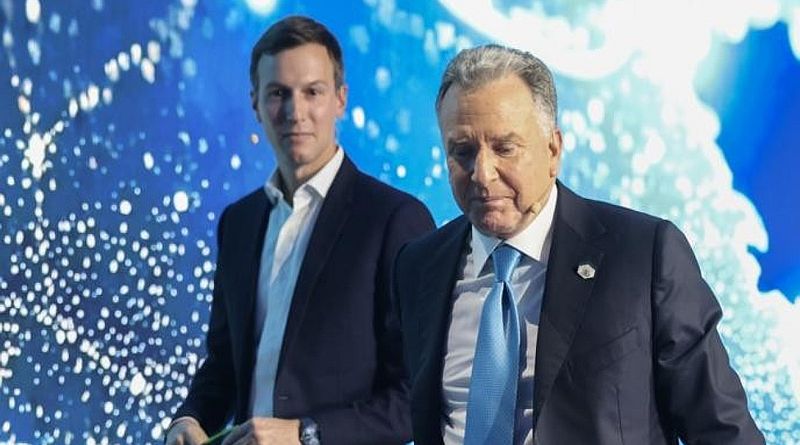
WASHINGTON – U.S. President Donald Trump is expected to send his special envoys Steve Witkoff and Jared Kushner to Kyiv in the coming weeks. This will be their first visit to Ukraine since they have played a leading role in the administration’s efforts to end Russia’s full-scale invasion.
According to Radio Liberty’s sources, the visit to the Ukrainian capital is expected in the second half of August – approximately during the celebration of the 35th anniversary of Ukraine’s Independence. They are also expected to explore new ideas to revive peace talks – an issue that remains a White House priority. At the same time, sources emphasized that final details of the trip are still being worked out.
If the visit goes ahead as planned, it will be the first trip to Ukraine for Steve Witkoff and Jared Kushner, although both have visited Russia multiple times and met with Russian President Vladimir Putin.
According to sources, the agreement on the visit was reached during a meeting between Ukrainian President Volodymyr Zelensky and Donald Trump at the White House on July 28. The trip was also preceded by renewed contacts between Kyiv and the special envoys, including a recent phone conversation with Zelensky dedicated to revitalizing peace efforts.
The visit may take place amid signs of a more positive attitude from Washington toward Ukraine.
Radio Liberty spoke with Kurt Volker – former U.S. special representative for Ukraine under the first Trump administration, former U.S. ambassador to NATO, and now a distinguished fellow at the Center for European Policy Analysis (CEPA). He explained what this visit might mean, whether Washington’s approach to Ukraine is changing, and how NATO should respond to increased Russian attacks.
“They have never been to Ukraine”
– Steve Witkoff and Jared Kushner are expected to visit Kyiv in the coming weeks. Why is this trip important and what should be paid attention to?
– First and foremost, because they have never been to Ukraine. They have traveled to Russia many times. They have met with Putin in Russia many times.
They have heard the Russian version of the war, of Ukraine, and everything that is happening, but have never seen the situation for themselves. They do not actually know what Ukraine is.
Going there, seeing it – a beautiful, large country, with a large number of people and a functioning economy… After all, all they might have seen are images in the media, which mostly show destruction.
But when they arrive, they will see that Kyiv is a large city that lives and functions, while Russia is simply shelling it with weapons. It’s madness. I think this will make a strong impression on them.
– President Trump supported granting Ukraine licenses to produce Patriot missiles (the conversation was recorded before the US President said that this matter is under consideration and expressed some doubts –ed.), President Zelensky returned from Washington, and Congress is advancing tougher sanctions against Russia. Can it be said that the political mood in Washington has significantly shifted in favor of Kyiv?
– The attitude has become more positive towards Ukraine and more critical and skeptical towards Russia. But I don’t think this will result in new American aid to Ukraine.
Instead, I believe the sanctions bill – the so-called Graham Sanctions Act – will be passed. I think it will go through, and then the president himself will decide to what extent to apply these sanctions, and, as it seems to me, he will use this authority.
So the situation has improved. Definitely improved. And this is because Ukraine is showing better results, while Putin continues to seek war and Zelensky clearly declares his desire to achieve a ceasefire.
But this is more about eliminating the negative than gaining a significant positive.
The absence of an ambassador does not play a significant role?
– The US still does not have a Senate-confirmed ambassador to Ukraine or a special representative dealing with the war. Does this weaken Washington’s influence at such a decisive moment?
– Honestly, I don’t think this matters much.
In the second Trump administration, everything works such that Trump decides everything himself.
So even if there were an ambassador in Kyiv, he or she wouldn’t be able to independently declare or do anything important, as it is Trump who determines what to say and how to act. Therefore, I don’t see this as a big problem right now.
– Meanwhile, Russia has intensified missile attacks, even though Ukraine is receiving more Western support. Additionally, reports suggest a Russian cruise missile violated Poland’s airspace. Is Moscow testing NATO’s resolve? And how should the Alliance respond?
– There are two different aspects here. Regarding why this is happening, there are several possible explanations, and it is quite possible that all are acting simultaneously. Electronic warfare means can change the course of drones, possibly missiles too, but definitely drones, causing them to inadvertently end up over the territory of a neighboring state. This can also be affected by GPS signal jamming. At the same time, it could be an intentional action by Russia – to send a signal: the situation could get much worse. Another possible explanation is testing NATO’s reaction.
How should NATO respond? The Alliance must ensure that it can intercept such targets as soon as they enter NATO airspace. As soon as they cross the border, air defense forces must be ready to act. This means the need to raise the level of combat readiness.
NATO should officially announce such a policy, implement it, and not tolerate such incidents.
Moreover, the best response would be to fully integrate the air defense systems of Ukraine and NATO and declare a joint no-fly zone approximately 200 kilometers deep into Ukrainian territory.
This would be a measure to protect NATO itself. The alliance should declare: we do not want any dangerous air objects to be within 200 kilometers of NATO territory. We will call this a restricted flight zone. And if any such object appears there, we, along with Ukraine, will ensure its destruction. This would not mean directly entering the war on Ukraine’s side. It’s about NATO doing more to enhance air defense to prevent the war from spreading to the territories of allied states while protecting its own security.
