

Information on current Russian losses due to sanctions as of 07/18/2026.
1. During a massive Ukrainian drone attack on the “Engels” military airfield in Saratov region on July 16, a strategic bomber Tu-95MS used by Russia to launch cruise missiles at Ukraine was hit.
– According to the SBU, the drones covered about 800 km, and the aircraft sustained critical damage — its tail section was completely torn off, making it effectively inoperable. The information about the hit was confirmed by the President of Ukraine.
– The special significance of this strike lies in the fact that the Tu-95 is no longer produced. The serial production of these strategic missile carriers ended after the collapse of the USSR, so each such loss is practically irreversible for Russia’s long-range aviation. It is impossible to replenish the fleet with new aircraft, and the repair and modernization of existing units are becoming increasingly difficult.
– This is not the first serious loss for Russian strategic aviation. During the “Spider Web” special operation in June 2025, satellite images confirmed the destruction of at least four Tu-95s, and overall a significant portion of Russia’s strategic bombers was hit then.
– It is estimated that after those strikes, Russia lost about a fifth of its combat-ready long-range aviation, and losses of aircraft such as the Tu-95 and Tu-22M3 cannot be quickly compensated because production has ceased.
2. On the night of July 18, Ukraine’s Defense Forces launched a massive strike on objects in Russia’s territory.
– In the Tambov region, a Wildberries warehouse caught fire following Russian air defense operations. According to Russian reports, at least seven people were killed, and 24 more were injured.
– In Vladimir, according to preliminary data, Russian electronic warfare means deflected a drone, which crashed into a residential building.
– In Noginsk, near Moscow, there are reports of a hit on an oil depot.
– Additionally, a fire broke out at a Wildberries logistics complex in Elektrostal, one of the company’s largest facilities, in the Moscow region.
3. The Russian stock market experienced its longest decline since 1997.
– The Moscow Exchange Index fell by 8.72% over the week to 1958.4 points, the lowest level since October 2022. This marks the 18th consecutive week of decline, the longest series of drops in records since 1997.
– Since the April peaks, the market has lost nearly 30% of its capitalization, dropping back to levels from a decade ago.
– The biggest losses were suffered by shares of major Russian companies: “Gazprom” has fallen by 21% since early July, VTB by 21.1%, “Surgutneftegas” by 20.8%, “Magnit” by 19.6%, “Nornickel” by 24%, “Aeroflot” by 26.7%, MTS by 28%, and the largest gold producer “Polyus” lost 53% of its market value in just over two weeks.
– The market is pressured by the threat of new sanctions, expectations of further key rate increases due to the fuel crisis, and a massive asset sell-off.
4. The construction industry in Russia is experiencing the deepest decline in the past decade.
– According to Rosstat, construction volumes from January to May 2026 decreased by 7.4% year-on-year. This is the longest industry decline since 2015-2016.
– Residential construction has seen a particularly sharp decline: since the beginning of the year, almost 22% less housing was commissioned in Russia than in the same period of 2025. One of the main reasons is the curtailment of state mortgage support.
– In February, the authorities restricted the issuance of preferential “family mortgages” — a family can now receive only one such loan. This program accounted for about half of all mortgage loans in the country, so demand for new buildings has fallen sharply, and developers have begun delaying new project launches.
– The situation may worsen further: from October 1, the Russian authorities plan to almost double the rates for the “family mortgage” program for families with one child. This threatens a further decline in housing demand and a deepening crisis in the construction industry.
5. Russia is preparing to import diesel fuel due to the deepening fuel crisis.
– The Russian government decided to extend the import damper mechanism to diesel fuel, similar to gasoline. Corresponding changes will be made to the Tax Code, allowing for subsidies on diesel imports in case of a domestic market shortage.
– The import damper compensates the difference between global and domestic prices from the budget to make overseas purchases economically viable for Russian companies. Payments will be made if there is a ban on the export of diesel fuel, aviation kerosene, and other middle distillates in the previous month.
– Until recently, Russia was one of the largest exporters of diesel fuel globally, but massive Ukrainian attacks on refineries have reduced oil refining to its lowest level in over 20 years.
– According to Reuters, diesel production has decreased by almost 40%, and the domestic market shortage is estimated at 400-600 thousand tons monthly.
– Russian companies have already started purchasing gasoline from Belarus, Kazakhstan, and India. Now the government is effectively creating legislative conditions for the import of diesel fuel.
– Russia, traditionally a large exporter of petroleum products, is forced to switch to purchasing them abroad due to the consequences of attacks on its oil refining infrastructure.
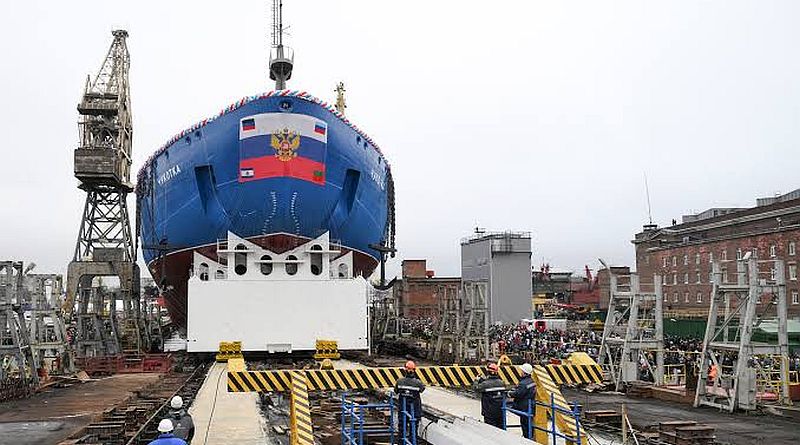
6. China is not ready to supply Russia with critical technologies for the construction of Arctic ships.
– According to the Central Research Institute of the Russian Maritime Fleet, Chinese manufacturers are not ready to supply key components for Arc7 class icebreaker ships without the easing of Western sanctions.
– This primarily concerns propulsion-steering complexes, without which the construction of large-tonnage tankers and gas carriers for Arctic operations is impossible. At the same time, there are currently no Russian power units for such vessels.
– According to the institute’s estimates, by 2030, Russia needs to build at least 23 large-tonnage ice-class Arc7 vessels, including 10 oil tankers, 5 LNG carriers, 3 dry cargo ships, 2 gas condensate tankers, and 3 liquefied hydrocarbon gas tankers.
– However, Russian shipyards are practically unable to build such vessels, and access to necessary imported equipment remains blocked by sanctions.
– This jeopardizes the Kremlin’s plans for the development of the Northern Sea Route. Despite the ambitious goal to increase transportation to 80 million tons by 2024 and 200 million tons by 2030, the actual cargo turnover remains almost half: in 2024, it was 37.9 million tons, and in 2025, it decreased to 37.02 million tons.
– China, which remains one of Russia’s key economic partners, is not ready to risk sanctions for supplying critical technologies for Russian Arctic projects.
