
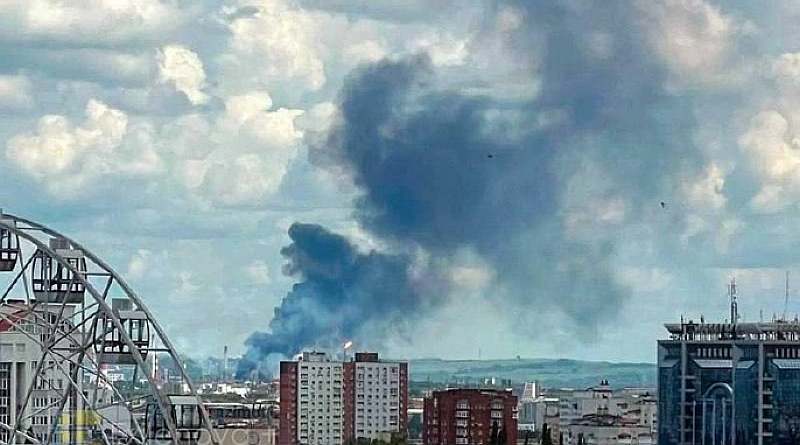

Let’s consider the events of the night-morning of June 25 in Russia through the prism of the triune “fuel crisis” formula: successful strikes – seasonal peak demand – frenzy.
CSO “A” of the SBU operated over a wide range.
On one hand, it reached the refinery in Ufa (1500 km away). The local gauleiter Radiy Khabirov automatically declared that nothing was damaged and things even got better! However, there were two centers of “smoke,” something was indeed affected.
On the other hand, they reached the oil depot in the village of Poltavskaya (Krasnodar Territory) again. At least three horizontal tanks burned there.
In summary?
Let me remind you that LLC “Poltavskaya Oil Depot” is a large regional operator in the fuel market of southern Russia. This company, as of May, owned two oil depots (in the village of Poltavskaya and the city of Ust-Labinsk) with 30K cubic meters of oil products, a fleet of 25 tank trucks, and a network of 43 traditional and multi-fuel gas stations in the Krasnodar Territory and Adygea under the PNB brand (more details – see the post from June 6). It acted as a regional dealer for Gazprom Neft and Lukoil.
On June 6, the base in Ust-Labinsk was seriously damaged and burned for 4 days.
On June 16, there was a visit to the village of Poltavskaya.
And now today, after 9 days, another visit to the village of Poltavskaya.
In total: LLC “Poltavskaya Oil Depot” has been de facto removed from the stage as a stable player in just three weeks (!). Now it will have to somehow save itself. This will inevitably affect the operation of the gas station network, fueling the “frenzy” factor that the Kremlin is precisely fighting. Local farmers will have to compete for fuel in the peak season. Everyone will pay more, everything will become more expensive.
Additionally, all of this affects the Russian occupation group from various sides. In particular, there are signs of a growing epidemic of fuel theft by the military (they are supplied on a priority basis) for resale on the side.
The results of the strike on the refinery in Ufa (two preliminarily affected) will be known later. But at the very least, they already contribute to the same frenzy.
Tens of thousands of frightened Russian “hamsters” are independently spinning the wheel of the crisis.
Indirect consequences: since the unplanned fuel costs will consume a lot of money and the situational deficit will break the rhythmic work, this will lead to a decrease in business activity (even against the backdrop of vacations) and a decrease in consumer demand for other goods. The third quarter in the Russian Federation promises to be even more exciting in terms of budget revenues than the second.
By September, the Russian public will certainly not feel rested.
In the picture: Fire at the refinery in Ufa. Photo: t.me/exilenova_plus
