
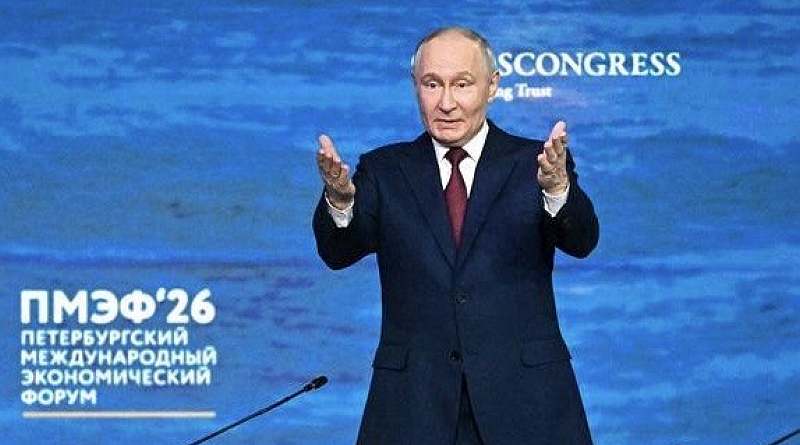

Putin’s speeches and statements at the SPIEF plenary session manifested a phenomenon analysts have rightfully called “toxic positivism.” The essence of this approach boils down to the unrelenting broadcasting of the thesis “everything is fine” in all areas of public life— from military actions and macroeconomics to budget policy and business conditions. Any systemic imbalances, structural failures, and growing deficits are either ignored or absurdly reformatted into new “achievements” and “benefits.”
The key message of the forum was the demonstration of absolute, unwavering stability. In the interpretation of Putin and Co., the troops are continuously advancing on the front, the economy shows unprecedented resilience, and businesses are thriving. Even the obvious overheating of the economy and its forced cooling through the Central Bank’s tight monetary policy are presented as some kind of benefit. The situation reaches direct but unfounded comparisons of the standard of living in Russia with the European Union using the formula “we live like in the EU,” aimed at counteracting the real decline in citizens’ purchasing power and the degradation of Russia’s technological base.
When reality intrudes upon this ideal picture, for example, in the form of infrastructure vulnerability to UAV attacks, the state rhetoric instantly switches to defensive mechanisms: “there are problems, but air defenses are being strengthened, so everything is under control.” A readiness for any negotiations— “even with the devil himself”— is declared exclusively from a position of strength and self-sufficiency: the system is supposedly so stable that it can function indefinitely without external compromises.
A special marker of Putin’s “positivism” at SPIEF-2026 was the harsh rejection of internal criticism. Any show of skepticism, even from loyal managers or direct participants in the processes, is branded as “narrow-mindedness” and “spring depression.”
Toxic positivism offers society primitive surrogates of solutions: metaphorically speaking, “if the gas runs out— walk or pedal,” as it’s about endorphins, sports, and joy. This irony reflects the actual import substitution strategy, where the lack of modern technological solutions is masked by appeals to archaic lifestyles under the guise of caring for health and ecology. The ostrich call to “discard all negativity” becomes the unspoken motto for surviving businesses.
Particular attention is drawn to the economic myth of moving away from resource, particularly oil, dependence, which became the leitmotiv of SPIEF-2026. What could not be achieved in 15 years of systemic reforms allegedly happened “by itself” over the past two years. However, critical analysis shows that such a “departure” is not the result of diversification but a consequence of forced isolation and the loss of traditional markets.
The paradox is that Russia has started buying gasoline from Belarus, which is almost presented as a victory over the “oil needle,” thanks to pressure from “Western partners,” who cut off export channels and equipment supplies. In reality, this points to a severe refining crisis caused by sanctions on components and physical damage to refinery infrastructure. The “bright future without oil dependency” in this context is, regrettably, not a post-industrial breakthrough but a forced reduction in technological potential, wrapped in sovereign pride.
Toxic positivism at SPIEF-2026 functions as a political anesthetic. It is intended to muffle elite anxiety and create an illusion of long-term stability among the population. However, deliberately ignoring imbalances: from fuel shortages to workforce scarcity, inevitably leads to the accumulation of systemic risks. Pedaling at an imposed pace can go on for a long time, but this movement in place does not bring Russia closer to real modernization, leaving it hostage to Potemkin villages.
