

Information on the current losses of the Russian Federation due to sanctions as of 05.06.2026.
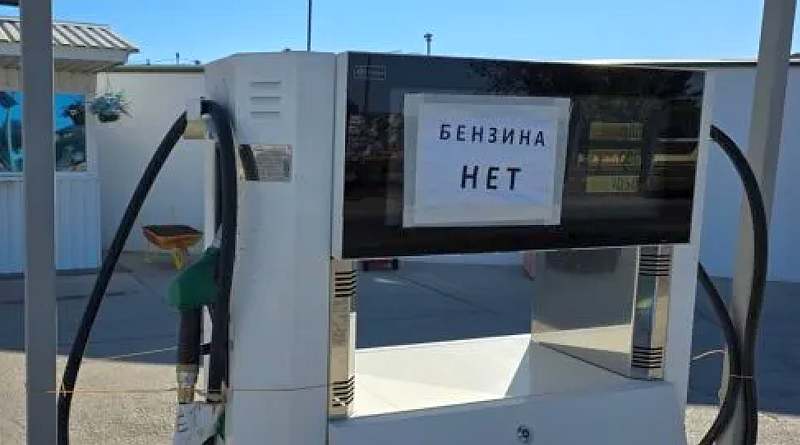
1. Restrictions on gasoline sales due to fuel shortages have already affected at least 20 regions of Russia, including Moscow, St. Petersburg, and five occupied Ukrainian territories.
– The first reports of shortages of AI-92 and AI-95 gasoline appeared at the end of May in Ryazan following strikes on the Ryazan Oil Refinery—one of Russia’s largest refineries.
– In occupied Crimea, a limit of 20 liters of gasoline per person was introduced at gas stations, later followed by a report of a temporary absence of AI-92 and AI-95.
– In early June, fuel sales restrictions were imposed in the Moscow region, St. Petersburg, and the Kursk, Belgorod, and Pskov regions. These restrictions are spreading amid a series of Ukrainian strikes on Russian refineries and oil depots.
– In May, oil refining volumes in Russia fell to the lowest level in the last 16 years, increasing the risks of fuel shortages and further price hikes in the domestic market.
2. Investments in the Russian economy are falling at record rates since the global financial crisis.
– In the first quarter of 2026, investments in fixed assets in Russia decreased by 14.3% year-on-year. This is the deepest decline since the second quarter of 2009.
– According to Rosstat, investments in Russia decreased by 15%, nearly six times more than last year (-2.5%). Investments in construction, equipment, modernization, and reconstruction of enterprises have decreased.
– Amidst this, the profit of Russian companies fell by 4% in 2025, and by another 26% in the first quarter of 2026, while debt servicing already takes about a third of the EBITDA of large industrial enterprises.
– An additional signal is the capital outflow: despite the Kremlin’s claims of “economic transformation,” Russia remains an exporter. About 4% of GDP—approximately 80-85 billion dollars—is withdrawn annually.
3. Business activity in Russia’s services sector continues to deteriorate amid weak demand and a decline in orders.
– According to the PMI index data from S&P Global, the business activity indicator in the services sector decreased to 48.7 points in May, compared to 49.7 in April. A value below 50 points indicates a contraction in economic activity.
– The volume of new orders in the Russian services sector shrank for the second consecutive month, with the pace of decline being the highest since September 2025. Export orders also showed deterioration, decreasing at the fastest rate since December 2022.
– Company surveys revealed that businesses are increasingly worried about weakening demand and clients’ financial capabilities. As a result, confidence in the outlook for the coming year has sharply deteriorated, falling to the lowest level since the beginning of 2023.
– New data indicate growing problems in the Russian economy outside the military-industrial sector.
– High interest rates, reduced consumer activity, and worsening external economic conditions are increasingly pressuring civilian industries, forcing businesses to lower their growth expectations.
4. Small and medium-sized businesses in Russia are increasingly sinking into crisis due to rising costs, tax burdens, and falling demand.
– In the last three months, more than a quarter of enterprises have cut staff, and one in five companies is already considering closure. This is evidenced by the results of a survey conducted among more than 6,500 entrepreneurs from 88 regions of the country. 92.9% of respondents noted the worsening state of their business.
– More than half of the companies were unable to offset the sharp rise in costs by raising prices due to weak consumer purchasing power.
– As a result, 26% of enterprises reduced their workforce, over 30% switched to strict savings mode, and 6.2% have already ceased operations.
– Amid deteriorating business conditions, some entrepreneurs have begun seeking ways to survive in the shadow sector. Some survey participants reported using gray accounting schemes, refusing to issue cash receipts, or splitting businesses to reduce costs and tax burdens.
– A particularly alarming signal is that 20% of respondents consider completely closing their companies, and more than 21% are considering further splitting the business as a way to adapt to economic conditions.
5. Russia’s main state development bank, VEB.RF, announced a 15% staff reduction due to the deteriorating economic situation and a sharp cooling of the credit market.
– The state corporation has already begun optimizing expenses and plans to reduce the organization’s budget in accordance with government parameters set for 2027. Next year, reductions will also affect the group’s subsidiaries.
– The decision seems indicative considering that just last year, VEB RF received 407 billion rubles from Russia’s National Wealth Fund and reported a profit of 89.4 billion rubles.
– However, even large-scale state support could not hide the consequences of high interest rates and a decline in demand for loans. VEB RF is one of the Kremlin’s key tools for financing major infrastructure projects and state programs.
– Budget and personnel cuts indicate that even state financial institutions are beginning to feel the effects of economic slowdown and a shortage of available funding sources.
– The problems at VEB RF could have broader implications for the Russian economy. A significant portion of large-scale construction and industrial projects was financed through this bank.
– Reducing its activity means fewer orders for contractors, material suppliers, and regional businesses that depended on state investments.
6. Russia purchased German engines for FSB boats bypassing sanctions.
– Russia continues to bypass Western sanctions to supply its law enforcement agencies with imported equipment. According to a journalistic investigation, a St. Petersburg shipyard building patrol boats for the FSB border service received German engines through intermediaries in Turkey and Hong Kong.
– The scheme involved purchasing German-made engines by a Turkish company with written guarantees that the equipment would remain in Turkey and not be re-exported to Russia. Subsequently, the engines were transferred through Hong Kong companies, but the actual destination was St. Petersburg.
– According to investigators, at least six engines for the FSB’s “Sobol” project patrol boats were supplied to Russia in this way.
– Financial documents show that the Russian shipyard paid the supplier 760 thousand euros for the engines.
– Meanwhile, one Hong Kong company received 37 million rubles from the Russian side, and 334 million rubles passed through the Turkish intermediary last year. Of this amount, 11.5 million rubles were a fee for intermediary services.
7. The U.S. may implement individual exemptions from the sanctions regime on Russian oil for specific countries, but does not plan a mass easing of restrictions. This was stated by U.S. Treasury Secretary Scott Bessent during a speech in Congress.
– According to Bessent, future exceptions, if granted, will be targeted towards individual states with specific economic needs.
– He emphasized that previous relaxations had practically not increased Russia’s revenues, as the main export volumes were already directed to China and other Asian buyers.
– The minister also noted that the issue of exceptions was raised by representatives of vulnerable countries during meetings of the IMF and the World Bank. At the same time, he stressed that Washington continues to support Ukraine and maintains sanctions pressure on Russia.
– During hearings, Congressman Bryan Fitzpatrick criticized the series of exceptions to the sanctions regime and recalled a bill that provides for the introduction of 500-percent duties on Russian goods, as well as on products from countries that help Moscow circumvent sanctions.
– In response, Bessent stated that a 500% duty is practically equivalent to a complete trade embargo and questioned the practicality of applying such measures to the U.S.’s largest trading partners, particularly China.
– The discussion in Congress indicates that Washington is seeking a balance between intensifying economic pressure on Russia and minimizing the negative consequences for global trade and U.S. allies.
– At the same time, the very emergence of legislative initiatives concerning 500-percent duties demonstrates the sustained strong support for tough sanctions against Russia among some American legislators.
8. Hungary lifted the blockade on the allocation of 6.6 billion euros from the European Peace Facility for military assistance to Ukraine.
– The decision was agreed upon at the level of EU member states’ permanent representatives in Brussels. Thus, the last serious obstacle to using the fund’s money to purchase weapons for the Armed Forces of Ukraine was removed.
– Previously, Budapest’s stance had long blocked the allocation of funds, preventing EU states from agreeing on new tranches of military support for Kyiv.
– The decision was an important signal of the European Union’s unity in supporting Ukraine amid the ongoing Russian aggression. The allocated funds can be directed to compensate EU member states for supplied weaponry and finance new procurements for the Ukrainian army.
– For Russia, the unblocking of financing means the preservation and potential strengthening of military support for Ukraine from Europe. Despite the Kremlin’s expectations of Western partners growing weary of the war, the EU continues to seek mechanisms for long-term support of Ukraine’s defense needs.
